


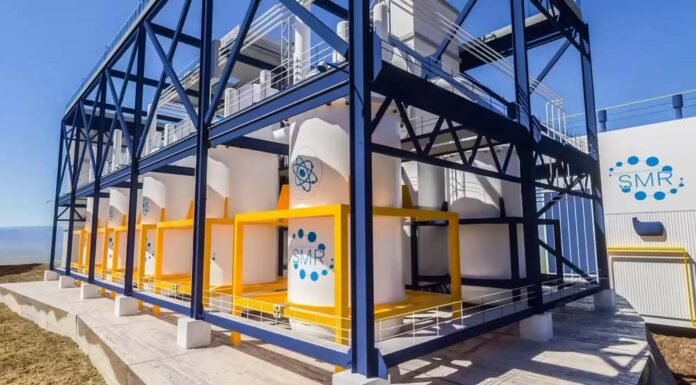
New Delhi: Tata Consulting Engineers (TCE), established in 1962, has long played a pivotal role in India’s civil nuclear programme, maintaining a close relationship with the Department of Atomic Energy.
The company is now focusing on the development of Small Modular Reactors (SMRs), with its Managing Director and Chief Executive Officer, Amit Sharma, emphasising that India has a unique opportunity to modularise its proven 220 MW Pressurised Heavy Water Reactor (PHWR) technology into Bharat Small Reactors (BSRs) within just two years.

Sharma explained that while Western nations are pursuing fully modular SMRs, which remain largely in the design phase and could take up to a decade to materialise, India’s approach is more pragmatic. By upgrading and modularising the existing 220 MW PHWR design, India can achieve a standardised modular reactor far more quickly.
TCE has already conducted a proof of concept, identifying four to six systems within the PHWR design that can be modularised, paving the way for a fully modular BSR in a short timeframe.
BSRs, based on the PHWR technology, benefit from a proven safety and performance record. They are being upgraded to reduce land requirements, making them suitable for deployment near industries such as steel, aluminium, and metals, where they can serve as captive power plants to support decarbonisation.
Bhabha Atomic Research Centre (BARC) is currently leading the design, development, and establishment of SMRs in India, ensuring that the initiative remains firmly rooted in indigenous expertise.

Sharma highlighted the importance of relying on certified and proven technology. According to international law, as outlined by the International Atomic Energy Agency (IAEA), a reactor must first be certified and operational in its home country before it can be exported. This gives India a competitive edge, as Western nations are still years away from deploying SMRs. By leveraging the PHWR design, India can accelerate adoption and position itself as a leader in nuclear energy.
Cost competitiveness is another major advantage of the BSR approach. Sharma noted that globally, SMRs are still at the drawing board stage, with the first true SMRs expected only by 2030. Their cost is projected to be no less than $5 million per megawatt, often ranging between $8 million and $20 million per megawatt.

In contrast, India’s indigenised nuclear technology, developed by NPCIL, DAE, and BARC, achieves capital costs between $0.7 million and $1.4 million per megawatt, making it far more affordable and sustainable. This cost advantage, combined with indigenous development, strengthens national security and energy independence.
Sharma stressed that SMRs must coexist with large reactors rather than replace them. India will continue to need 1,000 MW reactors, 700 MW PHWRs, and large reactors from international partners such as Russia’s ROSATOM, Westinghouse, and EDF.
However, SMRs will play a crucial role in meeting emerging needs, particularly for data centres, captive industrial use, and retrofitting retiring thermal power plants. The concept of thermal power retro-fitment with SMRs, already being explored in the United States, could be a transformative solution for India as well.
Beyond SMRs, microreactors are also gaining attention. These very small reactors, generating up to 10 MW, are under development in the USA and Canada, while IIT-Madras is working on similar concepts in India.
According to a joint report by TCE and Niti Aayog, microreactors could serve niche applications such as powering microgrids, supporting remote off-grid areas, restoring power after natural disasters, and enabling seawater desalination.
TCE, with a team of around 700 nuclear design and engineering specialists and nearly six decades of experience in the nuclear domain, is well positioned to drive India’s next phase of nuclear innovation.
By combining proven PHWR technology with modularisation and private sector partnerships, the company believes Bharat Small Reactors can be deployed within two years, offering India a cost-effective, indigenous, and scalable solution to meet its growing energy needs while advancing decarbonisation goals.






