


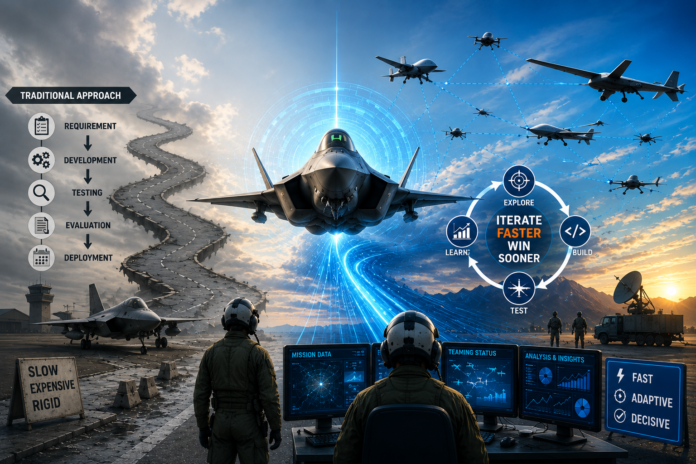
When Russian mechanised columns rolled into Ukraine in February 2022, nobody predicted they’d be stopped by inexpensive drones and homemade loitering munitions. The Russians had superior numbers, better-trained units, and sophisticated air defences. They had tech. What they didn’t have was speed in IDEA: Identify (need, problem, opportunity), Develop (concept, proto, tech), Evaluate (test, validate, iterate) and Accelerate (scale, deploy, commercialise). IDEA loop can be termed the OODA cycle of innovation.
By mid-2022, that gap had become fatal. Ukrainian forces figured out that you didn’t need tank-versus-tank combat anymore. A $500 quadcopter with a shaped charge could destroy a $5 million T-90. More importantly, they could destroy it before the Russian command structure even knew the tank was vulnerable. Decision cycles that took hours collapsed in minutes. The side that could tighten that loop — from observation to decision to action — won the engagement.

This is the real lesson of Ukraine. Not that tech doesn’t matter. It does. But it matters less than we think, and much less than clock speed matters.
The Component Problem
Here’s the uncomfortable truth that nobody wants to talk about in policy circles: India will always play catch-up to the West when it comes to niche technologies such as advanced seekers, composite manufacturing, high-entropy materials, and RF systems. The core technologies that took Western defence contractors thirty years to perfect.
We’re maybe halfway there on most of it, and that gap isn’t closing through genius. It’s closing through patient, grinding accumulation of manufacturing experience.
A lesson from Ukraine: When a Ukrainian unit observes that a particular munition variant cannot penetrate a Russian defensive position, the feedback reaches a factory. The factory modifies the design slightly. Three weeks later, an improved munition is in the field
This is genuinely frustrating. It’s the price of having missed the 1960s-1990s window when these foundations were being laid. But here’s what matters: you can’t be disruptive on a supply chain you don’t own. You can optimise it, improve it, eventually master it. But you can’t leapfrog it. Those thirty years of cumulative learning aren’t something you can compress into five years of brilliant engineering.

This is why Indian component development will necessarily look linear. Incremental progress. Steady improvement. Unglamorous. But real. The Arjun tank’s journey from prototype to operational deployment to mid-life upgrades — that’s not a sign of failure. That’s what maturation actually looks like. The ATAGS programme, the DRDO’s work on composite shells and advanced fuses — these things don’t make headlines, but they’re the real work. And they’ll keep looking linear because they are, by definition, catching-up work.
Accept this constraint and move on. Because something extraordinary happened while we were complaining about our supply chains: the game reset for everyone.

Where is the Moat Actually
The breakthrough tactic wasn’t a new weapon system designed in some institute five years ago. It was a commercial quadcopter frame that you could buy on Alibaba, weaponised by a young engineer in a garage. The edge came from trying it, seeing it work, refining it, and deploying it again within weeks. Not years. Weeks.
The Israeli Air Force understood this first. They pioneered what they call ‘rapid iterative cycles’ in UAV operations — test a tactic on Tuesday, refine it based on feedback on Wednesday, deploy the improved version on Friday. This compresses the traditional innovation cycle from years to days. But Israel’s advantage isn’t that they’re smarter. It’s that they have the institutional flexibility to run these cycles at all. They can say “we’re running an experiment” and actually run it, without needing approval from a committee that needs approval from a board that needs approval from a ministry.
The competitive advantage is not in the lab coat. It is in the procurement office. It is the willingness to say “we’re testing this tactic in a company-sized M-UMT formation next month, we’ll iterate based on feedback, and we’ll scale it to battalion level within six months if it works.” That clock speed is worth billions in R&D advantage
India doesn’t have that luxury. Our procurement and testing cycles are built around scarcity — long qualification processes, extensive trials, multi-year evaluation before we risk buying something at scale. This made sense in 1990. It makes no sense in 2026. Sameer Joshi, Co-Founder of NewSpace Research and Technologies, feels, “Tech like AI-driven targeting chains, swarming algorithms, electronic warfare systems resilient to jamming, cheap, disposable platforms didn’t exist ten years ago; they’re emerging now. Crucially, nobody has a head start on them, and we should accelerate this cycle to create disruptive solutions to stay ahead of the curve.”
The Ukraine Lesson Nobody Listens to
Here’s what the Ukraine conflict actually tells us: the moat isn’t technology. The moat is iteration speed.
A Ukrainian unit observes that a particular munition variant can’t penetrate a Russian defensive position. That feedback reaches a factory. The factory modifies the design slightly. Three weeks later, an improved munition is in the field. Meanwhile, on the Russian side, a similar observation is forwarded through the chain of command, processed through a qualification system, submitted for trials, evaluated by a committee, approved by a ministry, tendered to industry, and finally — six months later — enters production. By then, the Ukrainians have already moved on to their third iteration.
This is why iteration speed has become the true competitive advantage. It’s not about having the smartest lab. It’s about having the fastest testing and procurement cycle.
Is Protection Overrated?
The armoured vehicle design triangle — firepower, mobility, protection — becomes binary with M-UMT. Protection becomes redundant when reconnaissance, strike, and air defence are delegated to unmanned systems. The tank’s role shifts from “survive fire through armour” to “avoid fire through speed, dispersion, and network awareness.” This demands M-UMT integration across all domains: organic ISR that compresses decision cycles, network-centric C4I enabling manoeuvre from distant sensors, and distributed autonomous decision-making through AI processing. Survivability inverts: distributed risk beats concentrated armour. A formation of autonomous platforms on land and in air sustains more damage than a handful of heavily armoured vehicles.
Defence manufacturers must build agile product teams that leverage existing platforms as building blocks, rather than engineering from scratch. Instead of designing a new UGV propulsion system, use available engine packages; focus effort on integration and optimisation. Validate designs in weeks, iterate based on frontline feedback
This cannot be retrofitted. Mechanised brigades must be designed as integrated M-UMT formations from inception — land, air, and network elements co-designed as one organism. The doctrine that delays M-UMT for incremental armoured improvements optimises yesterday’s problem.
The Window
The competitive advantage isn’t in the lab coat. It’s in the procurement office. It’s the willingness to say “we’re testing this tactic in a company-sized M-UMT formation next month, we’ll iterate based on feedback, and we’ll scale it to battalion level within six months if it works.” That clock speed is worth billions in R&D advantage. Op Sindoor gave a sneak peek into what’s in store in phase II. We need agility in design, development, execution and procurement.
Defence manufacturers must build dedicated agile product teams that leverage existing platforms and proven subsystems as building blocks rather than engineering from scratch. Instead of designing a new UGV propulsion system, use available engine packages; focus effort on integration and optimisation. Validate designs in weeks, iterate based on frontline feedback. This requires a cultural shift from a project-to-product management mindset.
Defence ministries must enable it through accelerated qualification, recurring purchase orders, and contractual provisions for rapid design iteration. Without this structural support, iteration speed remains theoretical.
The User should create processes to compress the iteration cycle by making frontline feedback reach the factory in weeks, not years. Create models that provision for iterative spiral development rather than commodity-based procurement
The User, on the other hand, should create processes to compress the iteration cycle by making frontline feedback reach the factory in weeks, not years. Create models that provision for iterative spiral development rather than commodity-based procurement. A change in mindset from buyer to co-developer is the need of the hour. A country that figures out how to run test-and-buy loops on fast recurring cycles — six-month cycles, not six-year cycles — will produce breakthrough innovations that look like they came from nowhere because they didn’t come from a lab.
The ahead-of-the-curve innovations in M-UMT aren’t waiting to be discovered in a research facility. They’re waiting to be found through relentless iteration — trying, failing fast, learning faster, and scaling what works before the next cycle begins.
That’s India’s real competitive advantage. Not because we’re smarter. But because we can be faster.

The writer is a veteran Indian Army Artillery officer with over two decades of service spanning frontline combat operations, counter-terrorism, and high-altitude command along the Line of Control. He combines field command experience with institutional procurement policy and industrial execution capability. The views expressed are personal and do not necessarily reflect the views of Raksha Anirveda





