


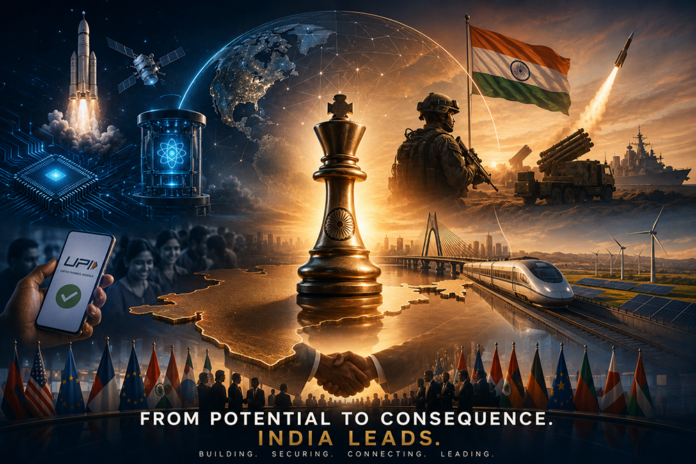
A decade ago, India was a story the world found promising. Today, it is a fact the world has to plan around. That shift—from potential to consequence—is the real transition of the past ten years, and it is not a matter of sentiment. It shows up in numbers that move markets, in infrastructure other countries now want to copy, and in the rooms where the terms of the global order are set. The change is clearest in three places: what India earns, what India builds, and how India is heard.
The Economy Changed Weight Class
In 2014, India was the world’s tenth-largest economy. In 2025 it became the fourth, with nominal output of about $4.19 trillion, edging past Japan, according to the International Monetary Fund and confirmed by NITI Aayog. It remains the fastest-growing major economy on earth, expanding 8.2 per cent in the second quarter of 2025-26, its strongest showing in six quarters, and it is on course to overtake Germany for third place before the end of this decade.

Moving from tenth to fourth in world economies is not a market cycle—it is a structural transformation built on formalisation, manufacturing, and domestic demand deep enough to weather global turbulence that has stalled most developed economies
The number that matters is not the rank, it is the trajectory. Moving from tenth to fourth in eleven years is not a market cycle, it is a structural change in how the economy is built: broader formalisation, a widening manufacturing base, and domestic demand deep enough to hold its ground through global trade turbulence that has stalled most developed economies. Growth of this kind is not borrowed from a good year. It is compounding.
Technology Stopped Being Imported and Started Being Built
The deeper story of the decade is that India stopped renting its strategic backbone and began building it.
Start with the rails everyone can see. The Unified Payments Interface, launched in 2016, processed more than 106 billion transactions worth over 143 lakh crore rupees in the first half of 2025 alone, and crossed 20 billion transactions in a single month for the first time in August 2025. It is now the most-used real-time payment system in the world, and it is being adopted in countries from France to the UAE. India did not license this from anyone. It built public digital infrastructure at population scale and is now exporting the model.
Under the National Quantum Mission, India has joined a small group of nations with indigenous quantum chips and a homegrown 25-qubit computer. A country that can make its own chips and secure its own communications cannot be held hostage by events ten thousand kilometres away
The same instinct is moving into harder domains. In 2025, the first Made-in-India chips from a pilot line were presented to the government under the India Semiconductor Mission, a ₹76,000-crore programme launched in 2021, in a country that still imports roughly $24 of semiconductors a year, its third-largest import after crude oil and gold. In space, Chandrayaan-3 made India the first nation to land near the lunar south pole in August 2023, on a budget smaller than several Hollywood films. And under the National Quantum Mission, approved in 2023 with an outlay of ₹6,003 crore, India set up indigenous quantum chip and sensor fabrication facilities in 2025 and saw a homegrown 25-qubit computer come online, joining a small group of nations with a dedicated national quantum programme.

Nowhere is this shift sharper than in defence. A decade ago, India was defined by what it imported. In 2024-25, its defence exports reached a record ₹23,622 crore, roughly $2.76 billion, up from just ₹686 crore in 2013-14. That is close to a thirty-four-fold rise in ten years, with Indian systems now reaching nearly a hundred countries and a stated target of ₹50,000 crore by 2029. Domestic defence production hit its own record of ₹1.51 lakh crore in 2024-25. BRAHMOS, Pinaka, Akash and a growing catalogue of indigenous platforms have moved India from the world’s largest arms buyer toward a credible supplier. Self-reliance in defence is no longer a slogan on a chart. It is an order book.
There is a layer beneath all of this that will decide how durable it proves to be: the cryptography that protects a digital economy this large once quantum computing matures. Here too, the country has chosen to build rather than buy, seeding a domestic deep-technology base to secure its own networks with sovereign, quantum-safe systems rather than depending on foreign suppliers for the keys to its most critical infrastructure. A nation that can make its own chips, run its own payment rails and secure its own communications is a nation that cannot be held hostage by events ten thousand kilometres away.

BRAHMOS, Pinaka, and Akash now reach nearly a hundred countries. Self-reliance is no longer a slogan on a chart—it is an order book, with domestic production hitting Rs 1.51 lakh crore and a stated target of Rs 50,000 crore in exports by 2029
Diplomacy Moved from the Margins to the Table
Capability earns a hearing. The clearest demonstration came in 2023, when India’s G20 presidency secured the African Union’s permanent membership of the group and delivered the New Delhi Leaders’ Declaration by consensus, at a moment when deep divisions over Ukraine were expected to make any joint statement impossible. That was not ceremonial hosting. It was the hard diplomatic work of holding a fractured room together, and India did it.
At the same summit, India, the United States, the European Union, Saudi Arabia, the UAE, France, Germany and Italy announced the India-Middle East-Europe Economic Corridor, a multi-modal trade and connectivity route designed to cut India-Europe trade time by up to 40 per cent and cost by 30 per cent, and widely read as a transparent alternative to other connectivity models. India is not a passenger on that corridor. It is the anchor.
At the same summit, India, the United States, the European Union, Saudi Arabia, the UAE, France, Germany and Italy announced the India-Middle East-Europe Economic Corridor, a multi-modal trade and connectivity route designed to cut India-Europe trade time by up to 40 per cent and cost by 30 per cent, and widely read as a transparent alternative to other connectivity models. India is not a passenger on that corridor. It is the anchor.
A country that everyone needs and no one owns has more room to manoeuvre than one that has picked a side—and India has made itself the most credible bridge between the developing world and the major powers that now court it
Underlying these moves is a doctrine India has grown confident enough to state plainly: strategic autonomy. India buys energy where it makes sense, holds positions in the Quad and engages in conversations with partners across the Gulf and the Global South, and declines to be slotted into anyone’s bloc. It has made itself the most credible bridge between the developing world, which it has consistently spoken for as a self-appointed voice of the Global South, and the major powers that now court it. A country that everyone needs and no one owns has more room to manoeuvre than one that has picked a side.
The Through-line is Sovereignty
Read together, the three stories are one story. An economy that earns its rank, a technology base that is built at home, and a diplomacy that shapes outcomes rather than absorbing them all, point to the same word: sovereignty, turned from aspiration into capability.
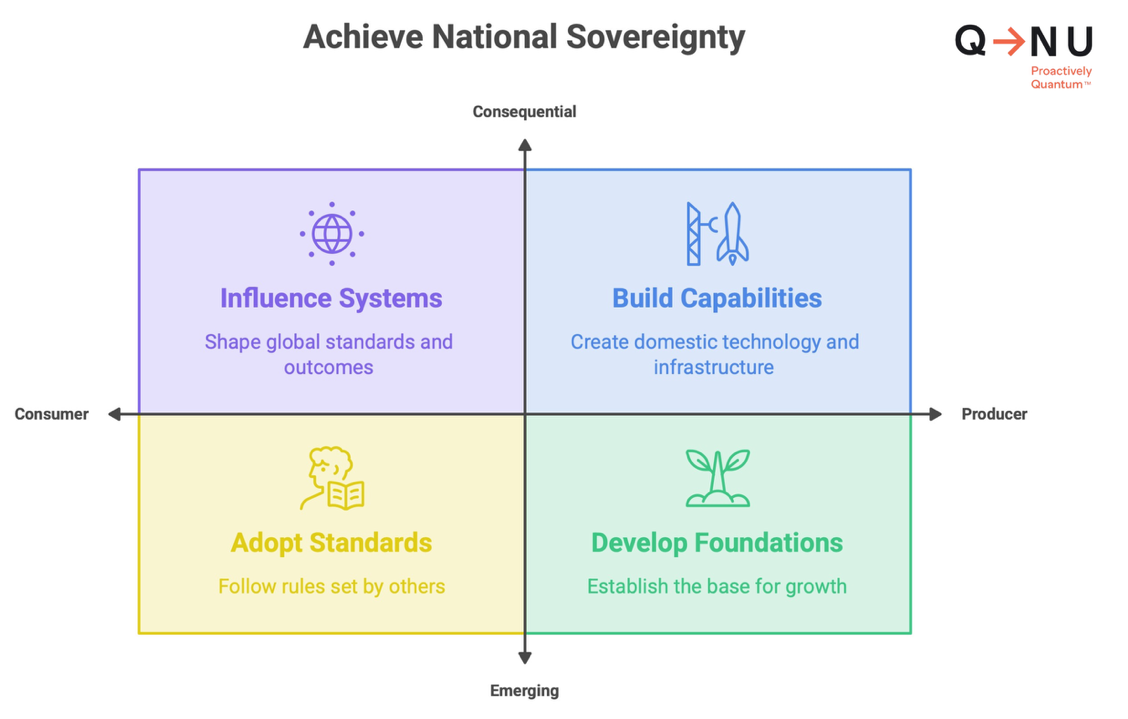
The distinction that matters as the next decade opens is between a country that consumes the world’s systems and one that produces them. For most of its modern history India was a rule-taker, adopting standards, platforms and doctrines set elsewhere. Over the past ten years it has started to become a rule-shaper, in payments, in space, in defence manufacturing, in the emerging standards of quantum-era security, and in the multilateral rooms where the century’s terms are being written.
That is the real transition — not from poor to prosperous, which is a longer road still being walked, but from emerging to consequential. The work of this decade was to arrive. The work of the next is to consolidate, to convert a strong position into a settled one, and to ensure that what India has built for itself, it can also offer the world. A power is not what a country promises. It is what a country can do, and can defend. On that measure, India has stopped emerging.

The writer is Chief Marketing Officer at QNu Labs, India’s pioneering quantum cybersecurity company incubated at IIT Madras. An IIM-Calcutta alumnus with 22+ years of global marketing leadership, she has led quantum security thought leadership initiatives positioning India’s “Made in India, Made for the World” quantum capabilities across defence, government, and enterprise sectors globally. The views expressed are of the writer and do not necessarily reflect that of Raksha Anirveda





