


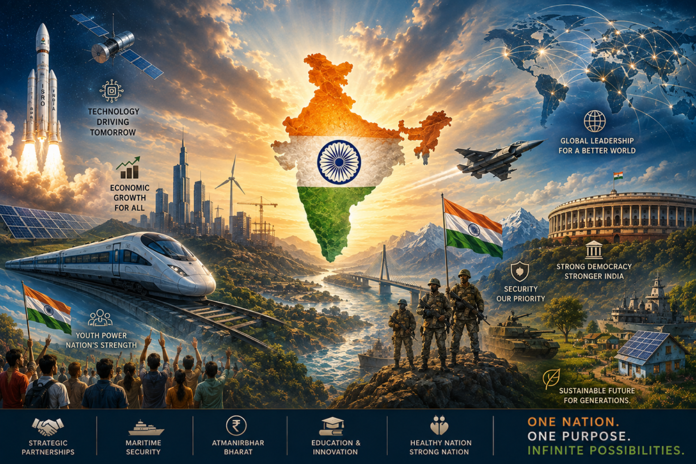
The international order is undergoing its most profound transformation since the end of the Cold War. The conflict in Ukraine continues to reshape European security, the war in West Asia has heightened regional instability, and strategic competition between the United States and China is redefining global politics. Trade routes are being contested, supply chains are being reorganised, critical technologies are becoming instruments of national security, and economic interdependence is increasingly viewed through the lens of strategic vulnerability. The world is witnessing not merely isolated conflicts, but the emergence of a new era of geopolitical rivalry, technological competition and economic realignment.
The Decade That Will Define India
In such periods of global transition, history rewards nations that recognise opportunity before it becomes obvious. The coming decade is likely to witness the redistribution of economic influence, technological leadership and diplomatic power on a scale unseen in generations. India finds itself uniquely placed at the centre of these shifts.

For over three decades, India has steadily built the foundations of national strength. It is now the world’s fastest-growing major economy, a trusted diplomatic partner across competing blocs, and an emerging technology powerhouse. Yet, the coming decade presents a larger challenge. The question is no longer whether India will emerge as a significant power. It is whether India can convert its immense potential into enduring global influence.
History occasionally presents nations with a narrow strategic window to redefine their destiny. India has entered such a moment. The decisions taken during this decade will determine whether it remains an important regional actor or graduates into a genuine global power.
Why This Decade Matters
Rarely have so many favourable strategic trends converged for a single nation.
Global manufacturing is diversifying beyond traditional production hubs. Businesses are seeking resilient supply chains, trusted partners and politically stable investment destinations. The digital revolution is creating entirely new industries even as artificial intelligence promises to reshape productivity, governance and military capability. Simultaneously, many advanced economies face ageing populations, while India continues to enjoy one of the world’s youngest workforces.

Geography has also regained strategic significance. Situated at the crossroads of the Indo-Pacific, India occupies a position central to maritime trade, energy flows and regional stability. Its democratic institutions, growing economic weight and policy of strategic autonomy have enhanced its credibility across the developed and developing worlds alike.
Unlike previous eras characterised by rigid alliances, today’s world is increasingly multipolar. Countries seek partners rather than patrons. India’s ability to engage constructively with the United States, Europe, Russia, Japan, the Gulf, Africa and the Global South simultaneously has created diplomatic space unmatched by many other major powers.

India has made remarkable progress over the past decade. Massive investments in highways, railways, ports, airports, logistics and digital infrastructure have significantly improved national competitiveness. However, investment in education, healthcare, research and skills will determine whether India’s demographic advantage translates into economic leadership
However, strategic windows do not remain open indefinitely. Demographic dividends eventually diminish. Technological revolutions move rapidly. Competitive advantages erode unless continuously renewed. Nations that hesitate during transformational periods often spend decades attempting to recover lost opportunities.
This decade is therefore not merely another phase of India’s development. It is the decade that will determine its place in the international order for generations to come.
Economy: The Foundation of National Power
Every enduring global power has first become an economic powerhouse. Military capability, scientific innovation, social welfare and diplomatic influence ultimately rest upon sustained economic strength.
India has made remarkable progress over the past decade. Massive investments in highways, railways, ports, airports, logistics and digital infrastructure have significantly improved national competitiveness. Financial inclusion, tax reforms, digital payment systems and ease-of-doing-business initiatives have strengthened the foundations of formal economic growth. Manufacturing is receiving renewed emphasis through production-linked incentives, while infrastructure development is reducing long-standing logistical bottlenecks.
India’s large domestic market provides resilience that many export-dependent economies lack. At the same time, expanding exports, growing services, increasing foreign investment and integration into global value chains are strengthening India’s external economic position.
Yet sustaining high growth requires moving beyond incremental reforms. Productivity must improve across agriculture, manufacturing and services. Labour-intensive industries need greater competitiveness. Urbanisation must become more planned and efficient. Investment in education, healthcare, research and skills will determine whether India’s demographic advantage translates into economic leadership.
Energy security will be equally decisive. Affordable, diversified and sustainable energy supplies are indispensable for industrial expansion and long-term competitiveness. Equally important is fiscal discipline that balances developmental spending with macroeconomic stability.
Economic strength does more than generate prosperity. It provides strategic freedom. Nations with strong economies possess the resources to modernise their armed forces, finance scientific research, respond to crises, invest in diplomacy and shape international institutions.
Every aircraft carrier, satellite, research laboratory, university and diplomatic mission ultimately rests upon economic foundations.
Technology: The New Currency of National Power
If economic strength provides the foundation of national power, technology determines its quality and durability.
The twenty-first century will not be defined primarily by industrial capacity but by technological leadership. Artificial intelligence, semiconductors, quantum computing, biotechnology, robotics, cyber capabilities, advanced materials and space technologies are rapidly becoming the decisive instruments of both economic competitiveness and national security.
India has already demonstrated remarkable capabilities. Its Digital Public Infrastructure has become an international benchmark for inclusive digital governance. The country’s space programme has consistently delivered world-class achievements at modest cost. Indian pharmaceutical companies have established global credibility, while the software industry continues to serve enterprises across continents. A vibrant start-up ecosystem is fostering innovation across sectors ranging from fintech and health technology to defence and deep technology.
The next stage of India’s technological journey, however, demands a shift in ambition — from adopting technology to inventing it.
The next stage of India’s technological journey demands a shift in ambition, from adopting technology to inventing it, which requires greater investment in research and development, stronger collaboration between universities and industry, world-class semiconductor manufacturing capabilities, and deeper artificial intelligence ecosystems
This requires significantly greater investment in research and development, stronger collaboration between universities and industry, world-class semiconductor manufacturing capabilities, advanced defence research, deeper artificial intelligence ecosystems and robust protection of intellectual property. Equally important is nurturing scientific talent and encouraging risk-taking entrepreneurship.
Technology is no longer merely an economic sector. It influences military superiority, cyber resilience, healthcare, education, governance, agriculture and financial systems. Countries that lead in frontier technologies will increasingly shape global standards, supply chains and international regulations.
The future will belong not simply to those who manufacture products, but to those who create the technologies upon which the world depends.
Nations that invent tomorrow’s technologies will write tomorrow’s rules.
Diplomacy: Converting Capability into Global Influence
Economic and technological capabilities achieve their fullest value only when translated into diplomatic influence.
India’s foreign policy has evolved considerably over the past decade. Rather than choosing between competing power blocs, it has pursued strategic autonomy while deepening partnerships across diverse regions. This approach has enabled India to maintain productive relations with the United States, Europe, Russia, Japan, ASEAN, the Gulf nations and Africa, while simultaneously emerging as an influential voice of the Global South.
India’s presidency of major international forums, humanitarian assistance during natural disasters, vaccine diplomacy, development partnerships and leadership in climate initiatives have enhanced its global standing. The expanding Indian diaspora further strengthens economic and cultural linkages across continents.
Perhaps India’s greatest diplomatic asset is credibility. In an increasingly polarised world, India is among the few major nations trusted by countries that often distrust one another. This unique position enables it to facilitate dialogue, promote stability and contribute constructively to resolving international challenges.
The Indo-Pacific will remain central to India’s strategic future. Secure maritime trade, resilient regional partnerships and a stable Indian Ocean are essential not only for India’s own prosperity but also for broader regional security.
India’s foreign policy has evolved considerably over the past decade. India has pursued strategic autonomy while deepening partnerships across diverse regions. This approach has enabled India to maintain productive relations with the US, Europe, Russia, Japan, ASEAN, the Gulf nations and Africa, while emerging as an influential voice of the Global South
India’s civilisational heritage further complements its diplomatic outreach. Democracy, pluralism, development partnerships, cultural exchanges and respect for sovereignty provide the country with a distinctive form of soft power that enhances its global influence without coercion.
Great powers are measured not merely by their capacity to protect national interests but also by their ability to contribute meaningfully to international peace, stability and prosperity.
The Power Triangle: Integrating Economy, Technology and Diplomacy
The three pillars of national power cannot operate in isolation.
Economic growth generates resources. Technology multiplies productivity, innovation and military capability. Diplomacy converts these strengths into international influence and strategic partnerships.
National power today is no longer additive; it is multiplicative.
A robust economy without technological leadership risks stagnation. Technological excellence without diplomatic reach limits global impact. Diplomatic ambition unsupported by economic strength eventually loses credibility.
The most successful nations build these capabilities simultaneously, allowing each to reinforce the others.
India’s policy framework must therefore encourage integrated thinking across ministries, institutions and industry. Economic reforms should strengthen technological competitiveness. Scientific innovation should support national security and industrial development. Diplomacy should open markets, attract investment, secure technology partnerships and expand India’s global influence.
The future belongs not to nations that excel in one domain but to those that synchronise all dimensions of national power into a coherent long-term strategy.
The greatest risk before India today is not a lack of potential but complacency. If India can sustain high economic growth, emerge as a leader in frontier technologies and continue practising confident, independent diplomacy, this decade may well mark its transformation from an emerging power into a genuine global power
From Transition to Transformation
India stands at a defining moment in its modern history.
Few nations have simultaneously possessed India’s demographic strength, entrepreneurial energy, democratic resilience, civilisational confidence, strategic geography and growing international credibility. Equally rare is a global environment in which economic realignment, technological disruption and geopolitical transformation converge to create unprecedented opportunities.
Yet favourable circumstances alone do not produce great powers. They merely create the possibility of greatness.
Real global power is built through sustained economic growth, technological innovation, institutional excellence, strategic clarity and diplomatic confidence. It demands investments in education, research, infrastructure, manufacturing, defence, governance and human capital with equal determination.
The greatest risk before India today is not a lack of potential but complacency. History offers few nations such favourable strategic conditions, and those windows seldom remain open for long.
If India can sustain high economic growth, emerge as a leader in frontier technologies and continue practising confident, independent diplomacy, this decade may well mark its transformation from an emerging power into a genuine global power.
The twenty-first century is increasingly being described as the Asian century. The defining question is no longer whether Asia will rise. It is whether India will lead that rise.

Lt Gen Rajeev Chaudhry (Retd) writes on contemporary national and international issues, strategic implications of infrastructure development towards national power, geo-moral dimension of international relations, and leadership nuances in a changing social construct. The views expressed are of the author and do not necessarily reflect the views of Raksha Anirveda





