


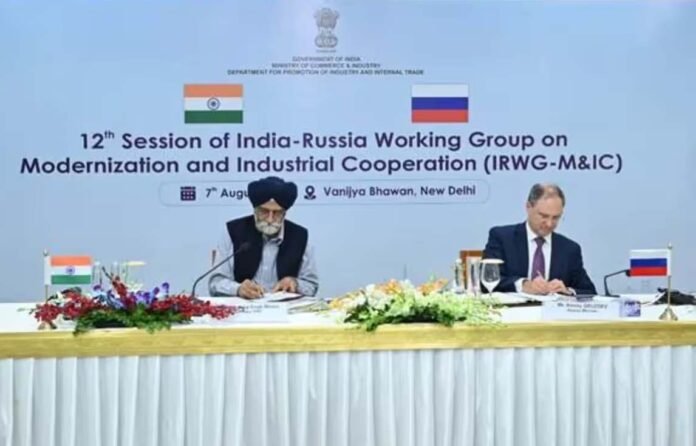
NEW DELHI. India and Russia recently reviewed key industrial joint ventures, expanding bilateral cooperation across high-speed rail, regional aviation, unmanned aerial systems and critical mineral exploration.
The strategic initiative was formalised during the 12th Session of the India-Russia Working Group on Modernisation and Industrial Cooperation, held at Vanijya Bhawan in New Delhi. Co-chaired by Amardeep Singh Bhatia, Secretary of India’s Department for Promotion of Industry and Internal Trade (DPIIT) and Alexey Gruzdev, Russia’s Deputy Minister of Industry and Trade, the high-level meeting brought together approximately 60 delegates from both nations.

A primary pillar of the discussions focussed on transport infrastructure, with both delegations welcoming ongoing cooperation under the Vande Bharat train project. The talks explored deeper technical partnerships in expanding modern rail networks, upgrading signaling architecture, and integrating heavy-rail engineering technologies.
Beyond surface transport, civil aviation and aerospace emerged as vital frontiers for industrial collaboration. Officials evaluated co-production frameworks for Russia’s SJ-100 regional passenger jet alongside joint manufacturing opportunities for aero-engines. To align with modern manufacturing paradigms, both sides agreed to widen technology-sharing initiatives into advanced propulsion systems, additive manufacturing (3D printing), carbon-fiber composites and unmanned aerial vehicles (UAVs).
Securing resilient supply chains for critical energy and industrial inputs formed another core agenda item. Delegations outlined strategic investments in lithium mining, rare earth mineral exploration, titanium technologies and aluminum processing. Discussions also targetted agricultural sustainability through steady DAP and NPK mineral fertiliser imports, alongside a proposed joint venture for domestic urea production.
Operating under the aegis of the India-Russia Intergovernmental Commission on Trade, Economic, Scientific, Technological and Cultural Cooperation, the session concluded with the formal signing of a joint protocol. The pact reaffirms New Delhi and Moscow’s shared commitment to diversify economic ties and drive long-term industrial modernisation across both economies.







