


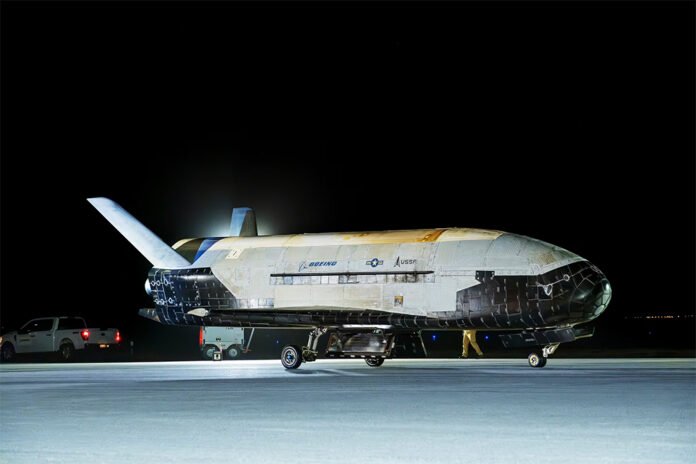
Washington: The Space Force’s X-37B spaceplane will take off on its eighth mission next month, this time with experiments focused on space-based communications and quantum sensing.
“These experiments come as part of a broader push across the US Space Force to uphold the safety and security of the space domain by enhancing the resilience and flexibility of US orbital systems,” the service said in a statement announcing the launch.

The spacecraft, built by Boeing, has served as a testbed for the Defence Department and NASA since its first flight in 2010. While not an operational spacecraft, the mini space shuttle is used to fly experiments and test manoeuvres and operational concepts in orbit. Much of that work has been classified, but the Space Force in recent years has offered more insight into the platform’s missions.
Chief of Space Operations General Chance Saltzman discussed the forthcoming mission, which will launch from the Kennedy Space Center in Florida, in a series of posts on X, formerly Twitter.
“It’s about making our joint force more connected, more resilient and ready to operate in the face of any challenge,” Saltzman said. “That’s how America’s Space Force secures our nation’s interests in, from and to space.”
For the communications experiment, the service will coordinate with commercial satellite networks in low Earth orbit, about 1,200 miles above the Earth’s surface, to demonstrate laser communications — a technology that enables larger amounts of data to be transmitted more securely than traditional radio frequencies.

“The use of proliferated relay networks enhances the resilience of US space architectures by ensuring that they contain no single point of failure,” the Space Force said.
The quantum sensing demonstration will feature the highest performing quantum inertial sensor that’s ever been used in space, according to the service. The sensor is designed to support navigation in orbit without GPS or other satellite networks.

“This technology is useful for navigation in GPS-denied environments and consequently will enhance the navigational resilience of US spacecraft in the face of current and emerging threats,” the service said. “As quantum inertial sensors would be useful for navigation in cislunar space, they additionally promise to push the technological frontiers of long-distance space travel and exploration.”
The service didn’t describe the length of the mission or list any other experiments. It’s last X-37B flight flew for 434 days, returning in March of this year. Among that mission’s milestones was the demonstration of a series of aerobraking manoeuvres that allowed the space vehicle to change orbits using minimal fuel.






