


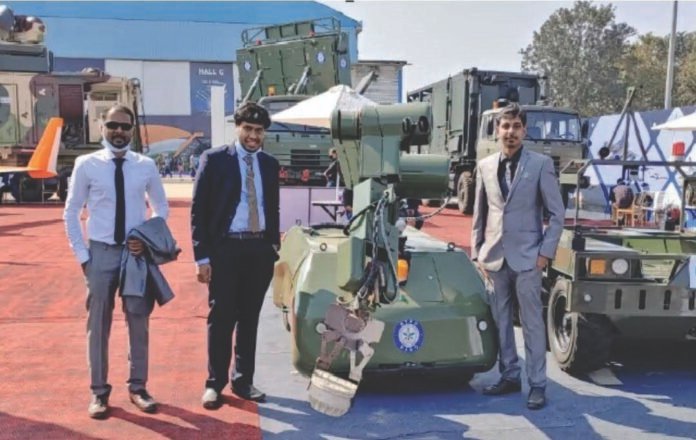
Chennai. While thousands of engineering graduates across India prepare for campus placement drives every year in pursuit of corporate roles, three friends from SRM University in Chennai decided to chart a vastly different course. Vignesh M, Vibhakar Senthil and Karthikeyan B chose to turn down high-paying corporate job offers, channeling their expertise in Mechatronics Engineering toward solving one of the toughest defence challenges in the world: assisting Indian armed forces serving at the Siachen Glacier.
Their mission began during their freshman year, when a campus robotics initiative encouraged them to apply engineering principles to real-world problems. Over the next four years, the trio built multi-terrain surveillance bots, designed a single-seat solar vehicle and won several national innovation competitions. But as graduation approached, they realised that building technology to strengthen India’s defence capabilities offered a far greater sense of purpose than climbing the corporate ladder.

Conquering the World’s Highest Battlefield
Located in the eastern Karakoram range of the Himalayas, the Siachen Glacier is widely recognised as the world’s highest and most unforgiving battlefield. Operating at elevations exceeding 18,000 feet, soldiers face extreme atmospheric conditions where oxygen levels drop to nearly half of those at sea level and temperatures regularly plunge below minus 50 degrees Celsius. Survival alone requires immense physical endurance, yet troops must routinely transport heavy combat loads exceeding 60 kilogrames – including weapons, survival gear, communication systems and essential rations – across steep, ice-slicked mountain paths and crevasses.
As extreme weather frequently grounds supply helicopters, ground transport remains the primary means of reaching isolated outposts. Recognising the immense physical strain and risk of frostbite or exhaustion faced by troops, the young engineers set out to build a mechanical solution capable of sharing that burden. Following extensive interactions with veteran officers from the Indian Armed Forces and the Army Design Bureau, they founded Torus Robotics in 2019 to construct a rugged, multi-purpose Unmanned Ground Vehicle (UGV).
MARS UGV: Breakthrough in Indigenous Technology
The company’s flagship product, the MARS UGV, is a fully electric unmanned ground vehicle engineered specifically for defence and military applications. The vehicle can be operated remotely from up to 1 kilometre away. Designed for complex tactical operations, it features a six-degree-of-freedom robotic arm built for detecting and handling explosives, alongside a specialised variant designed to support high-altitude logistics projects.
The company’s flagship product, the MARS UGV, is a fully electric unmanned ground vehicle can be operated remotely from up to 1 kilometre away. Designed for complex tactical operations, it features a six-degree-of-freedom robotic arm built for detecting and handling explosives, alongside a specialised variant designed to support high-altitude logistics projects
Rather than importing existing foreign technology or assembling off-the-shelf components, the founders chose to engineer their robotic platform entirely from scratch. Their biggest technical breakthrough came in the form of a proprietary electric drivetrain. Torus Robotics engineered custom brushless electric motors that are approximately 50 per cent lighter, 15 per cent more efficient, and 10 per cent less expensive than comparable imported alternatives.

This high power-to-weight ratio allows their MARS UGV to navigate steep, snow-covered inclines while conserving critical battery power in freezing temperatures. The autonomous platform is designed to haul heavy logistics loads, conduct real-time perimeter reconnaissance and assist in casualties’ evacuation without placing human soldiers in direct danger.
National Impact and Future Outlook
The startup’s innovative approach quickly gained national recognition. Torus Robotics won the prestigious Birla Global Innovation Challenge in 2020 and secured support from national defence technology incubation programmes. Beyond military applications, their lightweight motor design has attracted strong commercial interest from the broader electric vehicle market.

For Vignesh, Vibhakar and Karthikeyan, the success of Torus Robotics validates a powerful philosophy: that engineering is about addressing meaningful human challenges. By prioritising national service and technological self-reliance over immediate corporate employment, the trio has turned a classroom project into vital technology that protects the lives of Indian soldiers at the nation’s most extreme frontiers.






