


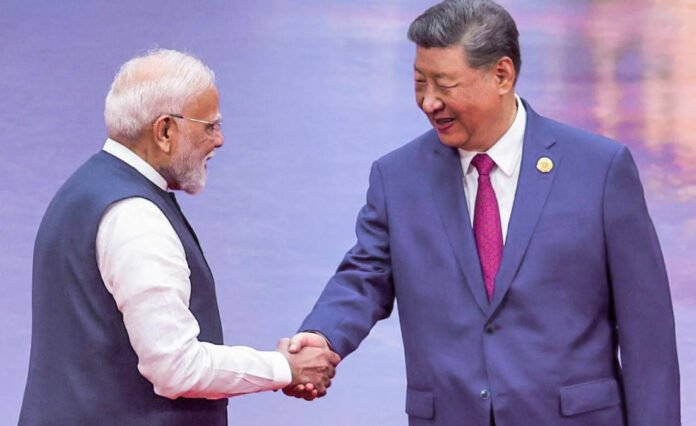
On September 12, 2026, China’s President Xi Jinping stepped off his plane in New Delhi for the 18th BRICS summit, his first visit to India since the 2019 informal summit at Mamallapuram, Tamil Nadu. Two weeks earlier, India’s National Security Adviser Ajit Doval and China’s Foreign Minister Wang Yi had held the 25th round of Special Representatives talks in Beijing and issued a rare joint eight-point outcome document. Flights between the two countries have resumed, and pilgrims are returning to Kailash. The photographs suggest bilateral ties are back on track. However, the harder question is what exactly has been restored.
The language of talks offers a clue. Prime Minister Narendra Modi told Xi that peace in border areas is a basic requirement for improving ties, and called for relations guided by ‘three mutuals’. Xi spoke of viewing the relationship from a ‘strategic and long-term perspective’. Both committed to a ‘fair and reasonable’ resolution of the boundary and agreed that differences should not escalate into disputes. These are reassuring words. They also echo the formula the two leaders adopted at Astana in 2017, three years before Galwan showed how little such formulas can hold.

The Tibet issue is one of the irritants in bilateral ties. After the Dalai Lama said in July 2025 that the India-based Gaden Phodrang Trust alone would identify his successor, a spokesperson for the Chinese embassy in New Delhi called the issue ‘a thorn in China-India relations’ and ‘a burden for India’
From Galwan to Kazan and Beyond
The arc is familiar. The June 2020 Galwan clash killed 20 Indian soldiers and froze ties for four years. The thaw began with an October 21, 2024, agreement on patrolling in Depsang and Demchok, followed two days later by the first delegation-level Modi–Xi talks in nearly five years, at Kazan. Since then, the Kailash Mansarovar Yatra has been restarted, direct flights resumed in October 2025 after a five-year gap, and the leaders met again in Tianjin. Beijing now says ties are back on the right track. The eight-point text adds two more military hotlines in the eastern and middle sectors, more pilgrim batches, and a recommitment to border trade through Lipulekh, Shipki La and Nathu La.
Yet the defining feature of this thaw is normalisation without settlement. Consider the ‘early harvest’ initiative. China first submitted early-harvest proposals in August 2019, with the Sikkim sector at the centre. India long opposed resolving the dispute piecemeal, but in August 2025 it agreed to an Expert Group to explore the idea. This year’s joint text raised the ambition to an ‘early and substantial harvest’. However, neither the 2005 boundary agreement nor the 2026 outcome defines the term. The phrase was also absent from the separate readouts after the talks and surfaced only in a joint document issued more than 24 hours later. Each word is being negotiated as carefully as any line on the map.
The trade deficit between India and China has reached a record $112.16 billion. Also, the access India has long sought for IT services, pharmaceuticals, and farm goods remains the unfinished part of the bargain. More trade has meant more dependence, not more balance
A Harvest Where the Stakes Are Lowest
The danger is not that a Sikkim deal would be bad. Delimiting a quieter sector would be a genuine achievement on a frontier 3,488 km long that has resisted settlement since the 1950s. The danger is that India accepts a settlement where the stakes are lowest, while the western sector, where Galwan happened, stays heavily militarised. Disengagement at friction points has not yet become de-escalation. India has opened a high-altitude airbase at Mudh-Nyoma near the LAC, and both sides continue to build infrastructure along the frontier. Even China’s ambassador Xu Feihong has acknowledged a serious deficit of trust. An early harvest that leaves Ladakh untouched could become the relationship’s ceiling rather than its floor.
Sequencing also shapes leverage. A deal in Sikkim would settle one of the few areas where both sides have something to trade, leaving the hardest western questions to be negotiated later, with less on the table and more concrete on the ground.

The joint text is also silent on the irritants most likely to test it. Tibet is one. After the Dalai Lama said in July 2025 that the India-based Gaden Phodrang Trust alone would identify his successor, a spokesperson for the Chinese embassy in New Delhi called the issue ‘a thorn in China-India relations’ and ‘a burden for India’. New Delhi says it takes no position on matters of faith, but the succession question will arrive on its own timetable, not the diplomats’. A thaw built on avoiding such questions is only as durable as the next occasion that forces them into the open.
China now supplies more than half of India’s imported phones and routers and nearly half of its semiconductors. India’s manufacturing is based on Chinese inputs, and every new assembly line risks deepening the very dependence it was meant to reduce
Deeper Trade, Deeper Asymmetry
The economic relationship shows the same pattern: deeper ties, deeper asymmetry. In 2025-26, China overtook the United States as India’s largest trading partner, with merchandise trade of $151.1 billion. But India exported only $19.47 billion while importing $131.63 billion, leaving a record deficit of $112.16 billion. The gap is still widening. The deficit reached $105.93 billion in January–September 2026 alone, close to the full-year record with a quarter still to go. Indian exports did grow by 40.7 per cent over the same period, but from so small a base that the absolute gap kept growing. What India does sell to China tells its own story: printed circuit boards, display modules, refined petroleum and naphtha. The access New Delhi has long sought for IT services, pharmaceuticals and farm goods remains the unfinished part of the bargain. More trade has meant more dependence, not more balance.

The composition matters more than the headline. India’s electronics deficit with China has roughly doubled, from around $20 billion in FY19 to $43.1 billion in FY26. The number of tariff lines where China supplies 80 per cent or more of India’s imports has risen from 461 to about 636. China now supplies more than half of India’s imported phones and routers and nearly half of its semiconductors. A Koan Advisory and Institute of Chinese Studies report calls this a structural trade deficit rather than a cyclical one. Put simply, India’s manufacturing is based on Chinese inputs, and every new assembly line risks deepening the very dependence it was meant to reduce.
Rare earths reveal where the leverage lies. In April 2025, Beijing imposed export licensing on seven rare earth elements and finished magnets, squeezing Indian automobile and EV makers. China controls about 92% of global rare earth refining and roughly 98% of magnet production
Rare Earths and the Question of Leverage
Rare earths reveal where the leverage lies. In April 2025, Beijing imposed export licensing on seven rare earth elements and finished magnets, squeezing Indian automobile and EV makers. China controls about 92 per cent of global rare earth refining and roughly 98 per cent of magnet production. Licences have since trickled through, but Beijing reportedly linked their resumption to India easing its Press Note 3 curbs on Chinese investment. New Delhi has moved on both fronts, with a ₹7,280 crore scheme for domestic magnet manufacturing and Press Note 2 of 2026, which amends the Press Note 3 framework. Officials describe the strategy as ‘managed interdependence’. For Indian carmakers, the lesson of 2025 was that a supply chain can be shut by an export licence as easily as by a war. The open question is who is doing the managing.
Rivers complete the picture. The hydrological data agreements that once gave India flood warnings lapsed in 2020 for the Sutlej and in 2023 for the Brahmaputra. The eight-point text promised an Expert Level Mechanism meeting in September with renewal of those agreements on the agenda, yet neither has been renewed. Meanwhile, a 60,000 MW dam is rising at Medog, just upstream of Arunachal Pradesh, on what Chinese geologists themselves describe as an active fault. For Assam and Arunachal, where the Brahmaputra floods every monsoon, this is not an abstract item on a summit agenda; it is the difference between a warning and a surprise. A relationship that can host a summit but cannot renew a flood-data memorandum is managing optics more than interests.
Why the Thaw Still Matters
None of this is an argument against the thaw. There are sound reasons to keep it going. Both countries press for reform of international financial institutions and a multipolar world order, and India is chairing BRICS this year under the theme of resilience, innovation, cooperation and sustainability. A calm border frees military resources for other priorities. Chinese components still feed Indian factories, and a permanent two-front posture is expensive. Critics of engagement also tend to underrate how much the dialogue mechanisms themselves, revived after years of silence, reduce the risk of another Galwan. New hotlines and meeting points are not glamorous, but they are the kind of plumbing that can stop a patrol clash from becoming a crisis. The point is not to reject the thaw but to define what success looks like.
The hydrological data agreements that once gave India flood warnings lapsed in 2020 for the Sutlej and in 2023 for the Brahmaputra. The eight-point text promised an Expert Level Mechanism meeting in September with renewal of those agreements, yet neither has been renewed
Three Tests for the Next 12 Months
India should judge the next 12 months against three tests. First, de-escalation in the western sector, not only a harvest in Sikkim: a verifiable pullback of forward deployments in eastern Ladakh. Second, economic access as a rule rather than a favour: rare earth licences on predictable timelines, and real market access for Indian pharmaceuticals, IT services and farm goods to begin narrowing the deficit. Third, renewal of the river data agreements, with transparency on Medog’s operations. These are not maximalist demands. They follow directly from India’s own stated principle that peace along the LAC is the prerequisite for normal ties.
Each test is also measurable. Deployments and patrol patterns can be verified on the ground. Licence approval times and the monthly trade deficit are published data. A renewed river memorandum either exists or it does not. That is the virtue of judging the thaw by outcomes rather than atmospherics: it lets New Delhi keep talking without mistaking talk for progress.
If the thaw passes those tests, normalisation will be real and durable. If it delivers only flights, summit photographs and an early harvest in a sector where little was at stake, it will have been a pause, not a peace. New Delhi is right to welcome the warmer weather. It should also keep checking the forecast.

The writer is an independent researcher. The views expressed are of the writer and do not necessarily reflect the views of Raksha Anirveda






