


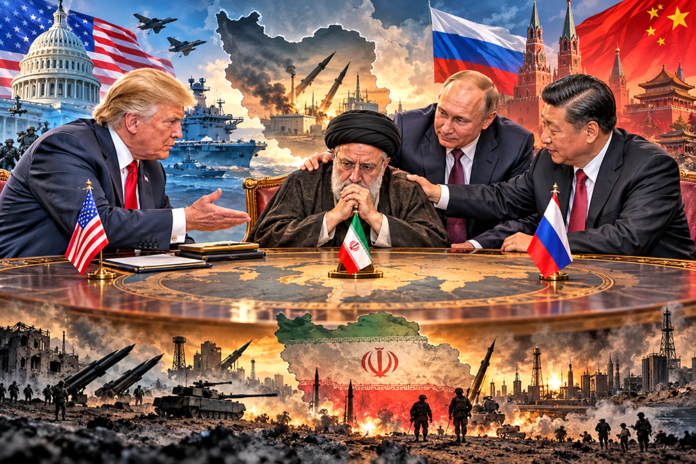
Russian Foreign Minister Sergei Lavrov visited Tehran last week. Al Jazeera said the visit aimed to “discuss the war with the United States and efforts to end it.” Iranian Foreign Minister Abbas Araqchi said talks with Lavrov focused on regional developments, including the US-Israel war on Iran. Israel was specifically included in the discussions. In the joint press conference, Russia reaffirmed its commitment to its strategic partnership with Iran and also called for a diplomatic solution to the conflict.
This may be the official line, but the visit’s timing and background present a different picture. The US, now the leading aggressor against Iran, is in a bind. It commenced its attacks on Iran after being prodded by Israel, intending to topple the regime and also stop Iran from possessing nuclear weapons. Instead, it has been caught in an adverse position with the closure of the Strait of Hormuz and damage to almost all its 20 bases in the Middle East. It has been unable to bring Iran to its knees.

Simultaneously, the US is short of critical missiles and hence hesitates to prolong the conflict. The rise in diesel prices in the US to over $6 per barrel, illogically blamed on Ukraine, has pushed Trump’s ratings down and threatens his retaining a majority in the Senate post-midterm elections. Trump is aware that any attack on Iran will be responded to, leading to further degradation of its limited missile reserves. This is forcing the US to consider a face-saving exit. This is where Russia comes into the picture.
The Trump-Putin conversation on October 9 was where possible bargaining took place, though no inputs on this were released to the media. It appeared that Trump offered Russia everything it desired, with nothing in return. Trump subsequently mentioned that Russia is “doing very little, if anything, to help the Islamic Republic of Iran, compared to what they could be doing, and I want to keep it that way.” The reality is that Russia is backing Iran by multiple means, including intelligence, food stocks, and technology.
Trump opened doors for Russia to export its diesel by lifting sanctions. He agreed to Putin’s demand for a possible trilateral summit with Xi Jinping in November, on the sidelines of the APEC summit in Beijing. He announced his intention to push for the release of some of Russia’s frozen funds
What did Trump offer Russia? Trump opened doors for Russia to export its diesel by lifting sanctions. He also agreed to Putin’s demand for a possible trilateral summit with China’s Xi Jinping in November, on the sidelines of the APEC summit in Beijing. He also announced his intention of pushing for the release of some of Russia’s frozen funds. To that end, US negotiators made the same request to Europe, which holds these assets. Europe refused the US’s demands. Soon after the conversation, Trump announced an energy ceasefire between Russia and Ukraine, which has not lasted.
Simultaneously, Trump began pressuring Ukraine. He accused Ukrainian President Volodymyr Zelensky of being the stumbling block to peace and demanded that Ukraine elect a new president, “capable of making peace with Russia.” He slowed the speed of Elon Musk-owned SpaceX’s Starlink and Starshield, on which Ukraine depends for defensive and offensive operations as well as logistics.

Russian missile and drone strikes have continued unabated at Ukraine’s energy infrastructure. Zelensky has repeatedly complained that there has been no forthcoming intelligence on Russian strikes, while the speed of SpaceX’s resources remains low, and the delivery of PAC-3 missiles for Ukraine’s Patriot missile systems is not forthcoming. After mounting domestic and international pressure, SpaceX asset speed has been restored.
US Secretary of State Marc Rubio said in Uzbekistan that due to a software glitch, intelligence was not coming through, an improbable excuse. There are also reports that the US threatened Kyiv with a slowdown in crucial weapons deliveries unless it stopped striking Russian oil refineries.

Trump accused Zelensky of being the stumbling block to peace and demanded that Ukraine elect a new president, “capable of making peace with Russia.” He slowed the speeds of Starlink and Starshield, on which Ukraine depends for operations and logistics
Trump gave his version on his Truth media network, “I am in the process of negotiating peace between Russia and Ukraine, and don’t want to do anything that will drive, foolishly, Russia away from the bargaining table. Zelenskyy doesn’t care, and frankly, with all of the money that Europe is famously giving him … he doesn’t want to end this war, and probably never did.” For Trump, Zelensky will be sacrificed to obtain what he desires from Russia.
In his meeting with Putin in Moscow, Trump’s negotiator Steve Witkoff offered the latest peace proposal, which included Ukraine withdrawing from parts of Donbas and no entry for Ukraine into NATO, meeting Putin’s demand, though Zelensky did not accept it. After this, Putin agreed to trilateral discussions with Ukraine and the US. Trump’s support for Russia comes despite mounting pressure from members of the Senate, including his own party. Moscow has not missed it.
Diplomacy offers no free lunches. Russia, in return for Trump accepting its stand on Ukraine, will return the favour by bringing Iran to the negotiating table. Iran needs Russia, which supplies it with food grains via the Caspian Sea route that cannot be blockaded, as well as technology and satellite intelligence. While Iran may agree to engage in talks, it would desire that the US adhere to the agreed Islamabad MoU for a face-saving start.
Iran’s other supporter is China. To appease China, Trump has not cleared the $14 billion sale of weapons to Taiwan. Trump hopes that by engaging both major allies of Iran, Russia and China, he can pressure Tehran into negotiations, thereby providing him a respectable exit.
This is the importance of Lavrov’s visit to Tehran. Before arriving in Tehran, Lavrov met members of the Gulf Cooperation Council in Bahrain, where they raised concerns over attacks in the Straits of Hormuz. While Lavrov publicly backed Iran in the conflict, in discussions he would have conveyed Putin’s views and suggestions for coming to the negotiating table.
To appease China, Trump has not cleared the $14 billion sale of weapons to Taiwan. Trump hopes that by engaging both major allies of Iran, Russia and China, he can pressure Tehran into negotiations, thereby providing him a respectable exit
Russia would also offer to take control of Iran’s nuclear stockpiles. Under the JCPOA (Joint Comprehensive Plan of Action) inked in 2015, Russia received over 11 tonnes of Iranian low- and medium-enriched uranium. This would be acceptable to Iran as it has a precedent.
Immediately after Lavrov, Pakistan’s Asim Munir and Qatar’s representatives visited Iran. It appears that Iran will be pushed into talks, with the US offering some concessions. This may happen soon after mid-term polls in the US. The only stumbling block is hardliners within the IRGC, who may force the leadership into refusing negotiations. In such a scenario, war will be the only option left.
To further push the US agenda on Iran, Iranian President Masoud Pezeshkian is visiting Moscow for the 8th summit of the Gas Exporting Countries Forum and will meet Putin. Iran would be threatened with withdrawal of support if it does not relent and accept talks.
Trump needs to resolve the Iran war for his own reputation and standing; Putin needs victory in Ukraine for his continued control over Russia, while Xi Jinping desires that the US stop arming Taiwan, thereby enhancing his reputation in China while also maintaining pressure on Taiwan. These three leaders, for their personal ambitions, will place Iran, Taiwan and Ukraine on the sacrificial altar.
The writer is a strategic analyst and a motivator. He can be reached at @kakar_harsha. The views expressed are of the writer and do not necessarily reflect the views of Raksha Anirveda





