


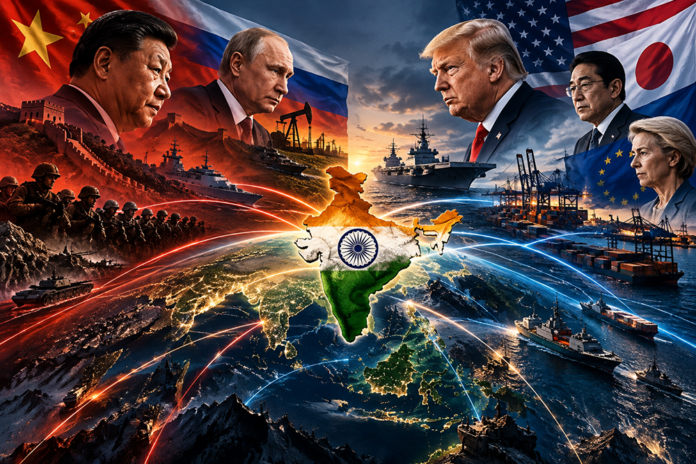
Security planners are trained to think in terms of convergence: the moment when separate pressures, each manageable alone, arrive at the same time and stretch the state’s attention, resources and legitimacy. India is in such a moment. Washington’s trade measures have swung from tariffs as high as 50 per cent last year to a 10 per cent Section 301 levy, and a new American law authorises tariffs of up to 100 per cent on buyers of Russian oil and gas, with India explicitly in its sights. At home, the opposition has run district-level ‘Save Democracy’ marches, its MPs have marched on the Election Commission, a mega rally is planned in Delhi for November 1, and a student movement born on social media has already forced a union minister out of office.
This is not a conspiracy. It is a pressure environment: many actors, foreign and domestic, pursuing their own interests in ways that together strain the Indian state. The national security task is to recognise the convergence, defend sovereignty without becoming defensive, and keep a clear line between external coercion and legitimate democratic contest.

India-US trade talks have reached what Finance Minister Nirmala Sitharaman calls a ‘plateau’, where further concessions would be ‘very, very difficult’. US Trade Representative Jamieson Greer says no deal is imminent
The External Pressure is Real and Documented
Begin with trade, because economic coercion is now the preferred instrument of great-power pressure. Between April and August 2025, Indian goods faced American tariffs that climbed to 50 per cent, half of it an explicit penalty for buying Russian oil. A February 2026 framework cut the reciprocal rate to 18 per cent and lifted the Russia penalty. Then the US Supreme Court struck down the reciprocal tariff regime, and in July, Washington imposed a 10 per cent Section 301 tariff specifically on India, citing forced-labour concerns. Talks have since reached what Finance Minister Nirmala Sitharaman calls a ‘plateau’, where further concessions would be ‘very, very difficult’. US Trade Representative Jamieson Greer says no deal is imminent.
The larger overhang is the Lindsey O. Graham Sanctioning Russia and Iran Act, signed on September 18. It does not impose 100 per cent tariffs automatically, but it gives the President the power to do so against major buyers of Russian energy. For a country that imports most of its oil, this is not a trade irritant. It is leverage aimed squarely at India’s strategic autonomy in energy. A state that can be made to change its energy partners under tariff threat has ceded a portion of its sovereignty.
The third strand is foreign funding of civil society. The BJP has alleged that money from USAID and Soros-linked foundations reaches organisations such as the Organised Crime and Corruption Reporting Project, whose investigations the opposition then uses against the government, and New Delhi has sought details of American aid flows. These are allegations, and they should be weighed as such. But foreign funding of Indian civil society is a fact, which is precisely why Parliament regulates it under the Foreign Contribution (Regulation) Act. Scrutinising where that money goes, and what it buys, is a legitimate sovereign function.
The opposition’s strategy is to challenge the legitimacy of the electoral process: alleging ‘vote chori’, contesting SIR, demanding the Chief Election Commissioner’s resignation, and calling for a return to paper ballots
None of this proves coordination. It does establish that external actors, both state and non-state, are working to shape India’s choices and its domestic environment. Every serious state treats that as a security concern.

The Opposition is Exploiting the Environment
The second layer is domestic. The opposition’s current strategy is to challenge the legitimacy of the electoral process itself: alleging ‘vote chori’, contesting the Special Intensive Revision of electoral rolls, demanding the Chief Election Commissioner’s resignation and calling for a return to paper ballots. Left student wings coordinate, loosely, with the Cockroach Janta Party, the satirical youth movement that grew out of a judicial remark comparing unemployed young people to cockroaches and whose pressure forced the resignation of Education Minister Dharmendra Pradhan.
This is what oppositions do. But a sustained campaign against the credibility of elections is different in kind from a campaign against a policy. Elections are the pillar on which an elected government’s authority rests. Gene Sharp, the theorist of strategic nonviolent action whose work shaped the colour revolutions, argued that power depends on ‘pillars of support’ that can be weakened by withdrawing cooperation and belief. In a democracy, belief in the fairness of the vote is the most important of those pillars.

The foreign-link narrative needs equal discipline. Viral images of Rahul Gandhi with George Soros have been shown by fact-checkers to be AI-generated. What is documented is a December 2025 meeting in Germany with Cornelia Woll, president of the Hertie School and a trustee of Central European University, which Soros’s Open Society network funds. That may be entirely innocent academic engagement. At a moment of heightened sovereignty concerns, it is also politically tone-deaf.
Student protests rest on real failures: 65 major exam leaks were recorded between 2019 and 2024. Nearly a quarter of 15-to-29-year-olds are not in education, employment, or training, and some measures put graduate unemployment above 40%
The opposition need not be colluding with anyone for the convergence to matter. When domestic discontent, foreign-funded civil society, international media amplification and external economic coercion all point at the same target, the cumulative effect is a strain on legitimacy that adversaries can exploit. India’s neighbourhood is a warning: in Sri Lanka, Bangladesh and Nepal, street pressure toppled governments faster than anyone predicted.
The Response: Democratic Resilience, Not Paranoia
India is not Bangladesh, and its response should reflect the difference. Its government holds an electoral mandate, its institutions function and its elections are contested and frequent. That strength should translate into confidence.
The government is right to apply FCRA rigorously and transparently, to ask why foreign-funded outlets produce politically consequential reporting, and to defend its energy choices against extraterritorial sanctions. It should resist overreach. Labelling every protest as ‘foreign-inspired’ or every critic as ‘anti-national’ is counterproductive, and the evidence does not support it. The Ministry of External Affairs itself said it had no information on foreign funding of the 2026 student protests.
The right response is to defend sovereignty when it is genuinely threatened, address genuine grievances, and trust Indian citizens to distinguish legitimate dissent from external manipulation
Those protests rest on real failures that are themselves security problems. India recorded at least 65 major exam leaks between 2019 and 2024. Nearly a quarter of 15-to-29-year-olds are not in education, employment or training, and some measures put graduate unemployment above 40 per cent. Some 2.28 million candidates sat the NEET examination that leaked this year. A large, educated, under-employed youth cohort that loses faith in fair competition is a strategic vulnerability no matter who is or is not funding it. No foreign-hand rhetoric can wish it away.
The path forward has three parts. Externally, counter coercion with strategic clarity: diversify trade partners, keep energy options open, including with Russia where national interest demands, and accelerate domestic manufacturing so that tariff threats lose their bite. Internally, treat exam integrity and youth employment as matters of national resilience, not merely of administration. And across both, invest in the information domain: transparent rebuttals, fast fact-checking of fabricated imagery and a clear public account of what foreign funding is and is not doing.
Confidence, Not Fear
India faces a real, multi-sourced, consequential pressure environment. External coercion, foreign-funded activity and opposition mobilisation are all happening at once. But India is not a fragile state. It is a resilient democracy with a strong government, a vibrant civil society and a strategic culture that has weathered far worse.
The right response is to defend sovereignty where it is genuinely threatened, address grievances where they are genuine, and trust Indian citizens to tell the difference between legitimate dissent and external manipulation. The real danger is not foreign plots or opposition marches. It is a state that loses confidence in its own people.
The writer is an expert on geopolitics, national security, and counter-terrorism; and he regularly contributes his subject thought-leadership and academic commentary with several publications in newspapers, journals, and periodicals. He works with investigative agencies, regulatory bodies, financial institutions and enterprises, providing strategic and regulatory advisory. The views expressed are personal and do not necessarily carry the views of Raksha Anirveda





