


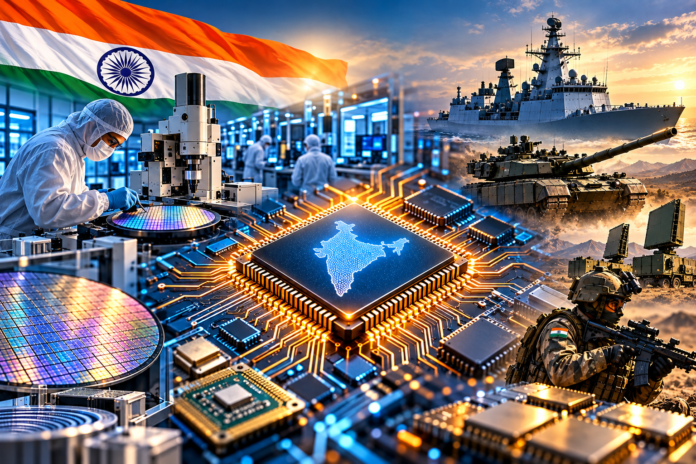
“The Silicon battlefields of future conflicts will be hallmarked by infinite tenacity, reverberate with lethality of defence technologies, evidenced with invincibility and resilience”
Modern warfare is increasingly determined by the ability to sense, process, communicate, decide and act faster than the adversary, and semiconductors support every one of these functions.

Impact on Defence Industry
Warfare has always been shaped by technology. The industrial revolution introduced mass production and mechanised warfare. The information revolution introduced precision weapons, satellites, digital communications and network-centric operations. The artificial-intelligence revolution is now producing a new military paradigm in which the speed of sensing, processing, deciding and acting increasingly determines battlefield advantage. The semiconductor is the enabling technology connecting these revolutions, and the defence implications of semiconductor self-reliance are therefore profound.
A modern missile may contain processors for navigation, inertial measurement, target recognition and flight control. A fighter aircraft contains thousands of electronic components controlling radar, avionics, communications, electronic warfare and weapons integration. An unmanned aerial vehicle requires processors for navigation, image processing, autonomy, communication and mission management.
Radar and Electronic Warfare
The semiconductor revolution and the changing character of war demand better force multipliers in air defence, maritime surveillance, airborne early warning and electronic warfare superiority. These require radar systems built on high-performance semiconductor devices, including:
- Active Electronically Scanned Arrays (AESA) and digital beamforming;
- gallium nitride transmit-receive modules;
- high-speed signal processing and low-noise amplifiers; and
- electronic support measures and countermeasures.
Indigenous GaN technology can significantly improve radar range, power efficiency, frequency agility and resistance to electronic attack.

An advanced radar does not merely transmit and receive electromagnetic energy; it digitally processes enormous quantities of information. Electronically scanned radars depend on sophisticated signal processing and computing architectures to detect, track and classify multiple targets, and India’s own defence radar systems illustrate this growing dependence on advanced electronics.
Artificial Intelligence and Autonomous Warfare
Faster sensor-to-shooter loops and enhanced autonomy in contested environments require AI-enabled defence systems with specialised processors able to perform complex calculations at low power. India’s development of indigenous AI chips and edge-computing processors could enable secure, low-latency decision-making without dependence on cloud infrastructure.

The applications include autonomous drones, unmanned underwater vehicles (as used in the Iran-USA war), target recognition, automatic threat classification, swarm intelligence, predictive maintenance, battlefield decision-support systems and autonomous navigation.
Drone warfare has very quickly emerged as the lowest-cost route to devastating aerial attack, compared with prohibitively expensive fixed-wing and rotary-wing aircraft. It has manifested itself in dangerous unmanned roles on the Russia-Ukraine battlefields of multi-dimensional warfare, combining precision strike accuracy with minimal detectability and a strong ability to evade counter-strike.
Drones are dreaded by all armies because they deliver precision strikes across diverse and hazardous terrain, with very affordable logistics and low costs for repair and maintenance. Training soldiers to operate them against enemy targets is inexpensive and user-friendly, which makes the drone a popular weapon with high kill probabilities on land, at sea and against aircraft. It is used not only by regular troops but also by asymmetric forces in sabotage and covert operations.
Secure Communications and Network-Centric Warfare
Greater confidentiality, integrity, availability and survivability of military networks require secure, resilient communication systems. Indigenous secure chips can reduce the risk of hardware backdoors and supply-chain compromise.
Semiconductors enable software-defined radios, secure satellite communications, tactical data links, frequency-hopping systems, anti-jamming communications, cryptographic processors and high-speed networking systems. Space-based targeting is also gaining credibility, directing weapons with greater accuracy and lethality across the land, sea and air dimensions of warfare.
Missiles, PGMs, Space and Strategic Systems
Semiconductor technology directly influences missile accuracy, reaction time, miniaturisation and resistance to electronic interference. India needs a quantum leap forward in highly reliable electronics for inertial navigation, guidance and control, flight computers, radar seekers, imaging infrared seekers, fusing systems, telemetry and actuator control.
Such systems would face minimal countermeasures, so that their efficacy can accentuate the destruction of vital installations and weapon assets in the minimum time on the visualised battlefield.
India also needs indigenous radiation-hardened processors, memory devices, sensors and power electronics for strategic space missions, including reconnaissance and navigation satellites, secure communications, space-based surveillance, missile warning systems, satellite-based electronic intelligence and space situational awareness.
India’s space programme is another major reason for semiconductor sovereignty. Satellites are increasingly integral to national security, supporting communications, navigation, intelligence, surveillance, weather monitoring, disaster management, missile warning, maritime awareness and battlefield connectivity.
Space electronics face extreme environmental conditions that can damage conventional semiconductor devices, so strategic space systems require radiation-hardened or radiation-tolerant components and rigorous qualification. India needs to strengthen domestic capability in this field.
The long-term objective should be to ensure that strategic spacecraft do not depend on uncertain access to foreign components that may be restricted during a crisis, which becomes particularly important as India’s military space architecture expands.
Naval Underwater Warfare and Cybersecurity
Semiconductors are critical in naval systems such as sonar signal processors, underwater communication systems, combat management systems, integrated navigation systems, shipboard radar, electronic warfare suites, autonomous underwater vehicles and propulsion control systems.
From AESA radars and autonomous drone swarms to radiation-hardened satellites, advanced semiconductors dictate the speed, precision, and lethality of modern military hardware
Cybersecurity is no longer limited to software; hardware itself can become a vulnerability. India needs to guard against embedded backdoors, malicious firmware, counterfeit components, hardware Trojans, unauthorised data leakage, remote exploitation and supply-chain manipulation.
India Needs Trusted Semiconductor Architecture
A few prerequisites must be analysed in sequence before a semiconductor architecture can deliver productive outcomes and meet defence requirements comprehensively.
They include secure boot, a hardware root of trust, hardware-based encryption, tamper detection, secure key storage, hardware authentication, indigenous verification and, ultimately, trusted scientific evaluation and validation by the most brilliant minds in the industry.
The existing procurement approach should evolve, with full security. Traditionally, defence procurement focuses on platforms and systems; future procurement must also consider the technology underneath those systems.
A fighter aircraft should not be evaluated only by its radar range or weapon load, since the resilience of its electronic architecture should also matter. Similarly, an unmanned system should be evaluated for the availability and trustworthiness of its processors.
Procurement specifications should therefore include semiconductor provenance and lifecycle security where appropriate. Defence contracts should encourage Aatmanirbhar indigenous chip design, trusted components and open architectures with modular electronics, upgradeability, component traceability and, above all, sustainment by the domestic defence industry.
The Future Battlefield: 2035 and Beyond
By the 2030s the battlefield is likely to become substantially more autonomous, networked and software-defined. Human commanders will increasingly operate within AI-assisted decision environments.
Sensors will generate enormous volumes of information, unmanned platforms will operate collaboratively, satellites will provide persistent surveillance, electronic warfare will contest the electromagnetic spectrum continuously, and cyber operations will target military networks.
Precision weapons will require increasingly sophisticated guidance, and all of this will raise semiconductor demand considerably. China, meanwhile, has meticulously planned the shaping of battlefields and their non-recuperative destruction through innovative low-cost warfare techniques.
Artificial intelligence will require specialised accelerators and electronic warfare will require high-speed processing. Hypersonic systems will need sensing and control electronics able to operate under extreme conditions, autonomous systems will need edge computing, satellites will need radiation-resistant processors, and directed-energy weapons will need high-power electronics.
Secure communications will require trusted cryptographic hardware, and quantum systems will require highly specialised control electronics. The semiconductor is consequently becoming the invisible infrastructure of military power. The country that controls this infrastructure gains strategic freedom; the country that cannot guarantee it remains exposed to technological dependency.
Future procurement must prioritise provenance alongside performance, embedding hardware roots of trust and tamper detection to protect critical systems from backdoors and supply-chain vulnerabilities
The battlefield of the future may therefore be visualised as a chain: Sensor → Semiconductor → Software → Network → Artificial Intelligence → Decision → Effect.
If any layer fails, the military system becomes less effective, and the semiconductor sits at the centre of this chain.
Semiconductors and Defence Industrial Self-Reliance
The defence sector often requires components for several decades, whereas commercial semiconductor products may become obsolete within a few years. This creates a special requirement for defence electronics, in which long-term availability, traceability, reliability, qualification and controlled configuration are as important as performance.
India must establish defence-oriented semiconductor policies that address obsolescence management, trusted foundries, indigenous component qualification, radiation and environmental testing, counterfeit prevention, lifecycle support, strategic stockpiling, secure design databases and assured production capacity during conflict.
A domestic semiconductor ecosystem will also strengthen initiatives such as Aatmanirbhar Bharat and Make in India, which essentially require Defence Industrial Corridors in both the North and the South.
The aim is indigenous weapon-system development through the entire stack, exports of defence electronics, and public-private R&D partnerships on a large scale. There is a felt need for an Indian Defence Semiconductor Mission 2026 for the Armed Forces, aligned with doctrinal warfare tenets.
India should urgently consider establishing a dedicated Defence Semiconductor Architecture linking the Ministry of Defence, the armed forces, DRDO, the semiconductor industry, academia, start-ups and the broader India Semiconductor Mission.
Such an architecture would begin with demand: the armed forces should identify future semiconductor requirements over a 10-to-20-year horizon, allowing DRDO and industry to invest in technologies before military demand becomes urgent.
On the lines of Semicon 1.0, the Semicon 2.0, is a dedicated mandate for robust, futuristic seminars and exhibitions on this defence technology spectrum should also be considered, linking DRDO, the armed forces, academia, industry and the finest semiconductor manufacturers at the earliest.
The objective should not merely be to manufacture chips. Priorities should include GaN and GaAs RF devices, SiC power electronics, radiation-hardened electronics, secure processors, AI accelerators, high-speed ADCs and DACs, MEMS sensors, infrared detectors, and quantum and photonic devices.
Institutional measures needed urgently include defence-qualified semiconductor foundries, indigenous EDA tools for sensitive applications, common test and qualification facilities, long-term procurement commitments, defence semiconductor technology roadmaps, university Centres of Excellence, high-end technology demonstrators and pilot production lines.
Strategic and Geopolitical Implications
Semiconductors have become instruments of geopolitical influence. Export controls, technology restrictions, supply-chain disruptions and competition for fabrication capacity demonstrate that semiconductor dependence can affect national freedom of action.
Unlike fast-moving commercial tech, defence platforms require long-term lifecycle assurance, making strategic stockpiling, trusted foundries and domestic redesign capabilities vital for crisis readiness
For India, indigenous Aatmanirbhar capability will provide the desired strategic autonomy, reduced vulnerability to sanctions, greater resilience during crises, enhanced defence export potential, technological bargaining power, protection against supply-chain disruption and greater control over critical military technologies.
Semiconductor sovereignty will increasingly become an incontestable component of national sovereignty, as strategists have envisaged.
Imminent Contours – Way Forward
India should pursue a balanced strategy based on five pillars:
- Design: develop indigenous processors, AI chips, RF chips and secure semiconductor IP.
- Manufacture: build domestic capabilities in mature nodes, compound semiconductors and power devices, and progressively in advanced nodes.
- Integrate: develop complete systems rather than isolated components.
- Secure: establish trusted supply chains, hardware security and anti-counterfeit mechanisms.
- Sustain: ensure lifecycle support, repairability, obsolescence management and long-term availability for defence systems.
Transitioning from self-reliance to true sovereignty requires a synchronised effort across five pillars: indigenous design, domestic manufacturing, system integration, hardware security and long-term sustainment
The Future of Indian Defence May Begin Inside a ‘Chip’
The strategic importance of semiconductors can no longer be measured by their physical size; the smaller the chip, the greater its potential strategic significance.
A semiconductor package may determine the speed of an electronic warfare system, a radiation-hardened device the reliability of a strategic satellite, and an AI accelerator how quickly a military command system interprets battlefield information.
A few millimetres of silicon may determine the performance of a radar, and a processor smaller than a coin may control an unmanned aircraft.
India has reached a critical moment. It has strong design talent, a large domestic market, expanding electronics manufacturing, growing research capability and a policy framework now extending across the semiconductor value chain.
Semicon 2.0 is an important evolution, moving beyond fabs and packaging towards design, equipment, materials, research and talent. Yet national capability should not be measured by the number of factories built or the volume of chips produced.
The real test is strategic. Can India guarantee that its armed forces will continue to receive trusted electronic components during a geopolitical crisis? Can it design its own critical processors, manufacture strategically important devices, protect semiconductor IPR and sustain defence electronics for decades?
To secure its tech stack by 2035 and beyond, India urgently needs a unified architecture linking the MoD, armed forces, DRDO and industry to map out decade-long military chip requirements
Can it rapidly replace imported components during conflict and secure the hardware beneath its AI, autonomous systems, space assets and electronic warfare capabilities? It can, with the brilliant fraternity under DRDO, attractive incentives, firm timelines and top-tier global competitive infrastructure.
The objective should therefore be broader than self-reliance. India must build semiconductor strategic resilience by combining domestic capability with trusted international partnerships, indigenous IP with global technology collaboration, commercial scale with defence-grade assurance, and innovation with national-security requirements.
The next generation of military power will be designed in silicon, accentuated by artificial intelligence, connected through secure networks and protected by sovereign technology.
The future of Indian defence will depend not merely on the weapons India builds, but increasingly on the chips that make those weapons intelligent, connected, autonomous, resilient and sovereign.
Education must keep pace. A ‘Cradle of Learning on Semiconductors’ could enter the final secondary-school curriculum and specialised under- and post-graduate courses, and form part of the curriculum for defence institutions, IITs and DRDO establishments.
India should build a national semiconductor talent pyramid, with world-class researchers and architects at the top, engineers and manufacturing specialists in the middle, and highly trained technicians at the base.
By scaling up defence-qualified packaging, compound semiconductors, and a national talent pyramid, India can secure its own operational autonomy while becoming a trusted supplier to global allies
Current national initiatives already report large-scale training and engineering access to semiconductor design tools; the next step is specialised defence semiconductor curricula.
India as a Trusted Semiconductor Defence Partner
India should aspire not merely to be self-reliant but to be indispensable. A trusted semiconductor ecosystem could make India an important partner for countries seeking to diversify their semiconductor supply chains, and its growing international partnerships already point in this direction. This offers a fine opportunity for strategic influence.
Short conflicts place enormous emphasis on weapons stocks, while long conflicts expose industrial weaknesses. A country may have thousands of drones at the start of a war but need millions of processors and sensors to replace losses; it may possess advanced missiles yet need continuous electronic components for replenishment.
Semiconductor manufacturing thus becomes part of wartime industrial mobilisation, and India must develop, without further procrastination, the ability to scale production during national emergencies. This requires pre-planned mobilisation frameworks and funding, especially for the future Integrated Theatre Commands.
The goal should not simply be “Make in India”. It should be to design in India, manufacture where strategically appropriate, test in trusted environments, protect the IP, maintain the supply chain and guarantee military availability.
Sovereignty is achieved in degrees: it may be impossible to eliminate every import, but dependence can be reduced where it matters most. The strategic question is which dependencies could seriously affect India’s military capability in a crisis, and those deserve immediate attention.
“To have durable Peace, you have to be prepared for War, to have assured victory in War, you have to invest during Peacetime with best defence technologies”

Lt Gen S K Gadeock is a distinguished military leader, global strategist, and scholar who served as the Commandant of the Defence Services Staff College. A decorated veteran and former Logistics Advisor to the Botswana Defence Force, he has held numerous high-ranking appointments including Director General of the Amity Institute of Defence & Strategic Studies. Serving on the Advisory Board of Raksha Anirveda, he is a prolific writer and motivational speaker.





