


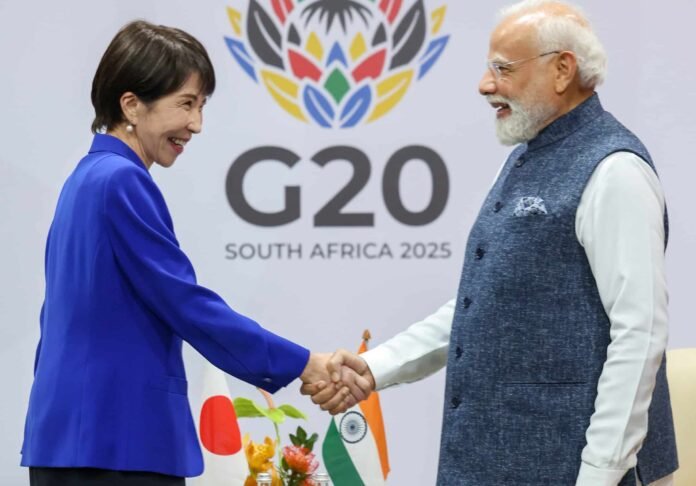
Japanese Prime Minister Sanae Takaichi’s maiden three-day visit to India, beginning from July 1, marks a new chapter in New Delhi and Tokyo’s strategic relationship as defying the past conventional approach in their long-term engagement, the two countries have shown their keen interest in reinforcing cooperation in the areas of economic security, investment and innovation.
Moreover, the visit takes place at a time when the Middle East war with its deleterious impact on the supply of crude oil and gas from the Strait of Hormuz, has taken a huge toll on the economic growth worldwide, while Japan’s relations with China have deteriorated since Prime Minister Takaichi’s last year statement in the Diet wherein she suggested that Tokyo could intervene if Beijing used military power against Taiwan.

The Middle East war with its deleterious impact on the supply of crude oil and gas from the Strait of Hormuz, has taken a huge toll on the economic growth worldwide. While Japan’s relations with China have deteriorated since Prime Minister Takaichi’s last year statement in the Diet wherein she suggested that Tokyo could intervene if Beijing used military power against Taiwan
Emergence of India as Japan’s valued partner
China has since then played spoilsport with Japanese companies operating from the mainland. It has placed 40 Japanese firms and organisations on its export control list. This has happened when there is already a decline in Japanese businesses’ operation in China.
According to a survey conducted by Japan’s Teikoku Databank, a financial research company, in November 2025, the share of Japanese firms prioritising China as a production base declined by around 30%, while those using it as a sales base declined by 50%. Even data from Japan’s Ministry of Finance showed the declining investment trend.
As per the ministry, Japan invested $3.2 billion in China in 2024, marking a nearly 60% drop compared with the level recorded a decade ago. Though rising geopolitical tension between the two countries and growing competitiveness of Chinese companies are also some of the reasons behind declining Japanese investment in China.
What is significant is that Japan looks at India and Southeast Asian countries as spots that can give value to its money and serve as replacements for China in its long-term plan to reduce its dependence on Beijing.

According to a survey conducted by Japan’s Teikoku Databank, a financial research company, in November 2025, the share of Japanese firms prioritising China as a production base declined by around 30%, while those using it as a sales base declined by 50%. Even data from Japan’s Ministry of Finance showed the declining investment trend
Japan has committed 10 trillion yen (approximately $68 billion) in new private investment in India over the next decade. Collaboration in semiconductors, critical minerals, pharmaceuticals, clean energy and information and communication technology are key aspects of India-Japan engagement.
In particular, to strengthen their efforts towards resilient supply chains for critical minerals, they have agreed to set-up a rare-earth processing and magnet project in Andhra Pradesh. While Japanese company, Toyota Tsusho is in partnership with an Indian company for this project, New Delhi is looking to build a stable domestic rare-earth supply chain.

Emergence of Northeast as India’s treasure trove
To this regard, India, under its Union Budget 2026-27, has announced the creation of dedicated rare earth corridors in Odisha, Kerala, Andhra Pradesh and Tamil Nadu. Besides these states, Assam and other Northeastern states have shown their potential to become a hub for critical minerals.
What is significant is that Japan looks at India and Southeast Asian countries as spots that can give value to its money and serve as replacements for China in its long-term plan to reduce its dependence on Beijing
The Geological Survey of India (GSI) has discovered more than 1,400 million tons of limestone in Assam. Known for its oil and gas reserves, Assam is also sitting on piles of deposits such as iron ore and glass sand. Total reserves of rare earth elements in Assam, as per the GSI, are around 28.64 million tons. Rare earth elements concentration in the state, as per the GSI, ranges from 1,000 to 5,000 parts per million (PPM).
Arunachal Pradesh possesses 17.89 million tons of natural flake graphite, 0.116 million tons of copper and 2.15 million tons of rare earth elements. The GSI has also discovered 17.17 million tons of Vanadium in Arunachal Pradesh. Vanadium discovery marks India’s first major resource of a critical alloying element, which is used in steel alloys and other industrial applications.
Meghalaya, considered as one of the beautiful states of India, has over 5737 million tons of high to moderate grade of limestone reserve. It also has a significant amount of Uranium reserves. While the GSI has recently discovered substantial reserves of bauxite and lithium in the state.
Going by the GSI’s report, India’s Northeast region is a treasure trove of minerals, possessing 70 million tons of untapped rare earth elements, including graphite, vanadium, lithium and cobalt. Experts argue that once these minerals are commercially exploited and processed, India will not only be able to reduce its dependence on China for strategic minerals, but also position itself as an important player in the global supply chain of advanced technology
On the other hand, recent findings in Nagaland suggest encouraging presence of nickel and cobalt deposits in the state, while Manipur has significant untapped resources like chromite, nickel and cobalt – all critical minerals essential for the country’s economic development and national security.
Going by the GSI’s report, India’s Northeast region is a treasure trove of minerals, possessing 70 million tons of untapped rare earth elements, including graphite, vanadium, lithium and cobalt. Experts argue that once these minerals are commercially exploited and processed, India will not only be able to reduce its dependence on China for strategic minerals, but also position itself as an important player in the global supply chain of advanced technology.
Moreover, with the consumption of rare earth expected to double in India by 2030 due to rapid growth in electric vehicles, renewable energy, electronics, and defence applications, it is essential for the country to expand its capability and invest in this sector to reduce import dependence and ensure long-term self-reliance. To support self-reliance in critical minerals, India has committed Rs 7,280 crore to develop 6,000 million tons per annum of integrated rare earth permanent magnets manufacturing capacity.
India-Japan critical minerals partnership
Further, in pursuit of self-reliance, India is keen to align with Japan, which is also grappling with China’s export controls on supply of critical minerals. Like India, which faced sudden imposition of export restrictions by China on the supply of rare earth elements and finished magnets in April last year, Japan is currently experiencing Beijing-imposed ban on the supply of rare earth elements used for the development of powerful magnets.
As India’s only foreign partner with large-scale projects in the Northeast region, Japan possesses necessary wherewithal in making New Delhi realise its ambition to become a major hub of rare earth materials. Experts argue that by combining India’s resource potential with Japan’s expertise in mineral processing and advanced manufacturing, New Delhi-Tokyo partnership could prove to be a milestone in building resilient supply chains
China accounts for about 60% of global mine production and 90% of refined and rare-earth magnet production. Since 2010 onwards, Japan has cut down its dependence on China from 90% to 60% for rare earth materials. Today, it is one of the world’s biggest rare earth magnet makers outside China, reports Reuters.
Japan is also said to have gained expertise in processing, advanced materials, recycling technologies, and supply-chain management. Japanese companies such as Mitsubishi Materials, Shin-Etsu Chemicals and Hitachi have technology and expertise not only in manufacturing rare earth magnets, but also in building rare earth refining facilities.
As India’s only foreign partner with large-scale projects in the Northeast region, Japan possesses necessary wherewithal in making New Delhi realise its ambition to become a major hub of rare earth materials. Experts argue that by combining India’s resource potential with Japan’s expertise in mineral processing and advanced manufacturing, New Delhi-Tokyo partnership could prove to be a milestone in building resilient supply chains.
“Both countries are working together to bolster critical minerals supply chains through partnership in the Mineral Security Partnership and the Indo-Pacific Economic Framework and Quad Critical Minerals Initiatives,” said a fact sheet on India-Japan Economic Security Cooperation released on August 29, 2025.

The writer is a senior journalist with wide experience in covering international affairs. The views expressed are of the writer and do not necessarily reflect the views of Raksha Anirveda





