


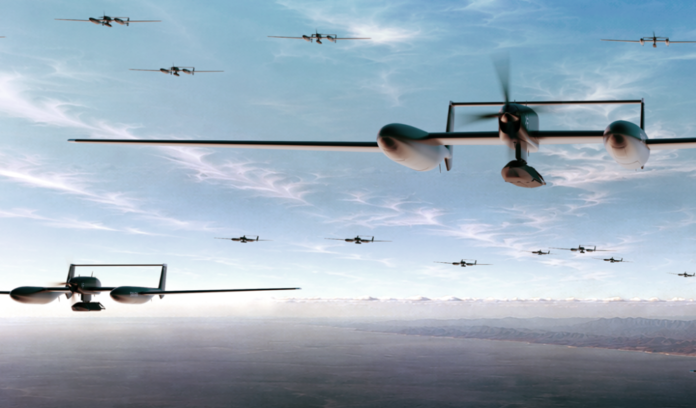
Swarm Aero has introduced Gamera, a large uncrewed aircraft intended to offer the US Air Force a lower-cost option for long-range strike and sensing missions. The California-based company revealed the aircraft at the Air & Space Forces Association’s Air, Space & Cyber Conference in National Harbour, Maryland.
Gamera is being positioned as a candidate for the Air Force and Defence Innovation Unit’s Massed Modular Aircraft programme, which seeks affordable unmanned systems capable of performing missions associated with the MQ-9 Reaper.

The aircraft has a wingspan of approximately 72 feet and belongs to the Group 5 category of unmanned aircraft. Swarm Aero says it will have an un-refueled range of more than 9,000 nautical miles and a mission radius of roughly 2,300 to 2,500 miles. The company has designed the aircraft for long-duration cruise and loiter operations, allowing it to maintain a persistent presence without requiring frequent refueling.
Gamera is powered by a Honeywell TPE331 turboprop engine and is designed to carry more than 2,800 pounds of payload across seven stations. The payload capacity is intended to support a range of missions, including surveillance, communications relay, electronic warfare and surface strike.
Swarm Aero says Gamera is the first uncrewed aircraft designed from the outset to carry bomber-class weapons such as the AGM-158 JASSM-ER and Long-Range Anti-Ship Missile. The company has also indicated that the aircraft could accommodate other cruise missiles, hypersonic weapons, sensors and mission-specific equipment.
The aircraft’s proposed role reflects a shift in the way military planners view large drones. Rather than relying only on a small number of expensive, highly capable platforms, the Air Force is examining whether large numbers of cheaper aircraft could provide greater resilience and coverage.

The Massed Modular Aircraft initiative is seeking systems with a long un-refueled range, a payload capacity of approximately 2,800 pounds and a target cost near $10 million per aircraft. The programme is intended to provide an affordable complement or eventual alternative to parts of the MQ-9 fleet. The Air Force has indicated that it wants the aircraft to be producible in significant numbers and capable of operating in higher-risk environments than traditional platforms.
Swarm Aero says Gamera has been under development since the company was founded in 2022. Its design uses a manufacturing approach intended to reduce production costs and support high-rate output. The company has received more than $10 million in Air Force Research Laboratory contracts connected to high-rate composite manufacturing, according to industry reporting.

The aircraft is also linked to Swarm Aero’s Legion command-and-control and autonomy software. Legion is designed to coordinate multiple heterogeneous unmanned systems, potentially allowing one operator or a small team to manage several aircraft and other autonomous platforms. That capability could enable Gamera aircraft to operate as part of larger formations rather than as isolated remotely piloted vehicles.
Swarm Aero’s proposal arrives as competition for the Air Force’s future large-drone requirement intensifies. General Atomics, the manufacturer of the MQ-9, has also presented a concept for the programme, while other aerospace companies are developing autonomous and modular aircraft. The competition will likely focus on cost, range, payload, manufacturing speed and the ability to integrate with existing command networks.
Gamera remains a development programme rather than an operational aircraft. The company has not yet announced a completed flight-test schedule, confirmed production contract or selected launch customer. Its performance claims will therefore need to be demonstrated through testing.
If those targets are achieved, Gamera could give the Air Force a new tool for persistent sensing and long-range effects delivery. Its central promise is a combination of global reach, substantial payload capacity and lower unit cost – capabilities intended to help the United States generate greater airpower with larger, more adaptable fleets.






