


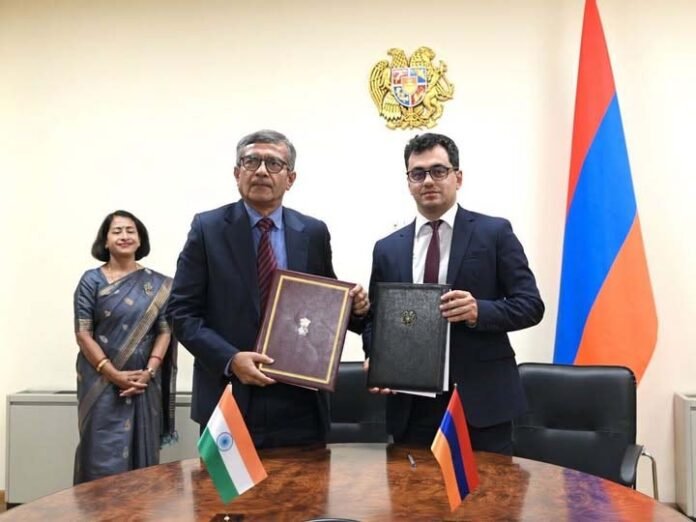
Yerevan. A bilateral Memorandum of Understanding (MoU) was signed during high-level meetings in Yerevan on August 17, 2026, led by Indian Defence Secretary Rajesh Kumar Singh and Armenian Minister of High-Tech Industry Davit Tadevosyan. Indian Ambassador Nilakshi Saha Sinha and senior military leadership accompanied the delegation.
Expanding Industrial Ties Beyond Procurement
According to official releases from the Ministry of Defence, the primary focus of the pact is to move beyond off-the-shelf armaments procurement toward co-developing next-generation technologies. The agreement lays down structured mechanisms for joint research and development, technology transfer and collaborative production facilities tailored for defence applications.

During the two-day diplomatic visit to Armenia, Defence Secretary Singh held extensive discussions with Armenian Defence Minister Suren Papikyan and Lieutenant General Edvard Asryan, Chief of the General Staff of the Armenian Armed Forces. The talks reaffirmed both nations’ shared commitment to elevating their defence architecture, exploring new avenues for technological collaboration and creating a unified industrial pipeline.
A Surging Strategic Partnership
Since 2020, Armenia has emerged as one of the largest international buyers of Indian military hardware. Facing ongoing regional security challenges in the South Caucasus and seeking to diversify its defence procurement sources, Yerevan has increasingly turned to New Delhi for critical weapon systems.
The total value of defence contracts inked between the two nations has exceeded $2 billion, encompassing a wide array of land-based and aerial combat technologies:
- Air Defence Systems: Delivery and deployment of the indigenous Akash surface-to-air missile platform.
- Artillery & Rocket Systems: Procurement of Pinaka Multi-Barrel Rocket Launchers (MBRL) and 155mm Advanced Towed Artillery Gun Systems (ATAGS).
- Radar & Surveillance: Acquisition of Swathi Weapon Locating Radars alongside specialised counter-drone anti-UAV equipment.
- Munitions & Light Weapons: Supply agreements covering sniper rifles, precision ammunition and tactical gear.
The global implications of the MoU span four major strategic vectors. Under the co-production framework, the two nations aim to establish shared manufacturing lines to produce defence components locally. Their joint R&D pipelines focus on partnering across high-tech defence innovation, electronic warfare and advanced sensor technology.

To ensure supply chain resilience, the partnership seeks to mitigate global logistics risks through diversified regional manufacturing hubs. Finally, this collaboration serves their broader geopolitical alignment by balancing regional dynamics while positioning India as a global defence exporter.
The MoU marks a significant milestone for India’s domestic defence manufacturing sector, aligning with New Delhi’s broader push to expand global defence exports. For Armenia, transitioning to joint manufacturing ensures reliable, long-term technological support and maintenance for its expanding arsenal of Indian-origin weapons. As both countries initiate work on joint R&D projects, the pact cements Armenia’s role as a cornerstone of India’s strategic outreach in Eurasia.







