


London: SYOS Aerospace is four years old, has no legacy baggage, and just became one of the only Western companies selling military customers an uncrewed vehicle across air, ground, sea surface, and now the seabed simultaneously — while established names are still defending a single domain.
The SU10 can sit motionless on the ocean floor for hours on end, tethered to surface power, watching a pipeline or cable through a fiber-optic line thinner than a finger — and that single design choice changes everything about how persistent underwater surveillance gets done.

With governments on both sides of the Atlantic pouring real money into protecting undersea infrastructure after a string of high-profile cable and pipeline incidents, the timing of this launch is anything but accidental.
Four years ago, SYOS Aerospace did not exist. This month, at the Combined Naval Event in the United Kingdom, it unveiled an underwater drone called the SU10 and became one of a short list of Western companies that can sell a military customer an uncrewed vehicle for the air, the ground, the surface of the ocean, and now the seabed. The same company that builds heavy-lift helicopter drones and uncrewed boats has, in the span of about 18 months, bought its way into subsea robotics and put a product in the water.
SYOS is a joint UK-New Zealand business, founded in 2021, with its maritime headquarters in Fareham near Portsmouth in England and its aviation operations in Mount Maunganui on New Zealand’s North Island. CEO and founder Sam Vye has told the New Zealand press he wants the company to become “the next Rocket Lab.”
The SU10 is the piece that fills out the pitch, and it lands at a moment when governments on both sides of the Atlantic are spending real money to put eyes on the ocean floor.

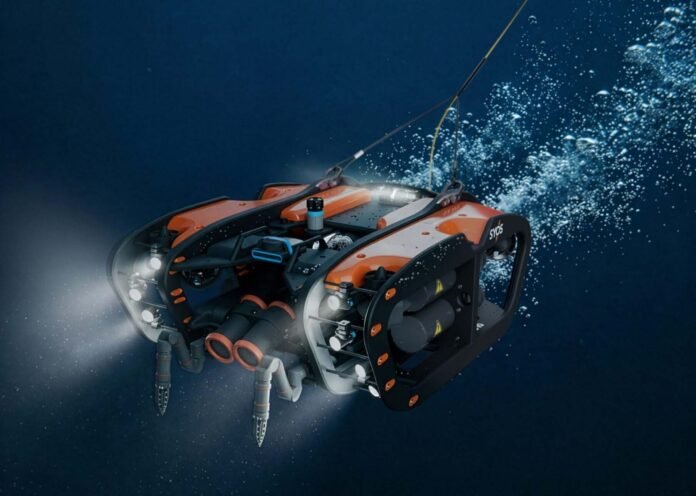
The SU10 is a small, tethered uncrewed underwater vehicle. It operates to a depth of 500 metres, about 1,640 feet, and carries a modular payload of up to 10 kilograms that can be configured for inspection, intervention, or intelligence, surveillance, and reconnaissance sensors. On its internal battery it runs for roughly four hours. Connected by tether to surface power, it can stay down indefinitely.
That tether is the design decision that defines the platform. It is an ultra-slim fibre-optic line that carries control signals and a live data feed at the same time, which is what lets a single operator keep the drone on station inspecting a fixed asset for hours rather than running a short pre-programmed sortie. According to Marine Technology News, the SU10 can be launched from shore, from a crewed vessel, or from one of SYOS’s own uncrewed surface vessels through a launch-and-recovery system, which is the configuration that turns it into part of a larger uncrewed network rather than a standalone tool.







