


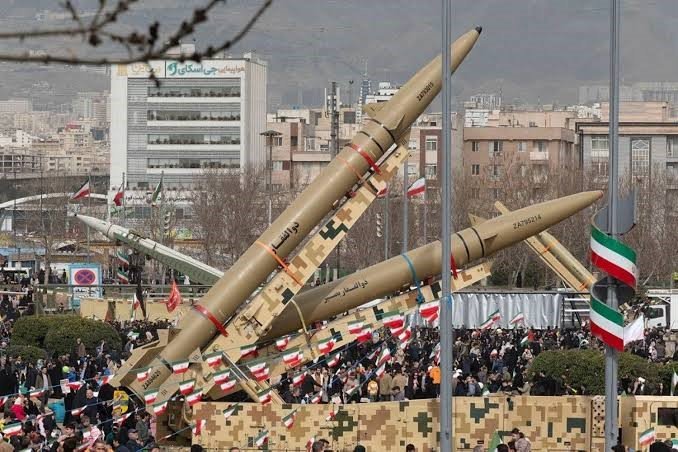
Tel Aviv: The US and Israel are closely following Iran’s efforts to develop new long range ballistic missiles powered by solid fuel. A solid fuel missile is relatively more protected than a liquid fuel one as the preparations for launch are shorter and decreases the possibility of early detection by different aerial sensors.
Recently, reports surfaced about an Iranian effort to develop a new version of the Sejjil ballistic missile. The Sejjil 3 would reportedly have three stages, a maximum range of 4,000 km, and a launch weight of 38,000 kg.

Development of the Sejjil missile likely began in the late 1990s, but stems directly from development work of previous Iranian missiles, most notably the Zelzal short-range ballistic missile (SRBM). Its use of solid propellant, in particular, is due to fuel technology advancement made in conjunction with the Zelzal programme during the 1990s, the development of which is believed to have been aided by China.
Though the missile has a similar size, weight, and range to the Shahab 3 variants, its use of solid propellants is a major improvement on the Shahab design. Solid propellants allow for a faster launch time, leaving the missile less vulnerable during launch. Because solid-propellant missiles do not have to be fuelled immediately prior to launch, they are more easily transported. On the other hand, solid-propellant missiles have particular performance characteristics that make it more difficult to guide and control.
The Sejjil missile is approximately 17.6 m long, has a diameter of 1.25 metre, and an overall launch weight of 23,600 kg. It can deliver a payload of 500-1500 kg. The Sejjil is launched from a 22-metre-long tractor trailer combination transporter-erector-launcher with three axels on both the tractor and trailer vehicles.
Unconfirmed reports from the United States suggest that the manufacturing of transporter erector launcher (TEL) vehicle for the Sejjil was being supported by Chinese technologies.

The Sejjil’s re-entry vehicle appears to have optical ports that could be for stellar or horizon reference systems, but likely relies on inertial navigation systems or global positioning systems for guidance.

-The writer is an Israel-based freelance journalist. The views expressed are of the writer and do not necessarily reflect the views of Raksha Anirveda






