


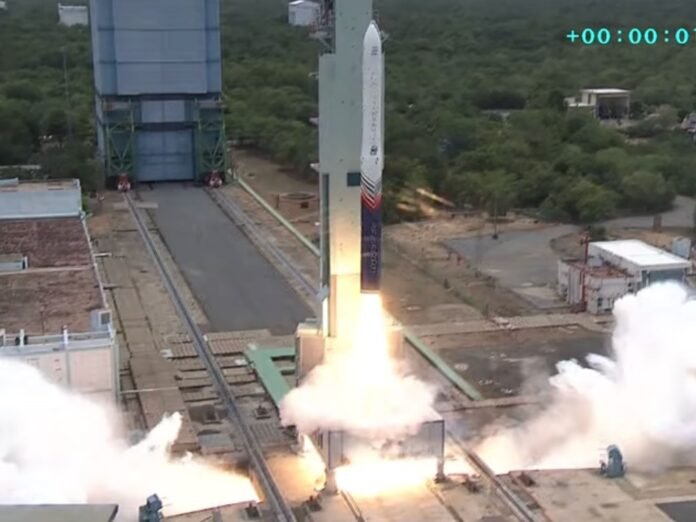
Sriharikota. Skyroot Aerospace’s Vikram-1 rocket lifted off from the Satish Dhawan Space Centre in Sriharikota at 12:05 pm India Standard Time (0635 GMT) on Saturday, marking the first time a privately developed Indian rocket has reached orbit. The mission, called “Aagaman” – Sanskrit for “arrival” – successfully injected its payloads into a 450-kilometre low-Earth orbit roughly 15 minutes after liftoff, mission officials confirmed.
The milestone places India alongside the United States and China as the only countries where a private company has independently achieved orbital launch capability, ahead of established or emerging players in Europe and Japan.

Standing about 22 metres tall, Vikram-1 uses three solid-fuel stages topped by a liquid-fuel orbital adjustment module powered by a 3D-printed engine – technologies Skyroot says are used for the first time in India. The vehicle, built with an all-carbon composite structure, is designed to carry payloads of up to 350 kg into low-Earth orbit.
The rocket carried a mix of commercial and symbolic payloads. Customer satellites included Skyroot’s own SCOPE satellite, a technology demonstrator from Germany’s DCUBED, the SOLARAS S3 nanosatellite from Indian startup Grahaa Space, and “Embrace” – a robotic arm built by Cosmoserve Space to test capture of orbital debris. Two symbolic items were: an 18-karat gold micro-rocket and “Cosmic Bloom” a floral-shaped artwork created with lab-grown gems. A handwritten postcard from Prime Minister Narendra Modi, bearing the words “Vande Mataram” was also tucked aboard.
Founded in 2018 by former ISRO scientists Pawan Kumar Chandana and Naga Bharath Daka, Skyroot became India’s first private company to reach space in 2022 with the suborbital Vikram-S demonstrator. Company executives say roughly 80 per cent of the technologies validated on that earlier flight carried over into Vikram-1, though scaling up to an orbital-class vehicle – about four times larger – took-up another four years of development. Skyroot became India’s first space-sector company to reach a $1 billion valuation earlier this year.
Prime Minister Modi telephoned Skyroot’s founders shortly after the launch to congratulate the team, many of whose members are in their mid-to-late twenties. “You have not only planted a new tree in space, but a new root has also been strengthened on the ground to inspire the new generation.” PM Modi told them. He also invited the team to dinner and framed the launch as vindication of India’s decision to open its space sector to private players in 2020, a move he said had faced skepticism at the time. In a subsequent post on social media, PM Modi called the launch “a defining moment in India’s space journey”.

External Affairs Minister S Jaishankar also welcomed the launch, describing it as a historic moment for India’s space sector.
The launch was enabled by reforms beginning with the 2020 liberalisation of India’s space sector, which for decades had been the exclusive domain of the state-run Indian Space Research Organisation, and further formalised through the Indian Space Policy of 2023. India now counts more than 300 space startups, and the government has set a target of growing the country’s share of the global space economy from about $8 billion today to $44 billion by 2033.

Skyroot’s success also intensifies competition in the global small-satellite launch market, where startups worldwide are challenging incumbents led by Elon Musk’s SpaceX, and where governments across Europe and Asia have been ramping-up support for domestic launch providers to secure independent access to space. Company officials say they are planning up to two more Vikram-1 flights this year, alongside development of an upgraded variant, Vikram-1U, capable of carrying up to 550 kg to orbit.






