


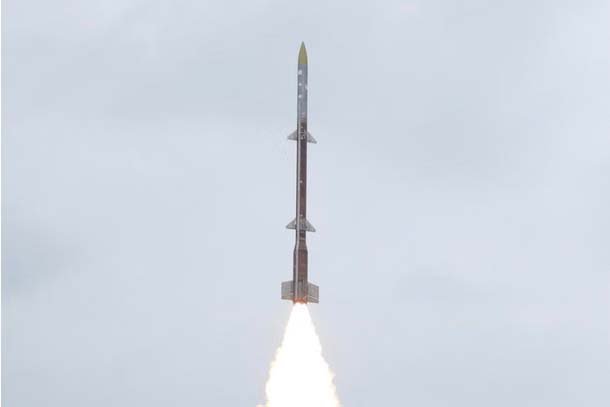
New Delhi: India’s Defence Research and Development Organisation has achieved a major breakthrough with the maiden flight test of the indigenous long-range surface-to-air missile system, Kusha. The test was conducted from APJ Abdul Kalam Island off the coast of Odisha, marking a critical milestone in India’s efforts to strengthen its air defence architecture.
The Kusha missile system is designed to neutralise a wide spectrum of aerial threats. It can engage fighter aircraft, cruise missiles, unmanned aerial vehicles and large enemy aircraft across extended ranges and varying altitudes. This versatility makes it a cornerstone of India’s future layered air defence network.

Defence Minister Rajnath Singh hailed the achievement, describing it as a landmark in India’s defence research and development. He emphasised that only a handful of nations possess the capability to develop such long-range surface-to-air missile systems. The successful trial, he noted, represents a giant leap in India’s air defence capability while simultaneously reducing dependency on imports.
The maiden test is expected to accelerate India’s indigenous air defence programme. By reducing reliance on foreign systems, it strengthens the country’s strategic autonomy and aligns with the government’s Aatmanirbhar Bharat initiative, which prioritises self-reliance in defence manufacturing. The programme also reflects India’s determination to build advanced systems tailored to its unique operational requirements.
Kusha has been conceived as a multi-layered defence solution. It is designed to provide protection against diverse airborne threats over extended ranges and altitudes, ensuring flexibility in countering both conventional and emerging challenges. The successful flight test marks the beginning of a series of developmental trials that will validate its performance before induction into the armed forces.
The system is expected to complement existing platforms such as the Akash, Barak-8 and the imported S-400, forming part of a comprehensive shield against aerial threats. Its indigenous design and development will also contribute to India’s growing expertise in missile technologies, radar systems and command-and-control networks.

The trial underscores India’s progress in building advanced defence systems that match global standards. It demonstrates the country’s ability to integrate cutting-edge technologies into operational platforms and signals a new phase in the evolution of its air defence capabilities.






