


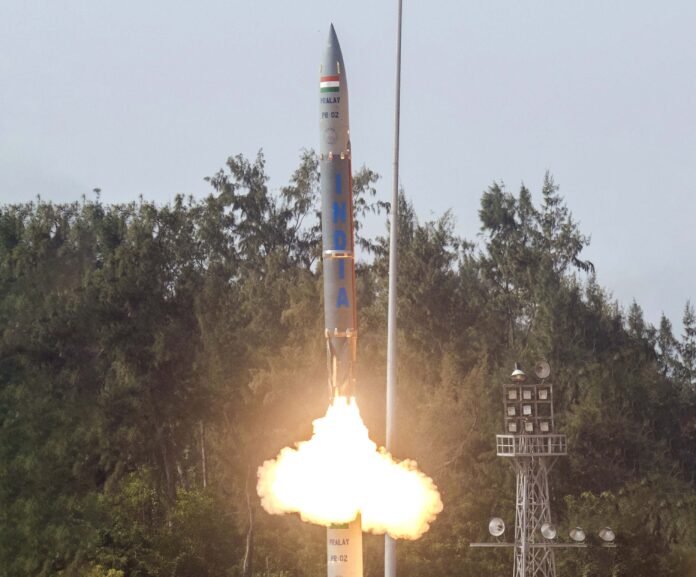
New Delhi: India’s missile programme has steadily expanded over the past decades, producing a wide spectrum of systems ranging from air defence platforms to cruise missiles and long‑range ballistic weapons. While names such as Agni and BRAHMOS often dominate public discourse, another indigenous missile is now emerging as a cornerstone of India’s conventional strike capability. That missile is Pralay.
Pralay is a short‑range, solid‑fuel, road‑mobile ballistic missile developed by the Defence Research and Development Organisation. It draws upon technologies from India’s Ballistic Missile Defence programme, making it a highly reliable and modern system. With a range of 150 to 500 kilometres, Pralay is designed to deliver rapid and precise strikes against high‑value targets deep inside enemy territory.

Unlike the Agni series, which underpins India’s strategic deterrence by providing nuclear delivery capability, Pralay is intended purely for conventional warfare. It allows India to strike critical military infrastructure without crossing the nuclear threshold, thereby maintaining escalation control in a conflict scenario. This distinction makes Pralay a tactical weapon system rather than a strategic one.
The missile is optimised to destroy command centres, air defence sites, logistics hubs and airbases. By doing so, it reduces the need to expose combat aircraft to heavily defended airspace, thereby lowering operational risks. Its solid‑fuel propulsion ensures rapid launch readiness, while its road‑mobile design enhances survivability and flexibility in deployment.
Pralay’s terminal manoeuvring capability makes it extremely difficult to intercept, even by advanced missile defence systems. This feature significantly increases its effectiveness against adversaries equipped with layered air defence networks. The missile’s precision strike ability ensures that India can neutralise high‑value targets with minimal collateral damage.
The development of Pralay reflects the changing character of modern warfare, where conventional ballistic missiles are increasingly required to deliver rapid, accurate, and hard‑to‑intercept strikes. India’s military planners recognised the need for such a system to complement existing assets like BRAHMOS and Nirbhay, thereby creating a layered strike capability across different ranges and speeds.

Pralay’s induction into service marks a significant step in India’s effort to strengthen its conventional deterrence posture. It provides the armed forces with a powerful tool to conduct deep strikes while staying below the nuclear threshold. This capability is particularly relevant in the regional security environment, where rapid escalation control and precision targeting are critical.






