


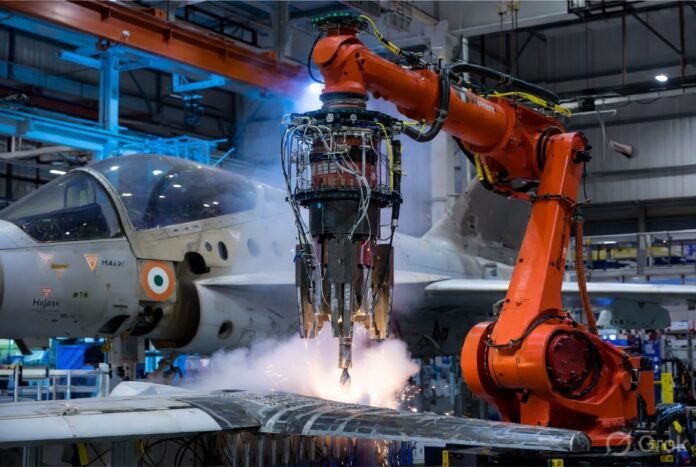
The Tejas Mk1A is India’s own fighter jet, designed and built on Indian soil. It is a proud symbol of Aatmanirbhar Bharat. The Indian Air Force has already ordered 83 of these aircraft. More orders are expected in the coming years. But behind this proud story lies one quiet problem that has slowed down production for a long time — the drilling of holes in the aircraft’s wings.
This may sound like a small matter, but it is not. Each Tejas wing is not a single sheet of metal. It is like a sandwich, made of carbon fibre composite layered with metal. Carbon fibre is very light but extremely strong, which is exactly what a fighter jet needs. To join the skins, spars and brackets of the wing, roughly 8,000 holes must be drilled. Every single one must be perfect. If even a few holes are slightly off, fuel can leak or the structure can become weak.

And, here lies the difficulty. Drilling each hole by hand takes 25 to 35 minutes. Multiply that by thousands of holes, and one set of wings takes weeks of tiring, highly skilled labour. This has been a real bottleneck in delivering more Tejas jets to the Air Force on time.
To solve this, Hindustan Aeronautics Limited (HAL) Aircraft Division published a Request for Quotation, or RFQ. An RFQ is simply a formal document asking companies to offer a solution under clear technical conditions. HAL’s conditions are strict. The robotic system must drill and countersink each hole in less than 60 seconds. Countersinking means widening the top of the hole in a cone shape. This lets the rivet sit flush with the surface, keeping the wing smooth for airflow. The accuracy must be within ±0.30 mm — thinner than a few strands of hair. There must be zero delamination, which means the carbon fibre layers must not separate or peel while drilling. The machine must work without coolant on carbon fibre. It must also inspect every hole automatically. The target is 20 wing sets a year — that is 40 left and right modules — with room to make more when required.
Carbon fibre is very light but extremely strong, which is exactly what a fighter jet needs. To join the skins, spars and brackets of the wing, roughly 8,000 holes must be drilled. Every single one must be perfect. If even a few holes are slightly off, fuel can leak or the structure can become weak
An Indian MSME has stepped forward to take on this challenge — and has won the order. ADD Engineering Components (India) Pvt. Ltd., based in Bengaluru, has secured this prestigious contract from HAL. It is the Indian arm of ADD Engineering GmbH of Germany. The company is headed in India by Girish Linganna. He is a well-known name in defence and aerospace, with more than 25 years of experience in precision metal cutting and manufacturing technology. Under his leadership, the company has earned a solid reputation as a dependable partner for critical aerospace work.
From the German side comes Norbert Kreller, a veteran of the global cutting tool industry. His lifetime of knowledge ensures the drills used on Tejas wings cut cleanly through carbon fibre and titanium without harming the structure. Adding further strength is Dr Werner Gryksa, who holds a Doctorate in Aerospace and Rocket Technology. His experience includes work connected to NASA programmes and several international fighter aircraft projects.

To build the actual machines and software, ADD Engineering has formed a consortium — a partnership of companies working together. True Position Robotics Limited of the United Kingdom is an expert in automated drilling and inspection for aircraft structures. Robot-Technology GmbH of Germany brings advanced industrial robotics and system integration knowledge. An Indian MSME leading the effort, supported by German tooling expertise and British robotic technology, makes a powerful combination.
So, what will happen on the shop floor? A six-axis robot will be mounted on a mobile platform. Six-axis means the arm can move and turn in six directions, much like a human shoulder, elbow and wrist together. At the tip of the robot is a specially designed end-effector — the working “hand” of the machine. In one smooth automatic sequence, it will clamp the surface, sense the exact angle, drill the hole, cut the countersink, measure the result and check for defects. Vision cameras will keep the robot perfectly aligned. Dust extraction will keep the area clean. Using CATIA design software, HAL engineers can plan every hole on a computer before the robot even starts. The same system can be designed to serve Tejas Mk2 and the Advanced Medium Combat Aircraft (AMCA).

The result is simple but powerful. Work that once took thousands of man-hours will finish in a fraction of the time, with the same quality every time. More wings mean more complete aircraft delivered to the Air Force every year. Every year saved is a squadron strengthened sooner
This new pace matters for a bigger reason. The Air Force needs to rebuild its squadron strength, and every delay pushes that goal further away. HAL has been working hard to catch up. Under former Chairman and Managing Director Dr D K Sunil, the company set a clear direction — raise output, modernise the shop floor and bring in new technology partners. The present leadership under Chairman and Managing Director Kota Ravi, popularly known as the “LCA Man” for his long association with the Tejas programme, has carried that momentum forward with the same urgency. The private sector is now entering defence manufacturing in a big way. HAL is answering that competition by becoming faster, leaner and more open to working with capable Indian MSMEs. This robotic cell is one clear proof of that change.
Even the Rafale programme is moving in the same direction. After tying up with Tata Advanced Systems for fuselage manufacturing in India, Dassault Aviation is now looking for an Indian partner to produce the aircraft’s wings locally. Advanced robotic drilling technology of this kind can also be of interest to them as they build India’s aerospace manufacturing strength further.
The result is simple but powerful. Work that once took thousands of man-hours will finish in a fraction of the time, with the same quality every time. More wings mean more complete aircraft delivered to the Air Force every year. Every year saved is a squadron strengthened sooner.






