


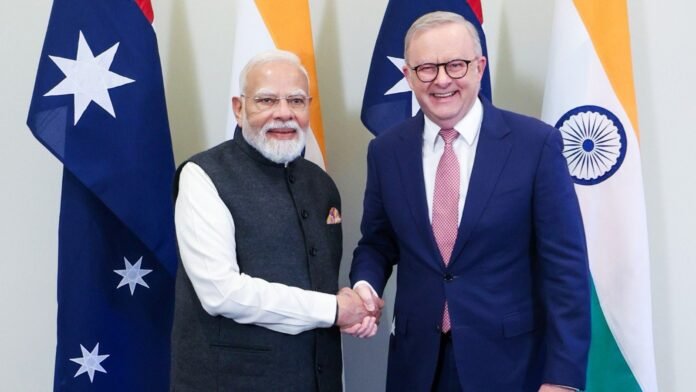
When Prime Minister Narendra Modi and his Australian counterpart Anthony Albanese sat down in Melbourne in July 2026 for the 3rd Australia-India Annual Leaders Summit, the headlines were dominated by uranium. Eighteen agreements were signed that day, spanning civil nuclear energy, maritime security, defence and cyber cooperation. But, tucked within that raft of pacts was something arguably more consequential for the next three decades of the bilateral relationship: the Australia-India Partnership on Critical Minerals and an agreement to build a dedicated critical minerals corridor. This is not a story about one summit. It is the story of two middle powers trying to write themselves into the supply chains that will determine who controls the technologies of the twenty-first century.
From Aspiration to Architecture
For years, India-Australia cooperation on minerals subsisted mostly on paper. The relationship traces back to a memorandum of understanding signed in June 2020, when Scott Morrison and Narendra Modi elevated ties to a Comprehensive Strategic Partnership and agreed, in principle, to explore trade, investment and research collaboration in critical minerals. A joint working group followed later that year, and by 2021 Australia’s resources minister was talking up his country’s potential to become a top supplier of cobalt and zircon to India. These were useful first steps, but they were declarations of intent rather than instruments of delivery.

The 2026 Melbourne summit transformed years of aspirational declarations into an actionable, co-funded reality. By establishing joint investment frameworks across five key projects and formalising long-term lithium offtake agreements, both nations have effectively de-risked downstream battery manufacturing and gigafactory investments in India
What changed by 2026 was structure. According to analysis of the Melbourne summit, the India-Australia Critical Minerals Investment Partnership established co-investment frameworks across five specifically identified projects, moving the relationship from memoranda and aspirational language into joint funding architecture.
Long-term offtake agreements from Australian lithium operations were also formalised in detail, which matters more than it might sound. Offtake certainty is precisely the ingredient that de-risks downstream battery manufacturing investment in India, giving Indian companies the confidence to build gigafactories without wondering whether the lithium will actually arrive.
Why the Fit Works
The economic logic underpinning this partnership is almost textbook complementarity. Australia sits on some of the world’s largest reserves of lithium, cobalt, nickel, rare earths and other minerals essential to electric vehicles, semiconductors, batteries and renewable energy systems.
Australia holds extensive reserves of 21 of the 49 minerals India considers critical for its clean energy, EV and semiconductor ambitions. By pairing Australia’s vast raw material reserves with India’s immense market demand and refining aspirations, ECTA and the upcoming CECA are building a robust, tariff-free trade pipeline
A report by Rubix Data Sciences ahead of the 2026 summit underlined the scale of this endowment, noting that Australia holds reserves of 21 out of the 49 minerals India has classified as critical for its clean energy and industrial goals.

India, on the other hand, has the refining ambition, the manufacturing base, and crucially the market. A country building out solar capacity, electric mobility and a domestic semiconductor ecosystem needs feedstock at a scale and reliability that spot markets cannot guarantee.
The commercial scaffolding for this trade already exists in the form of the Australia-India Economic Cooperation and Trade Agreement (ECTA), in force since 2022, which eliminated tariffs on more than 85 per cent of Australian goods exported to India, including many mineral inputs.

By January 2026, all Indian exports were slated to enter the Australian market duty-free, and India’s trade deficit with Australia had narrowed to roughly USD 6.5 billion in FY2026. Negotiators are now racing to finalise a successor Comprehensive Economic Cooperation Agreement (CECA), alongside a bilateral investment protection framework, both of which leaders in Melbourne agreed to expedite.
The Geopolitical Subtext
None of this is happening in a vacuum. Australia has spent the last several years diversifying its critical minerals partnerships away from overwhelming dependence on Chinese processing capacity, having already signed comparable minerals agreements with the United States.
India, for its part, is trying to insulate its clean energy and electronics ambitions from a global supply chain, in which China currently dominates refining and processing for many of the same minerals. A minerals corridor with Australia is, therefore, also a hedge and the way forward for both middle powers, to build resilience into a system that has, for two decades, been quietly concentrated in the hands of one supplier.
The nuclear dimension signed alongside the minerals pacts reinforces this reading. The operationalisation of a civil nuclear energy agreement nearly twelve years after it was first inked paves the way for commercial uranium supply from Australia to fuel India’s nuclear power expansion.
Beyond pure economics, the partnership serves as a strategic move to reduce reliance on Chinese processing dominance. By bundling critical minerals alongside civil nuclear uranium supply, maritime security and cyber agreements, Canberra and New Delhi are creating an integrated stack of energy, tech and mineral security
Add to this a new Partnership on Cyber, Critical Technologies and Supply Chains, and a pattern becomes visible: Canberra and New Delhi are building an integrated stack of energy security, mineral security and technology security, rather than treating these as separate files.
What Still Stands in the Way
Enthusiasm should be tempered by candour about the distance still to travel. A roundtable convened by the Institute for Energy Economics and Financial Analysis captured this tension well, noting broad agreement that the partnership has moved beyond simply securing access to mineral resources toward jointly building resilient, trusted and commercially viable value chains but that the next phase depends on translating policy into investment-ready projects. That is a polite way of saying the hard part is still ahead.
Four gaps in particular deserve attention. First, capital: critical minerals projects, especially processing and refining facilities, are capital-intensive and slow to generate returns, requiring the kind of patient, blended finance that governments alone cannot supply.
Second, technology co-development: India needs not just raw ore but processing know-how, and Australia’s own downstream processing capacity remains limited, meaning both countries may need to build new capability rather than simply trade what already exists.
Third, workforce: refining and battery-grade processing require skilled technical labour that neither country currently has in sufficient depth.
Fourth, ESG and community consent: mining projects in Australia increasingly require rigorous environmental and Indigenous consultation processes, and Indian companies entering these projects will need to internalise standards that may be unfamiliar in scale and rigidity.
The Corridor as a Test Case
The proposed critical minerals corridor is where these abstractions will be tested concretely. If it functions as intended, it should knit together Australian mine-mouth production, midstream processing (potentially split between the two countries or routed through third partners), and Indian battery and electronics manufacturing into something resembling a coherent value chain with logistics, financing and offtake all pre-negotiated rather than left to spot markets.
Translating policy into commercially viable projects requires navigating significant hurdles. Both middle powers must address heavy capital intensity, limited technical processing know-how, critical workforce shortages and strict Australian ESG and Indigenous consultation standards to ensure smooth project approvals and execution
This is a materially harder task than signing a minerals MoU, which is why the shift from aspiration to named projects and co-investment structures at the 2026 summit matters as much as it does.
There is also a quieter diplomatic value here. Critical minerals cooperation gives India and Australia a low-friction arena, in which to build institutional trust is the core that can later support cooperation in more sensitive domains like defence, cyber, maritime security all of which were, notably, bundled into the same eighteen-agreement package in Melbourne. Minerals, in other words, are as much a confidence-building measure as they are a commercial arrangement.
Learning from the Semiconductor Playbook
India does not need to invent this model from scratch; it can borrow lessons from its own semiconductor push. The government’s semiconductor mission has already shown how targeted incentives, anchor investments and state-level execution can pull global capital into a sector where India previously had almost no presence.
Micron’s assembly, test and packaging facility in Sanand, Gujarat, which began commercial production in early 2026, is the clearest evidence of that model working.
To accelerate critical minerals processing, India can replicate its successful semiconductor mission – evidenced by Micron’s Gujarat facility. Implementing targeted incentives, single-window clearances and state-level competition, paired with institutional learning from Australia’s established regulatory regimes, will be crucial for scaling-up refining capabilities
A similar architecture dedicated incentives for battery-grade mineral processing, single-window clearances for downstream plants, and state governments competing to host anchor facilities could do for critical minerals refining what the PLI scheme has done for electronics manufacturing. The difference is that minerals processing also requires foreign feedstock, which is exactly why the Australian relationship is not optional but structural to the plan.
Learning from Each Other’s Institutions
There is a less-discussed benefit to this partnership: institutional learning. Australia has decades of experience running transparent, rules-based resource extraction regimes, with royalty structures and Indigenous consultation processes stress-tested over generations.
India’s own mining and processing regulatory apparatus is comparatively younger and still being modernised. Deeper collaboration gives Indian regulators and companies a working template for building extraction industries, that are both commercially viable and socially licensed to operate a lesson that matters, as India develops its own domestic lithium and rare earth reserves, where local community consent will be as important as capital.
The Private Sector Must Lead the Next Phase
Government-to-government agreements can only take a relationship so far. The five co-investment projects identified at the Melbourne summit will only succeed if Indian companies from battery manufacturers to automakers to renewable energy developers treat Australian mineral supply as a strategic input worth locking in through long-term contracts, not merely an opportunistic spot purchase.
Equally, Australian mining companies, many of which are mid-cap firms without deep balance sheets, will need Indian capital and demand certainty to justify the investment required to move from extraction into higher-value processing. Sovereign wealth vehicles, pension funds and export credit agencies on both sides have a role to play in bridging this financing gap, and the summit’s emphasis on a bilateral investment protection framework is a signal that both governments recognise this.
A Template for Middle-Power Cooperation
Beyond the bilateral economics, this partnership carries a broader signal about how middle powers can operate in a fracturing global order. Neither India nor Australia can individually match the scale of Chinese processing capacity, but together they can build a credible alternative pole in the global minerals market, one anchored in transparency, contractual predictability and shared democratic values rather than opacity.
While government frameworks set the stage, long-term success hinges on private sector capital, long-term corporate contracts and institutional finance. Ultimately, this partnership offers a scalable template for middle-power democracies to construct transparent, resilient and trusted global supply chains in a contested Indo-Pacific
This is precisely the kind of “trusted supply chain” language that has become common currency among Quad partners, and it dovetails with parallel initiatives such as the Minerals Security Partnership that both countries participate in, alongside the United States, Japan and others. If the India-Australia corridor succeeds, it could become a template that other resource-rich democracies like Canada, Chile, Indonesia etc, can look to replicate in their own bilateral arrangements with large manufacturing economies.
The Road Ahead
India’s clean energy transition, its semiconductor ambitions, and its defence-industrial base all run through the same narrow chokepoint: reliable access to processed critical minerals at competitive cost. Australia’s economy, heavily reliant on resource exports, has every incentive to diversify its customer base beyond its traditional markets and move up the value chain from raw ore to processed material. The 2026 summit outcomes suggest both governments understand this alignment and are, for the first time, building institutional machinery robust enough to act on it.
Whether the critical minerals corridor becomes a genuine value chain or remains another well-intentioned framework will depend on decisions made far from summit stages in project finance committees, environmental clearance offices, and corporate boardrooms in Perth, Chennai and Bengaluru. But the direction of travel, from MoUs to co-investment, from aspiration to architecture, is unmistakable. For two democracies navigating an increasingly contested Indo-Pacific, that is not a small achievement.

The writer is an independent researcher. The views expressed are of the writer and do not necessarily reflect the views of Raksha Anirveda





