


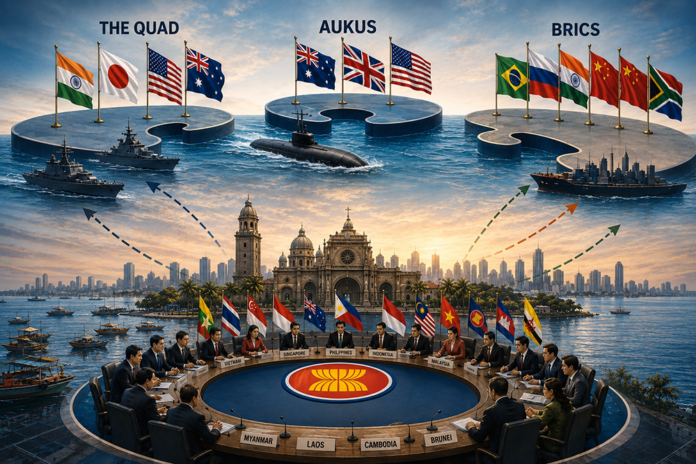
For three days in late July, the Philippine capital did something that no rival institution in the Indo-Pacific can consistently pull off: bringing the American, Chinese, Russian, Indian, and European foreign ministers under one roof, and holding talks. The 59th ASEAN Foreign Ministers’ Meeting, held while the bloc celebrated 50 years of its Treaty of Amity and Cooperation, rolled out something like 120 bilateral conversations on the side. Marco Rubio and Wang Yi met to help stabilise the world’s most consequential rivalry, ahead of the planned Trump-Xi summit. Meanwhile, the Quad came back together on ASEAN’s own ground and, in a pretty telling move, they again underscored ‘ASEAN centrality’ as their guiding compass. When serious diplomacy is required, the region still books Manila.
For much of the past decade, this was considered to be impossible. The rise of the Quad, the AUKUS submarine pact and an expanding BRICS encouraged claims that nimbler, harder-edged coalitions have overtaken ASEAN’s slow, consensus-bound diplomacy. Manila suggests the opposite, but not for the reason ASEAN’s admirers usually give. The bloc has not ‘reclaimed’ strategic primacy, because it never held it. What it holds is something rarer and, in a fracturing order, far more valuable: convening authority.

The distinction matters. Strategic power in Asia is increasingly organised outside ASEAN, in the Quad’s technology and maritime-security agenda, in AUKUS, in the US-Japan-Korea and US-Japan-Philippines trilaterals, in bilateral defence treaties and export-control regimes. ASEAN commands none of that hardware. What it offers, instead, is like the only real inclusive chamber in the region. A forum that comes without an ideological test, doesn’t ask for alignment, and puts treaty partners beside strategic rivals. Nobody else usually brings Washington, Beijing, Moscow, New Delhi, Tokyo, Canberra, Seoul, Brussels and 11 Southeast Asian capitals together at one table in the same way. This legitimacy can’t really be conjured up on cue; it can’t be made overnight. It was formed patiently since 1967, and that’s exactly what makes ASEAN indispensable to powers who, more or less, agree on almost nothing else.
External Affairs Minister S Jaishankar used Manila to run a compressed tour of Indian strategy: reconvening the Quad, steadying ties with China’s Wang Yi, and reviewing the long-standing partnership with Russia’s Sergei Lavrov, while pushing cooperation with the US on critical minerals, defence and AI. It all happened in just two days
Honesty requires admitting what this centrality is not. It is not the ability to solve problems. Myanmar remains a running indictment of the bloc’s Five-Point Consensus, which its own generals openly ignore. The South China Sea Code of Conduct, negotiated for more than two decades, remains unfinished while Chinese and Philippine vessels collide in contested waters. Consensus, ASEAN’s source of legitimacy, is also its instrument of paralysis: a single member with close ties to Beijing can dilute any communiqué, and often has. To call Manila a ‘reclaiming’ of centrality flatters the bloc. The more accurate reading is that the limits of the exclusive minilateral clubs have grown clearer, and ASEAN’s peculiar value has come back into focus by contrast.
The right metaphor is not driver but the air traffic controller. Asia’s order is no longer just one contest where a single institution wins, and it’s done; it stops working like that because it has become layered. In this setup, different bodies do different jobs, and some of them do similar things but in their own way. The Quad coordinates strategy; AUKUS builds capability; BRICS and the Shanghai Cooperation Organisation service Global South and Eurasian outreach, while the CPTPP and IPEF handle trade and economic resilience. Meanwhile, ASEAN keeps the channels open, quietly steady. Read in that way, ASEAN isn’t really being replaced by newer groupings; it’s more like it’s still there, just not starring alone. It is the layer that allows the others to coexist without the region splitting cleanly into blocs.
New Delhi treats ASEAN centrality like an article of faith, not out of pure sentiment. More like, because an inclusive architecture serves its interests: it keeps every major power engaged, without forcing smaller states, or even India itself, to pick a camp. And with 2026 set as the ASEAN-India Year of Maritime Cooperation, that logic has only thickened further
Where the Manila optimists, and the original telling of this story, fall short is in treating the agenda as though it were still mostly about territory. It isn’t. The most consequential contest in the Indo-Pacific seems to be moving away from the big maritime lines and into the plumbing of the modern economy: semiconductor supply chains, critical minerals, undersea cables, payment systems, sanctions architecture, financial- intelligence flows, and the governance of artificial intelligence. The disruption of shipping through the Strait of Hormuz after the war on Iran, which sparked fuel shortages and price spikes across Southeast Asia, was a reminder that energy and trade choke points now feed into security as directly as any naval standoff. Economic statecraft, coercion through tariffs, export controls, and financial exclusion, has become the region’s dominant means of projecting power.

This is the real test of ASEAN’s relevance, and it is harder than hosting ministers. Getting rivals to talk about freedom of navigation is one task, sure; making shared standards for AI, cross-border information flows, digital payments and supply chain resilience across states with wildly different abilities, with China as their biggest trade partner, is a whole other thing. The bloc has started doing this, bundling cybersecurity, digital connectivity, and AI oversight into its discussions, not just in a theoretical way but also in practical terms. Whether its consensus model can produce anything binding in these domains, or whether, here too, it will generate cautious language and little enforcement, will determine if its centrality is substantive or merely ceremonial in the decade ahead.
In an era of fragmentation and low trust, an institution that can keep rivals in the same room without expecting they all agree is not just a boring bureaucratic ritual. It is supplying a strategic public good. ASEAN’s task now is to prove it can convene not merely over the disputes of the last century, but over the economic and technological contests that will define the next
For India, none of this is abstract. External Affairs Minister S Jaishankar used Manila to run a compressed tour of Indian strategy. He did it, reconvening the Quad, steadying ties with China’s Wang Yi, and reviewing the long partnership with Russia’s Sergei Lavrov, while also pushing cooperation with the United States on critical minerals, defence and AI. It all happened in just two days, which is why people are calling it a quick swing.

New Delhi treats ASEAN centrality like an article of faith, not out of pure sentiment. More like, because an inclusive architecture serves its interests: it keeps every major power engaged, without forcing smaller states, or even India itself, to pick a camp. And with 2026 set as the ASEAN-India Year of Maritime Cooperation, that logic has only thickened further.
The irony of Indo-Pacific geopolitics is therefore sharp. ASEAN no longer really sits at the strategic centre of a region where the military and tech balances are decided somewhere else. Still, whenever tension spikes, like in the South China Sea, near the Taiwan Strait, in Myanmar, or even around the Gulf, the key players come back to its table. In an era that seems defined by fragmentation and low trust, an institution that can keep rivals in the same room without expecting they all agree – well, that is not just doing some boring bureaucratic ritual. It is supplying a strategic public good. ASEAN’s task now is to prove it can convene not merely over the disputes of the last century, but over the economic and technological contests that will define the next.

The writer is an expert on geopolitics, national security, and counter-terrorism; and he regularly contributes his subject thought-leadership and academic commentary with several publications in newspapers, journals, and periodicals. He works with investigative agencies, regulatory bodies, financial institutions and enterprises, providing strategic and regulatory advisory. The views expressed are personal and do not necessarily carry the views of Raksha Anirveda





