


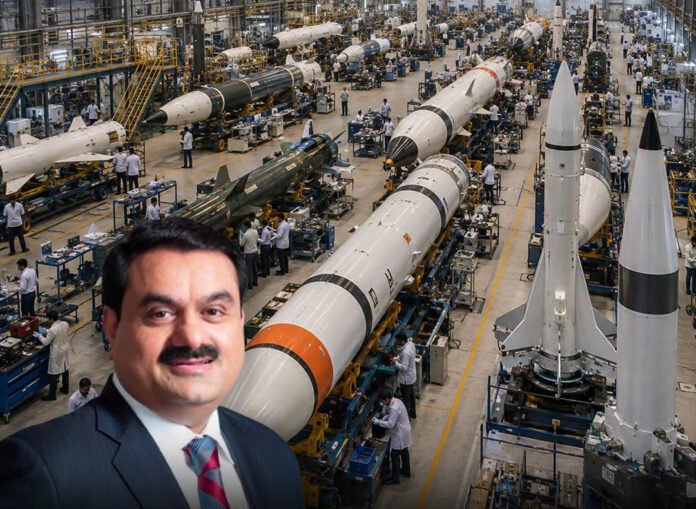
NEW DELHI. Marking a historic departure from decades of strict state-run monopolies, the Government of India has decided to open up its strategic missile manufacturing sector to domestic private companies. The paradigm-shifting move is aimed at building massive wartime industrial capacity and meeting a surging global demand for Indian defence hardware among friendly foreign nations.
According to defence ministry sources, the government will soon float a Request for Proposal (RFP) inviting leading private defence conglomerates to participate in the manufacturing of the Astra Mark 2, a highly advanced Beyond-Visual-Range (BVR) air-to-air missile.

Overburdened State Infrastructure Drives Reform
Historically, missile production in India has been the exclusive domain of Defence Public Sector Undertakings (DPSUs), specifically Bharat Dynamics Limited (BDL). However, recent geopolitical flare-ups have triggered an unprecedented surge in domestic requirements and export orders, pushing state-owned manufacturing facilities to their absolute limits.
The immediate catalyst for this policy overhaul is a profound spike in international interest. India recently secured major defence export breakthroughs in Southeast Asia, culminating in a historic $630 million agreement with Indonesia for BrahMos supersonic cruise missiles and Astra air-to-air weapons systems. With BDL fully committed to fulfilling baseline orders for the Indian Armed Forces, the state infrastructure lacks the surplus bandwidth required to execute high-volume export timelines, making private-sector integration a structural necessity.
Astra Mark 2: The First Off the Blocks
Developed by the state-run Defence Research and Development Organisation (DRDO), the Astra Mark 2 is a lethal, next-generation aerial weapon with a strike range of 180 to 200 kilometres. The missile is powered by an indigenous dual-pulse solid rocket motor and features an advanced Active Electronically Scanned Array (AESA) radar seeker engineered to bypass heavy electronic warfare jamming.
Major corporate giants and defence conglomerates, including the Tata Group, Adani Defence, Mahindra Group, Bharat Forge and ICOMM, are expected to aggressively bid for the production rights. The Astra Mark 2 is slated for rapid integration across the Indian Air Force and Navy’s frontline combat fleets, including the indigenous LCA Tejas Mark 1-A, Sukhoi Su-30 MKI, MiG-29 and the naval Rafale Marine fighters.

The Aatmanirbhar Push: Domestic enterprises now secure over 80 per cent of India’s defence procurement by value. This policy advances private firms from component suppliers to complete system integrators.
Following the initial rollout of the Astra Mark 2, the Ministry of Defence plans to expand private participation to surface-to-surface weapon systems. The next asset slated for private manufacturing is Pralay, a 500-kilometre-range, highly manoeuverable tactical ballistic missile deployed by the Indian Army for theatre-level operational strikes.

A Global Shift Toward “Industrial-Scale” Readiness
Military planners emphasise that this structural reform is heavily informed by modern, attritional conflicts like the Russia-Ukraine war, which have demonstrated that cutting-edge military platforms are useless without deep, rapidly replenishable stockpiles of precision-guided ammunition.
Concurrently, regional security dynamics – such as Pakistan’s recent modernisation of its rocket forces and China’s proliferation of the PL-15 E long-range missile – have underscored the urgency of establishing an agile defence supply network.
By decentralising production across public defence labs, massive private conglomerates and specialised micro-enterprises, India seeks to establish a highly resilient, wartime-ready industrial base. The strategy will not only safeguard domestic airspace but firmly position New Delhi as a reliable, high-tech defence exporter in the evolving Indo-Pacific strategic order.






