


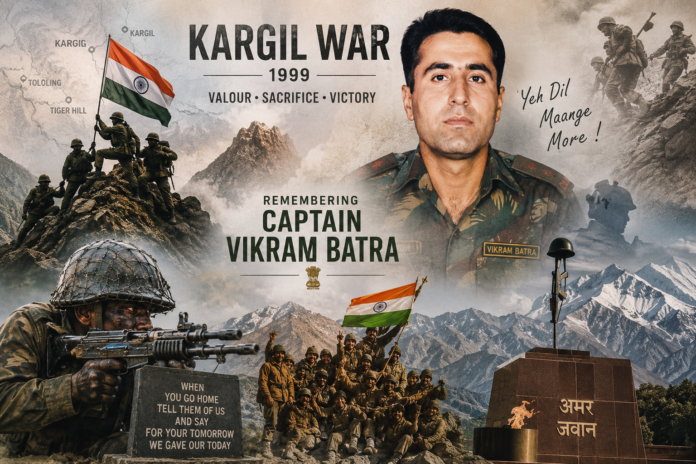
Every generation of soldiers seems to inherit a handful of names, the kind of which stop being just people and start acting like measuring sticks. In the Indian Army, Captain Vikram Batra is one of those. More than two decades after he fell on the ridgelines of Kargil, his name keeps showing up in officers mess conversations, in training academy lectures and even in the private arithmetic of young lieutenants, wondering if they would have the nerve to do what he did. Still, when you look closer and closer, it gets clearer that Batra’s legacy isn’t really about raw nerve. It’s about judgment, and also that discipline which made his courage count, not just look impressive.
Captain Vikram Batra was born in Palampur, HP, in September 1974, commissioned into the 13th Battalion of the Jammu and Kashmir Rifles, and he went to war under the call sign “Sher Shah”. That name, the Lion, has since acquired a mythic weight, but in the summer of 1999, it belonged to a company commander doing an ordinary officer’s extraordinary job, i.e. taking peaks that the enemy had every geographic and tactical reason to hold.

The engagement that made him famous, the capture of Point 5140, is usually remembered for the radio message that followed it. It should be remembered first for the decision that preceded it. Conventional wisdom holds that uphill assaults against dug-in defenders happen under cover of darkness. Batra chose to attack in broad daylight, in the middle of the afternoon, up near-vertical rock, into machine-gun fire from superior elevation.
Captain Batra’s famous daylight assault on Point 5140 defied conventional military wisdom. By attacking up near-vertical cliffs in broad daylight, he inverted enemy expectations, using speed, shock and tactical judgment to save lives rather than risk them needlessly
This was not a death wish. It was a calculated inversion of the enemy’s expectations, meaning, speed and shock deployed against defenders braced for a night attack. He scaled the cliff faster than his adversaries could adjust their sights to. That is not recklessness. That is a junior leader reading the geometry of a battlefield and betting, correctly, that audacity would cost fewer lives than caution.
Then came the four words. “Yeh Dil Maange More”. A nation heard a battle cry; his battalion headquarters heard something more precise. It was a situation report. Translated out of its poetry, it said: objective secured, unit intact, morale high, ready for the next task. This is the detail officers should sit with.
The most quoted sentence from the Kargil War was, at its core, kind of an act of professional communication, clear, disciplined and quite tuned to keep the offensive momentum alive, right when a pause would have let the enemy regroup. Batra understood that in mountain fighting, momentum is a weapon by itself, not just some feeling, and that a leader’s voice on the radio can actually carry it forward, no delays.

What he did next is the part that resists easy heroism. At Point 4875, running a high fever and physically depleted, ordered by his commanding officer to stay back, he insisted on leading the assault anyway. And in its final moments, already wounded, he moved forward to pull an injured junior officer clear of enemy fire, and was killed doing so.
It is tempting to file this under pure self-sacrifice, and it was that. But it was also colder and more instructive. Batra grasped what happens to a unit when it watches its leader prioritise his own survival: cohesion collapses, and with it the fighting effectiveness needed to actually hold the ground.

Rescuing an injured junior officer at Point 4875 wasn’t just raw emotion – it was a leader reinforcing unit cohesion. Batra knew that a commander who prioritises his own survival, destroys the fighting morale needed to hold the ground
He traded his life not in a haze of emotion but in a hard, lucid calculation about what would keep his men in the fight. The armed forces have a phrase for the principle he was honouring, that leaders never abandon their people. He obeyed it to the last breath.
This is why reducing Batra to a symbol of fearlessness does him a disservice. Fearlessness is common and kind of cheap, disciplined courage is rare and expensive. His valour did not just live in the spotlight, it sat on a groundwork most admirers quietly skip, viz. training, terrain study, those fire-and-movement drills, and the physical conditioning that let bravery become captured objectives instead of wasted lives.
Underneath all that flamboyance, it was professionalism, not some spontaneous temperament thing. The lesson is uncomfortable, for anyone who thinks heroism is just a personality trait and nothing else. Heroism, in Batra’s case, was the visible tip of years of unglamorous competence.
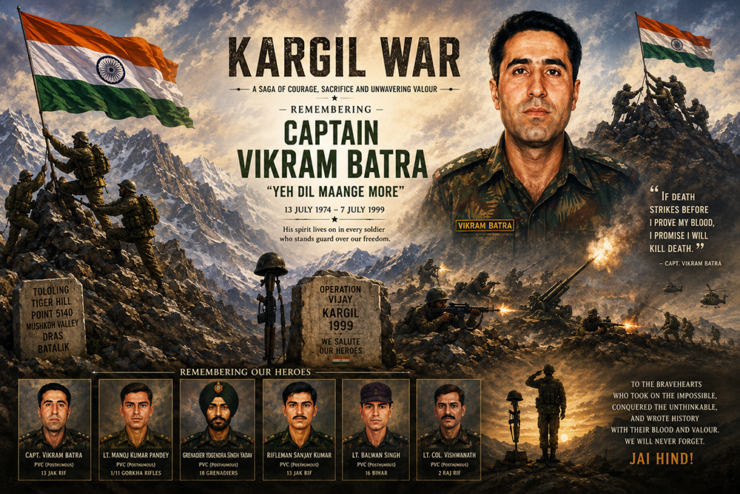
So, what should the next generation of officers actually learn from him? Not the manner of his death, which no one should aspire to. But they should study the architecture of his leadership. Authority comes with rank, but influence has to be earned: his men followed him because they trusted his judgment, not because his shoulder carried a captain’s stars.
Leading from the front, is less about always being first into danger and more about never asking a soldier to swallow a risk that you yourself would not. The whole thing is initiative, it wins battles because the terrain shifts faster than orders can, and an officer who waits around to be told loses the edge.
Batra’s soldiers followed him because they trusted his military judgment, not just his stars. He demonstrated that authority is granted by rank, but genuine leadership requires never asking a soldier to take a risk you wouldn’t take yourself
That kind of optimism, in a leader, isn’t some charming personality thing, it is more like operational capability a force multiplier, which keeps panic from running the show amongst frightened men. Further, mission and men are not competing loyalties; caring for your soldiers is often precisely how the mission gets accomplished.
Captain Batra’s character has since been distilled into a tidy acronym, Belief, Accountability, Tactical competence, Resilience, Altruistic service, and the framework is useful for a cadet’s notebook.
But frameworks risk sanding down the paradox, that made him worth studying in the first place. He was this flamboyant extrovert who fought like a ruthless pragmatist, a man who hollered for more then gave everything he had. He wanted the next summit, the next fight, the next unthinkable thing and that same hunger is what made his last moment of restraint, turning back for an injured man, so devastating.
The measure of an officer, in the end, is not the confidence he has in himself but the confidence his soldiers place in his judgment. Captain Batra earned that in full, and he spent it well.
That is the inheritance he left to everyone who now wears the uniform, a proof that the men who want “More” are precisely the ones who must learn when to give everything they have. His country awarded him the Param Vir Chakra for the way he died. His profession should study him for the way he lived and led.
The writer is an expert on geopolitics, national security, and counter-terrorism; and he regularly contributes his subject thought-leadership and academic commentary with several publications in newspapers, journals, and periodicals. He works with investigative agencies, regulatory bodies, financial institutions and enterprises, providing strategic and regulatory advisory. The views expressed are personal and do not necessarily carry the views of Raksha Anirveda





