


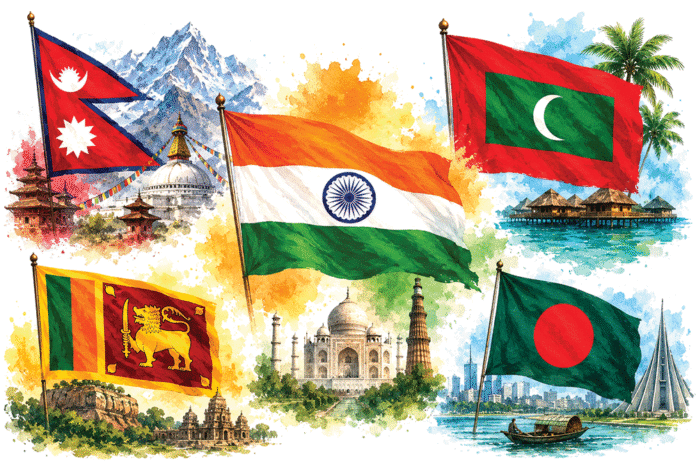
India is actively recalibrating its neighbourhood diplomacy to manage significant political upheavals and generational shifts in Nepal, Bangladesh, Sri Lanka, and the Maldives. The policy has shifted from merely fixing problems to actively building infrastructure and trade links such as faster roads, ports and energy grids so that its smaller neighbours see clear benefits in staying close. This reinvigoration involves balancing security concerns with economic diplomacy, aiming to transform traditional patronage into partnership.
Supporting proactive regionalism, India is now acting as a first responder and regional systems integrator, using tools like UPI and energy grids (cross-border electricity trade) to connect economies.

India is also building maritime trust by stationing personnel from neighbouring countries on Indian naval vessels, exemplified by the INSV Kaundinya, deployed under the IOS Sagar initiative, and enhanced maritime joint exercises in the Indian Ocean. India is prioritising regional stability and border security over strict governance norms.
Situation in Northeast India
In the Northeast, new peace deals with rebel groups and better border markets have reduced insurgency, making the region a bridge to Southeast Asia rather than a troubled frontier. The Ministry of Home Affairs applies a dual strategy: implementing counter-insurgency measures alongside the Armed Forces Special Powers Act (AFSPA), while simultaneously pursuing peace accords with any rebel groups willing to drop weapons and hold dialogues under the Indian Constitution.
India is actively recalibrating its neighbourhood diplomacy to manage significant political upheavals and generational shifts in Nepal, Bangladesh, Sri Lanka and the Maldives
Historically, the political and security landscape of the Northeast has been a complex matrix of ethnic, historic border friction, and lingering insurgencies. While states like Mizoram and Tripura have now successfully transitioned to sustained peace and normal governance, 40 per cent of Assam and 50 per cent of Nagaland continue to manage active local factions. Manipur faces the steepest hurdles, with nearly 60 per cent of the state heavily affected by deep-rooted ethnic division between valley-dwelling communities and hill tribes. The government is aligning NE’s development with the Act East Policy, strengthening border infrastructure to ensure connectivity with neighbouring countries.
Let us look at recent developments in this context—

Nepal: A New Political Order
Following the massive 2025 ‘Gen Z’ protests that saw the fall of old-guard politicians, Nepal is undergoing a leadership transition toward younger and pragmatic leaders. Balendra Shah from Rastriya Swatantra Party (RSP) was elected as the youngest serving prime minister of Nepal on 27 March 2026. India is adjusting to the new government with calls to re-engage on pending issues like the 1950 Friendship Treaty and air overflight rights for new Nepalese airports.
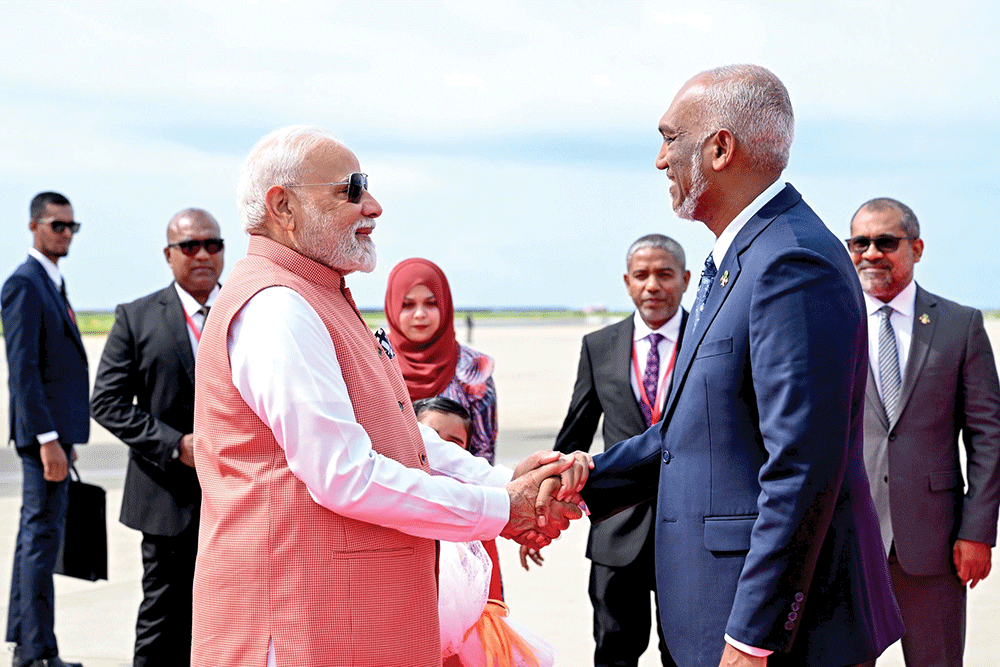
At present, India–Nepal relations are experiencing a pragmatic, cooperation-focused phase prioritising economic partnerships in hydropower, digital connectivity and infrastructure. The existing policy focuses on economic interdependence as a prerequisite for stable relations. Both nations maintain active economic energy and development partnerships, including railway links and integrated check posts.

India remains Nepal’s largest trade, investment, and development partner, with a focus on connectivity projects and long-term energy trading. The government is prioritising economic cooperation through digital connectivity (UPI), hydropower and fintech integration. In early 2026, progress was made on high-capacity transmission lines (e.g., Inaruwa–New Purnea) to enhance power trade.
India–Nepal relations are experiencing fresh tension over border disputes, specifically regarding the Lipulekh pass and the Kailash Mansarovar Yatra route. However, both nations have expressed commitment to resolving these issues through diplomatic channels.
Despite temporary tensions, the relationship remains strong due to the open border and deep cultural ties. India continues to prioritise partnership through “Neighbourhood First” policy, focusing on infrastructure and development.
Sri Lanka: India’s Sagar Bandhu
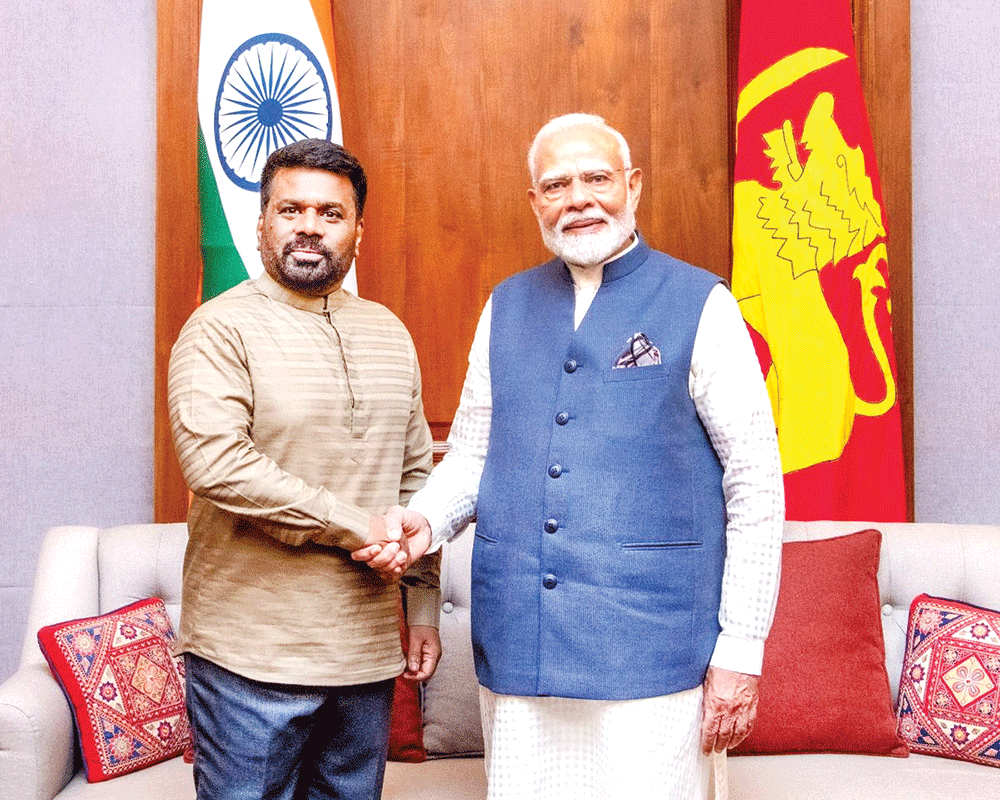
Sri Lanka, after its severe 2022 economic crisis, has tilted toward India for debt relief, energy projects, besides strategic and economic support. India has strengthened its role as a trusted partner, assisting with financial, energy, and developmental aid.
In the November 2024 parliamentary election, the National People’s Power (NPP) won a landslide victory, and Harini Amarasuriya was sworn in as Prime Minister.
India-Sri Lanka relations are currently strong and characterised by high-level economic integration and security cooperation. India has played a crucial role in providing nearly USD 4 billion in emergency aid during Sri Lanka’s 2022 economic crisis, extending significant economic and financial support.
Defence ties between India and Sri Lanka are focused on maritime security with the Colombo Security Conclave acting as a key mechanism. India provides significant training to Sri Lankan forces and acts as the “first responder” for security challenges, facilitating maritime surveillance through aircraft and supporting port developments.
Efforts for trade expansion between the two nations are being accelerated and negotiations are active on the Economic and Technology Cooperation Agreement (ETCA) to upgrade the existing Free Trade Agreement (FTA). India is one of Sri Lanka’s largest trading partners and investors with bilateral trade reaching approximately USD 5.5 billion in 2023-24.
Energy ties between India and Sri Lanka are strengthening, focusing on regional integration, renewable energy, and infrastructure. Key initiatives include renewable energy projects in Sampur, potential oil/LNG pipelines, power grid connectivity, and developing the Trincomalee oil tank farm as a regional energy hub.
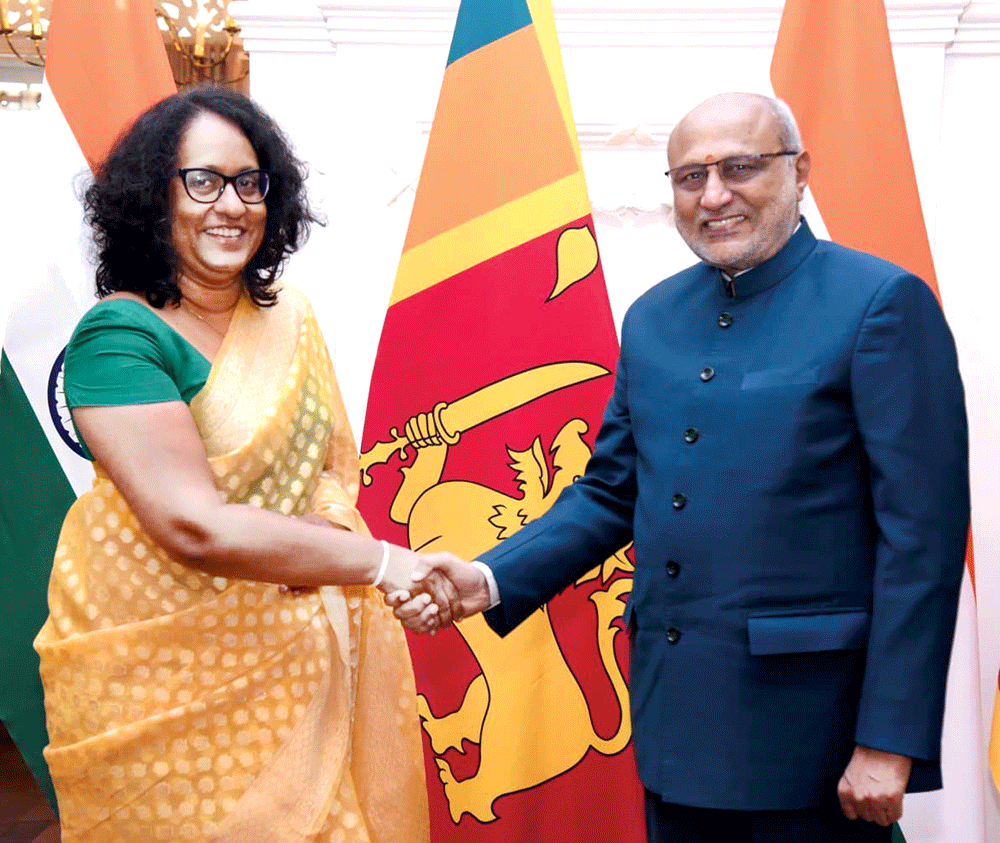
India is Sri Lanka’s largest tourist source market (~20–22 per cent of total, with over 5.3 lakh arrivals by mid-2025). Connectivity is advancing through resumed flights (Chennai-Jaffna) and passenger ferries (Nagapattinam–Kankesanthurai).
Maldives: Maritime Security Focus
The Maldives saw a pro-China President Mohamed Muizzu from People’s National Congress (PNC) elected in 2023, briefly straining ties, but India responded with quick financial aid and strategic patrols, offering a $565 million (approx. ₹4,850 crore) line of credit for infrastructure development and reducing previous debt-repayment obligations, showing it won’t cede influence easily.
The “India Out” sentiment and the demand to remove Indian military personnel were resolved by replacing them with civilian technical professionals by mid-2024. The Muizzu administration has shifted from a pro-China stance to a more balanced approach, recognising India as a crucial developmental and security partner. India has solidified this partnership by gifting surveillance assets, funding ship refits, and conducting joint military exercises to bolster security in the Indian Ocean.
India-Maldives relations have undergone a significant reset and warming, transitioning from intense diplomatic friction to a robust partnership under President Muizzu. This shift is marked by high-level visits, economic assistance and renewed cooperation in infrastructure and maritime security.
India continues to play a central role, with the Greater Malé Connectivity Project and other projects moving forward. Cooperation in maritime security (patrols, surveillance) remains a priority.
India’s neighbourhood policy and its Northeast strategy are deeply interconnected, as stability, connectivity and development in the NE directly strengthen India’s ability to engage effectively with its eastern neighbours
Tourism between India and the Maldives is undergoing a recovery phase in 2026, aimed at restoring India as a top source market after a significant dip in 2024 to 1.3 lakh tourists, down from over 2 lakhs in 2023. The Maldivian government is actively hosting roadshows in Indian cities, promoting tourism, and leveraging flights from carriers like Maldivian to boost numbers. An open skies agreement exists, with airlines like Maldivian operating flights to Kochi and Thiruvananthapuram and plans to expand to other cities. The Maldives Association of Travel Agents and Tour Operators (MATATO) and resorts are aggressively targeting Indian travellers with tailored and experiential luxury packages.
Bangladesh: Vital for Regional Security
The Bangladesh Nationalist Party (BNP) has returned to power amid ongoing tensions between Islamist factions and New Delhi. Tarique Rahman from BNP became the Prime Minister of Bangladesh on 17 February 2026. Soon after the swearing in of the new government, India moved quickly to recognise the new political reality.
New Delhi sent a high-level delegation including Lok Sabha Speaker Om Birla and Foreign Secretary Vikram Misri, to participate in the swearing-in ceremony. In turn, less than a week after the BNP-led government took charge, Bangladesh’s newly appointed Directorate General of Forces Intelligence (DGFI) Maj. Gen. Mohammad Kaiser Rashid Chowdhury made a trip to New Delhi.
Both sides have started restoring visa services since the BNP took office in Dhaka. While Bangladesh recommenced full-scale visa services at its missions in India on February 24, India indicated that it would soon resume various categories of visas for Bangladeshis in phases, including medical, tourist, and student visas.
India’s approach focuses on long-term structural interdependence, including enhancing cross-border connectivity and energy cooperation, rather than relying solely on political alliances, to ensure stability on its eastern border. In March 2026, India supplied around 5,000 tonnes of diesel to Bangladesh via the Bangladesh–India Friendship Pipeline as part of an agreement under which New Delhi supplies approximately 180,000 tonnes each year from the Numaligarh refinery in its Northeast. Bangladesh has become a key partner with India investing in its ports and power plants to counter China’s influence, jointly managing river waters and border security.
Economic links between the two countries are showing signs of revival. Export growth is particularly strong in footwear (43 per cent), fish (42 per cent), and ready-made garments (17.38 per cent). Bangladesh continues to import roughly $9 billion worth of goods annually from India, underscoring the scale of cross-border supply chains despite the broader political tensions.
The reopening of diplomatic and intelligence contacts indicates that both Dhaka and New Delhi recognise that prolonged tension in their relationship is simply not an option. Despite some disagreements, the two countries remain closely linked through security concerns, trade, and geography.
Takeaways
India’s neighbourhood policy and its Northeast strategy are deeply interconnected, as stability, connectivity and development in the Northeast directly strengthen India’s ability to engage effectively with its eastern neighbours.
The coming months will show whether the momentum observed in the first part of 2026 can be sustained and whether India will be able to transform tactical achievements into a stable regional order
The Union government is showing active engagement with “new-generation” leaders and the focus is on engaging new governments based on shared interests and equality rather than historical ties. Recent developments indicate that India’s neighbourhood policy is entering a new stage. The previous focus on the concept of Neighbourhood First is shifting to a more proactive approach that can be termed Neighbourhood Shaping.
Despite these efforts, India faces significant headwinds in 2026, including the influence of external actors like China, persistent boundary disputes, and the need to manage internal volatility in neighbouring countries. The neighbourhood is, in most respects, the most challenging area of India’s foreign policy. The coming months will show whether the momentum observed in the first part of 2026 can be sustained and whether India will be able to transform tactical achievements into a stable regional order.

The author retired as a Senior Technical Officer at the Central Salt and Marine Chemicals Research Institute, Bhavnagar (Gujarat), and currently contributes articles to research journals and magazines. The views expressed are personal and do not necessarily carry the views of Raksha Anirveda.





