


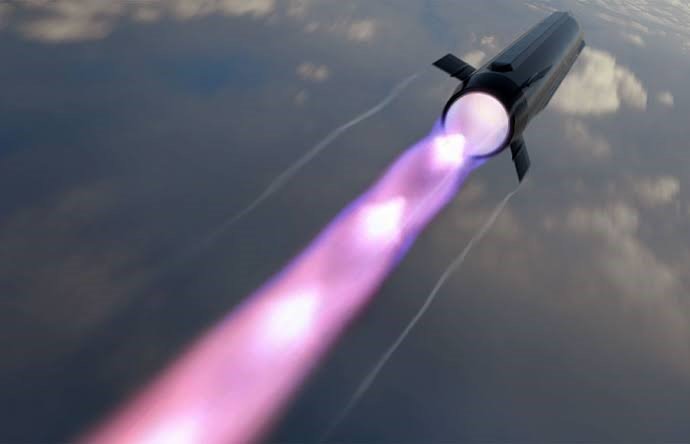
In a major advancement for high-speed missile technology, Kratos Defense & Security Solutions announced the delivery of a critical turbo-machinery sub-system designed to power Lockheed Martin’s next-generation ramjet propulsion architecture. The delivery follows comprehensive ground testing that confirmed the integrated propulsion system is ready to advance into active flight testing and near-term operational fielding.
Engineering High-Speed Efficiency
Ramjets are air-breathing jet engines that rely on a missile’s forward momentum to compress incoming air for combustion, eliminating the bulky rotating compressor assemblies found in conventional turbojets. While this architecture enables sustained supersonic and hypersonic flight, high-speed tactical missiles still require reliable onboard energy to operate internal guidance systems, flight control actuators and thermal management loops.

To solve this challenge without adding unnecessary mass, Kratos engineered a compact, self-regulating turbo-machinery unit. The specialised component harnesses kinetic energy directly from incoming ram air, converting airflow into usable mechanical and electrical power during flight. By replacing traditional auxiliary batteries and mechanical power sources, the unit delivers significant size, weight, power and cost (SWaP-C) savings, freeing up internal volume for larger warheads or extra fuel capacity.
Rigorous Validation and Joint Testing
Development of the turbomachinery followed a strict, multi-stage testing campaign. Kratos first conducted standalone ground evaluations to verify the hardware’s structural integrity, fluid dynamics and operational performance across extreme simulated airflow conditions.
Following standalone verification, the turbomachinery was integrated directly into Lockheed Martin’s complete ramjet engine assembly. Subsequent full-system ground testing was observed by representatives from both Lockheed Martin and the US Army Aviation and Missile Centre, who confirmed that the propulsion core met all operational thresholds.
“Our philosophy is to collaborate with industry leaders who share our mission of delivering cutting-edge technologies and capabilities to market quickly and cost-effectively,” stated Stacey Rock, President of Kratos Turbine Technologies. “This opportunity with Lockheed Martin has been highly successful and represents a cornerstone of our long-term strategic initiatives”, he further added.

Strengthening National Defence Manufacturing
The successful test marks a crucial milestone for military services seeking to modernise standoff strike capabilities. Ramjet-powered weapons offer higher sustained cruise speeds and significantly longer ranges than traditional solid-fuel rocket motors, giving military commanders a decisive tactical edge in contested operational environments.
The project aligns with Kratos’s broader initiative to treat affordability as a strategic technology. By prioritising domestic supply chains, vertically integrated prototyping and design-for-manufacturability, Kratos aims to ensure that advanced propulsion systems can be mass-produced rapidly to replenish missile stockpiles and meet growing global national security requirements. With ground validation complete, joint teams are preparing for full-scale flight demonstrations that will bring the advanced ramjet platform closer to active deployment.







