


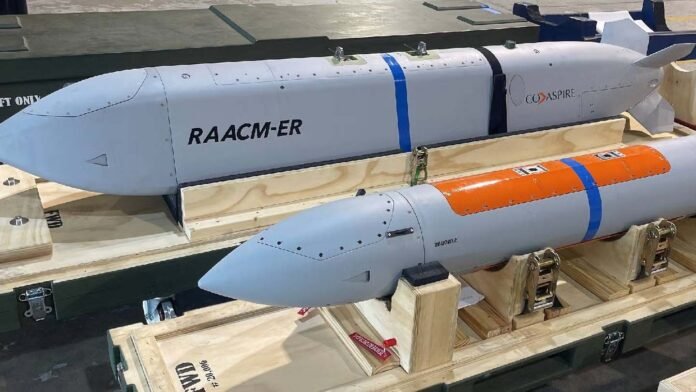
WASHINGTON. The United States Navy has awarded Virginia-based defence contractor CoAspire a $70 million agreement to develop a ground-launched, mid-range cruise missile aimed at equipping allied forces with low-cost maritime strike capabilities.
The deal, structured as a Prototype Other Transaction Agreement (OTA) via CMG Networks on behalf of the Naval Aviation Systems Consortium, tasks CoAspire with designing, testing and delivering the missile system to the Navy’s Programme Executive Office for Munitions (PMX-201). The initiative forms the core of the Navy’s new Coalition Heterogeneous Affordable Offensive Strike (CHAOS) programme, which is designed to supply allied and coalition nations with scalable anti-ship and land-attack munitions via Foreign Military Sales (FMS).

Under the CHAOS programme, CoAspire will deliver a ground-launched variant of its Rapidly Adaptable Affordable Cruise Missile-Extended Range (RAACM-ER). The system integrates the RAACM-ER airframe with a dedicated rocket booster and ground launcher, creating a mobile platform capable of engaging both fixed land targets and moving vessels at sea. The design builds upon the technology architecture of the company’s GHOST variant, which was previously selected for the US Army’s Low-Cost Containerised Munition (LCCM) initiative.
A central feature of the RAACM family is its reliance on advanced additive manufacturing (3D printing) for major structural components. By leveraging 3D printing, CoAspire aims to streamline assembly, reduce touch labour and maximise interior volume for fuel and warhead payloads. The process allows the company to adjust weapon configurations or develop new sub-variants in months rather than years, circumventing lengthy re-tooling phases that traditional aerospace manufacturing lines require.
The CHAOS initiative reflects a broader shift in military procurement toward “affordable mass” – building high-volume inventories of mid-range precision weapons that can complement exquisite, high-cost munitions. By integrating commercial off-the-shelf components alongside a distributed network of tier-one suppliers across the United States, the programme aims to mitigate single-source supply chain bottlenecks and accelerate production rate capacity.
Equipped with GPS-assisted navigation and passive infrared seekers, the RAACM-ER design allows ground units to strike mobile naval targets without relying on active radar signals that could alert threat defences. With the ground-launched configuration, coalition forces gain extended-range strike coverage without requiring aircraft certification or specialised naval vessels.

Following prototype delivery, the system will undergo flight testing and target integration assessments to evaluate performance, production scalability and deployment readiness for partner militaries.






