



The Paradox of Reform
Every society believes in reform—until reform demands change before a crisis.
History tells a curious story. Nations rarely reform because they are wise; they reform because they are cornered. The recent calls for educational reform following student protests remind us that this pattern is still very much alive. Institutions often wait for public pressure before confronting problems that have been quietly accumulating for years. Wars reshape militaries, financial collapses rewrite economic policies, public outrage transforms laws, and institutional failures force governments to act. Reform, more often than not, arrives as a response to pain rather than an expression of foresight.

This crisis-driven approach comes at a heavy price. By the time reform begins, public trust has eroded, opportunities have been lost, and the economic and social costs have multiplied. What could have been corrected through timely adjustment often ends up requiring painful reconstruction.
A confident nation should not wait for failure to validate the need for change. Just as successful businesses innovate before competitors overtake them and healthy individuals undergo preventive medical check-ups, institutions too must renew themselves before they become liabilities. The measure of national maturity is not how effectively it recovers from crises, but how successfully it prevents them.
The best reforms are those that make crises unnecessary.
When Should Institutions Reform?
Institutions should evolve because society evolves.

The world today changes faster than at any other time in history. Artificial intelligence is redefining work, demographics are altering social priorities, climate change is reshaping development, and citizens expect governments to be faster, more transparent and more accountable than ever before. Yet many institutions continue to function with assumptions, procedures and laws designed for another era.
Institutional decay is rarely dramatic in its beginning. It starts quietly, with a delayed file, an outdated regulation, an unnecessary approval, a vacant post, a conflicting rule, or a process that no longer serves its purpose. These small inefficiencies appear harmless in isolation, but together they create friction
Reform, therefore, should never be hostage to political upheaval or public unrest. It should become a periodic exercise triggered by measurable changes in technology, economics, national security, demographics and citizen expectations. Waiting for a crisis before reviewing institutions is like servicing an aircraft only after it develops engine trouble.

The strongest institutions are not those that resist change. They are the ones that adapt without losing their core purpose. Continuity of values must coexist with flexibility of systems. Governance should treat reform as preventive maintenance rather than emergency repair.
Institutions should evolve because society evolves.
Anatomy of Institutional Decline
No institution collapses overnight; it declines one unnoticed friction at a time.
Institutional decay is rarely dramatic in its beginning. It starts quietly—with a delayed file, an outdated regulation, an unnecessary approval, a vacant post, a conflicting rule, or a process that no longer serves its purpose. These small inefficiencies appear harmless in isolation, but together they create friction.
Unchecked friction gradually produces dysfunction. Decisions slow down, costs rise, accountability weakens, and innovation becomes difficult. As performance declines, public confidence begins to erode. Distrust replaces credibility, and citizens start seeking alternatives outside the system. If this cycle continues unchecked, breakdown becomes inevitable—not always through spectacular collapse, but through growing irrelevance.
Every great institution in history has faced this cycle. Those that survived did so because they recognised friction early and treated reform as a continuous responsibility rather than an occasional response.
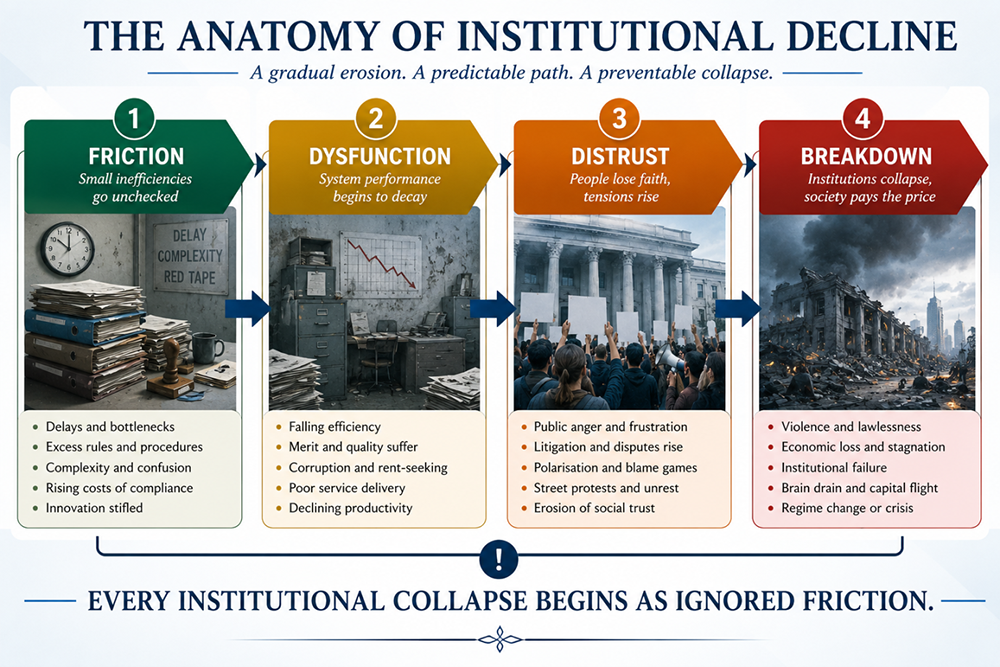
This is why institutional health should be measured not merely by present success, but by its capacity for self-correction. The greatest strength of an institution is not perfection; it is the willingness to renew itself before decline becomes irreversible.
Every institutional collapse begins as ignored friction.
The Doctrine of Continuous Reform
Reform should not be an event in governance; it should be a habit of governance.
If institutional decline follows a predictable pattern, then institutional renewal must follow one too. The Doctrine of Continuous Reform rejects the notion that institutions deserve permanence simply because they have existed for a long time. Instead, it argues that every institution must periodically earn its relevance
If institutional decline follows a predictable pattern, then institutional renewal must follow one too. This calls for a new philosophy of governance—The Doctrine of Continuous Reform. It rejects the notion that institutions deserve permanence simply because they have existed for a long time. Instead, it argues that every institution must periodically earn its relevance.
The doctrine rests on five simple but powerful tests.
- Relevance. Does the institution still serve the purpose for which it was created?
- Justice. Is it fair, inclusive and responsive to contemporary realities?
- Efficiency. Does it deliver outcomes with minimum delay, cost and complexity?
- Adaptability. Can it absorb technological, economic and societal change without losing its core values?
- Accountability. Can its performance be measured, reviewed and corrected transparently?
No institution, law or policy should be exempt from these questions. They are not instruments of criticism; they are instruments of renewal. Institutions that willingly submit themselves to periodic review strengthen public confidence, while those that resist scrutiny slowly lose legitimacy.
Continuous reform does not weaken institutions. It protects them from irrelevance.
Institutions should earn periodic legitimacy.
Institutionalising Reform
Good ideas become national strength only when they become national practice.
A doctrine acquires meaning only when it shapes institutions. Continuous reform should therefore be embedded into the architecture of governance rather than left to the priorities of individual governments.
Every major law, ministry, regulatory body, public enterprise and welfare programme should undergo a structured review every eight to ten years. Such reviews should examine whether objectives remain relevant, whether outcomes justify public expenditure and whether technology or changing circumstances demand a different approach.
An independent National Reform Commission, comprising domain experts and public consultation, could provide continuity across political cycles. Reform would then become a regular feature of governance instead of an emergency response to failure. Nations that review themselves periodically rarely need disruptive corrections
An independent National Reform Commission, supported by domain experts and public consultation, could provide this continuity across political cycles. Reform would then become a regular feature of governance instead of an emergency response to failure. Nations that review themselves periodically rarely need disruptive corrections.
Reform should become a constitutional habit.
The Doctrine for Viksit Bharat
The true value of a doctrine lies not in its elegance but in its application.
India has demonstrated an extraordinary capacity for transformation over the past three decades. Yet the next phase of national development will depend less on creating new institutions and more on renewing existing ones.
The Doctrine of Continuous Reform offers a common framework.
- Governance can become more citizen-centric by simplifying procedures and reducing administrative friction.
- Judicial reforms can focus on speed, accessibility and technology without compromising justice.
- Anti-corruption efforts should redesign systems to minimise discretion and maximise transparency.
- Education must prepare young Indians for an AI-driven and innovation-led economy rather than the needs of the previous century.
- Welfare and affirmative action should continue to advance social justice while being periodically reviewed to ensure that they remain equitable, effective and aligned with contemporary realities.
Every generation inherits institutions built by those before it. Its responsibility is not merely to preserve them, but to leave them stronger, fairer and more relevant for those who follow. Reform is therefore not an admission of past failure; it is an investment in future success
These are not isolated reforms. They are different expressions of the same governing philosophy—that institutions remain strong only when they continue to learn, adapt and improve.
Strong institutions welcome scrutiny because renewal strengthens legitimacy.
The Republic Must Learn to Renew Itself
The greatest strength of a Republic is not its permanence but its capacity for self-renewal.
Every generation inherits institutions built by those before it. Its responsibility is not merely to preserve them, but to leave them stronger, fairer and more relevant for those who follow. Reform is therefore not an admission of past failure; it is an investment in future success.
The nations that lead the twenty-first century will not necessarily be those with the oldest institutions or the largest economies. They will be those that possess the courage to question themselves, the wisdom to adapt and the confidence to reform before circumstances compel them.
History does not reward nations that reform after failure. It remembers those that reformed before it.

Lt Gen Rajeev Chaudhry (Retd) writes on contemporary national and international issues, strategic implications of infrastructure development towards national power, geo-moral dimension of international relations, and leadership nuances in a changing social construct. The views expressed are of the author and do not necessarily reflect the views of Raksha Anirveda





