



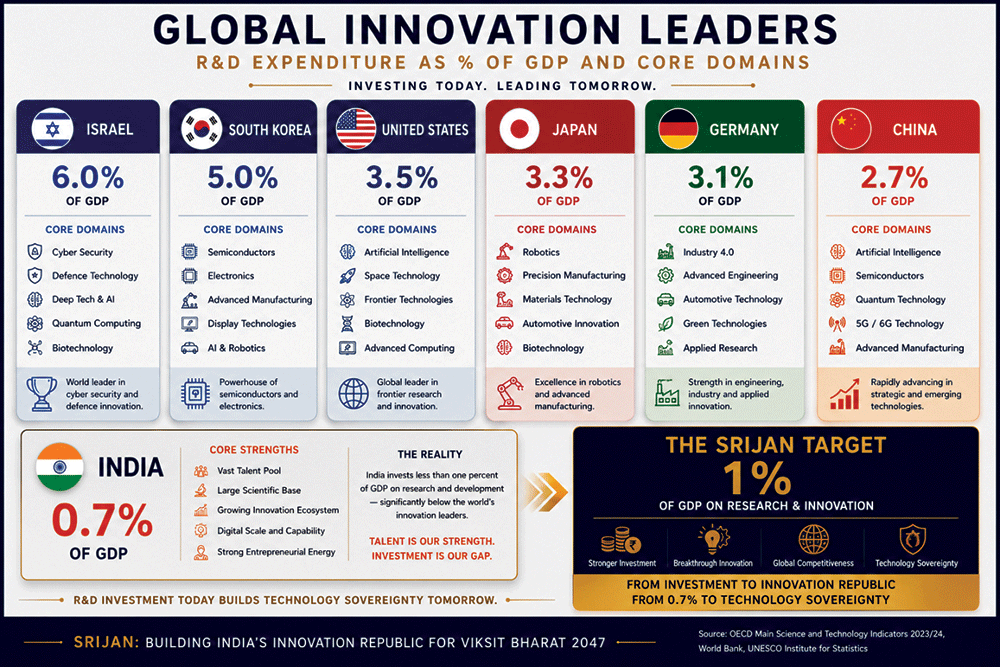
India today stands at a paradoxical moment in its development journey. It is home to one of the world’s largest startup ecosystems, possesses a vast pool of scientific and engineering talent, and has demonstrated remarkable capabilities in sectors ranging from digital public infrastructure to space exploration. Yet, despite these achievements, India’s expenditure on research and development remains below 1% of GDP, significantly lower than many of the world’s leading innovation economies.
This gap is more than a statistical observation. It reflects the defining challenge of the 21st century.

The great powers of the future will not be distinguished merely by the size of their economies, the strength of their militaries, or the scale of their domestic markets. They will be distinguished by their ability to generate, absorb and deploy innovation at scale. Technology has ceased to be a sector of the economy; it has become the operating system of national power.
History offers compelling evidence. Nations that mastered steam power shaped the Industrial Revolution. Those who harnessed electricity transformed manufacturing. Countries that led in nuclear science acquired strategic influence in the 20th century. The digital revolution created new centres of global power. The next era, driven by artificial intelligence, quantum technologies, advanced materials, biotechnology, semiconductors, autonomous systems and space-based capabilities, will be even more consequential.
The contest of the future will not be fought primarily over territory. It will be fought over technological leadership.
For India, therefore, the challenge is no longer innovation adoption. It is innovation leadership. The question is not whether India can use advanced technologies. The question is whether it can create them, scale them and sustain them across generations.

To achieve this, India must move beyond an innovation ecosystem and build an innovation state. It needs a permanent national architecture that aligns funding, institutions, geography and human capital towards a common strategic objective. This paper proposes such a framework through SRIJAN — Strategic Research and Innovation through Janshakti for Aatmanirbhar Nationhood.
Countries that led in nuclear science acquired strategic influence in the 20th century. The digital revolution created new centres of global power. The next era, driven by artificial intelligence, quantum technologies, advanced materials, biotechnology, semiconductors, autonomous systems and space-based capabilities, will be even more consequential
India’s Missing Innovation Architecture
India possesses many of the ingredients required for technological leadership.

It has globally respected educational institutions, a vibrant entrepreneurial culture, an expanding venture capital ecosystem, ambitious national missions, a rapidly digitising economy and one of the youngest populations in the world.
Yet innovation outcomes remain fragmented. Research institutions often operate independently of industry. Startups struggle to transition from prototypes to large-scale deployment. Talent frequently migrates towards established commercial sectors rather than frontier technologies. Funding remains dispersed across multiple programmes and ministries. Innovation clusters continue to be concentrated in a handful of urban centres.
The problem is not a lack of initiatives. The problem is the absence of an integrated architecture. Funding, research, talent and geography function as separate pillars rather than components of a single national mission.
India has successfully built an innovation ecosystem. What it now requires is an innovative architecture capable of sustaining technological leadership over decades. The proposed SRIJAN framework seeks to address this structural gap.

The world’s leading innovation powers consistently devote a significant portion of their GDP towards research and scientific capability creation. China invests nearly four times the share of GDP in R&D that India does, while South Korea invests more than seven times as much.
SRIJAN: A National Mission for Technology Sovereignty
SRIJAN is not conceived as another government scheme. It is envisioned as a national mission designed to transform innovation into an instrument of economic growth, strategic autonomy and national development.
The framework rests upon four mutually reinforcing pillars:
- The 1% Innovation Doctrine.
- National Strategic Technologies Agency.
- National Innovation Districts Network.
- National Innovation Service.
Together, these pillars seek to create the financial, institutional, geographical and human foundations of India’s innovation republic.
Pillar One: The 1% Innovation Doctrine
Every major technological power has made sustained investments in research and development over long periods.
Breakthrough technologies are rarely created through sporadic funding cycles. They emerge from patient capital, institutional continuity and long-term commitment. India should therefore adopt a phased pathway towards allocating 1% of GDP exclusively for research, innovation and strategic technologies by 2047.
Such funding should be protected from annual budget fluctuations and guided by clearly articulated national priorities. This investment would support:
- Frontier scientific research.
- Strategic technology development.
- University-industry collaboration.
- Advanced manufacturing capabilities.
- Deep-tech startups.
- National innovation challenges.
The significance of this proposal lies not merely in the quantum of funding but in the predictability of funding. Innovation cannot flourish in uncertainty.
The world’s leading innovation powers consistently devote a significant portion of their GDP towards research and scientific capability creation. China invests nearly four times the share of GDP in R&D that India does, while South Korea invests more than seven times as much
Just as highways, ports and power networks created India’s physical infrastructure, sustained research investment will create the intellectual infrastructure of the next century.
Pillar Two: National Strategic Technologies Agency
The technologies that will define future prosperity and security often involve high risks, long gestation periods and uncertain commercial returns.
Consequently, private investors frequently avoid them, while conventional bureaucratic systems tend to prioritise procedural caution over experimentation. India requires a dedicated institution capable of bridging this gap.
A National Strategic Technologies Agency should be established with the mandate to identify, fund and accelerate breakthrough technologies critical to national competitiveness and security. Its priority domains could include:
- Artificial Intelligence.
- Quantum Computing.
- Semiconductors.
- Advanced Materials.
- Biotechnology.
- Cybersecurity.
- Space Technologies.
- Autonomous Systems.
- Next-generation Defence Technologies.
The agency must enjoy operational autonomy, attract world-class talent and embrace calculated risk-taking. Its purpose would not be to eliminate failure but to maximise the probability of transformative success.
History demonstrates that technological revolutions are rarely led by institutions that seek certainty. They are led by institutions willing to explore the unknown.
Pillar Three: The National Innovation Districts Network
Innovation thrives where ideas, talent, institutions and capital converge.
India’s innovation geography, however, remains heavily concentrated in a limited number of metropolitan centres. This concentration risks regional imbalance and leaves significant reservoirs of talent underutilised.
SRIJAN proposes creating 50 specialised Innovation Districts across the country. Each district would focus on a strategic technological domain aligned with local strengths and national priorities. Illustratively:
- Bengaluru may deepen its leadership in Artificial Intelligence.
- Hyderabad could specialise in Defence Electronics.
- Pune could focus on Autonomous Mobility Systems.
- Chennai may become a hub for Advanced Manufacturing.
- Ahmedabad could emerge as a Semiconductor Innovation Cluster.
- Guwahati may pioneer Mountain and Climate Technologies.
- Coastal districts could lead the Maritime Innovation.
- Frontier regions could become test beds for high-altitude technologies.
These districts would integrate universities, laboratories, startups, investors, manufacturers and government agencies into cohesive innovation ecosystems. Just as industrial corridors
transformed India’s manufacturing geography, innovation districts must transform India’s technological geography.
Innovation must become a national phenomenon, not a metropolitan privilege.
Pillar Four: National Innovation Service
The most transformative pillar of SRIJAN is the National Innovation Service. India’s greatest strategic asset is its Janshakti.
Every year, the country produces hundreds of thousands of engineers, scientists, technologists, medical researchers and innovators. Yet much of this talent enters narrow professional pathways disconnected from national priorities.
India possesses many of the ingredients required for technological leadership. It has globally respected educational institutions, a vibrant entrepreneurial culture, an expanding venture capital ecosystem, ambitious national missions, a rapidly digitising economy and one of the youngest populations in the world. Yet, innovation outcomes remain fragmented
The National Innovation Service seeks to mobilise this immense human capital. Under this framework, young professionals would be encouraged to undertake a voluntary two-year period of national innovation service after graduation or early in their careers. Participants could contribute to:
- Strategic laboratories.
- Defence research projects.
- Space missions.
- Innovation districts.
- Semiconductor initiatives.
- Digital public infrastructure.
- Grand national technology challenges.
This is neither employment generation nor compulsory service. It is nation-building through
innovation.
Just as earlier generations built the foundations of independent India through public service, infrastructure development and national institutions, the coming generation can contribute through scientific and technological advancement.
The National Innovation Service would cultivate mission-oriented leadership while simultaneously strengthening India’s innovation capacity.
Why SRIJAN Matters for Vision 2047
The strength of SRIJAN lies not in any individual pillar but in their interaction. Funding without institutions leads to inefficiency. Institutions without talent become stagnant. Talent without opportunity migrates elsewhere. Innovation clusters without strategic direction struggle to achieve national impact. SRIJAN integrates these elements into a coherent national architecture.

- The 1% Innovation Doctrine provides financial certainty.
- The National Strategic Technologies Agency provides strategic direction.
- Innovation Districts provide physical ecosystems.
- The National Innovation Service provides human capital.
Together, they create a self-reinforcing system capable of sustaining innovation over generations.
From Startup Nation to Innovation Republic
As India approaches the centenary of its independence, the defining question is no longer whether it can grow. The defining question is whether it can lead.
The transition from a developing economy to a developed nation will depend not only on infrastructure, manufacturing, or consumption, but also on the ability to create, command, and continuously renew advanced technologies.
The question before India is not whether it can produce more startups, patents or unicorns. The larger question is whether it can build institutions capable of sustaining innovation across generations. Nations are remembered not for the technologies they import but for the technologies they create.
If the 20th century was India’s quest for political sovereignty, and the first decades of the 21st century its pursuit of economic transformation, the decades leading to 2047 must become its journey towards technology sovereignty.
SRIJAN offers a blueprint for that journey. It seeks to transform research into capability, innovation into national power, and Janshakti into a force for technological leadership.
For a Viksit Bharat, innovation cannot remain an ecosystem. It must become a national doctrine.

Lt Gen Rajeev Chaudhry (Retd) writes on contemporary national and international issues, strategic implications of infrastructure development towards national power, geo-moral dimension of international relations, and leadership nuances in a changing social construct. The views expressed are of the author and do not necessarily reflect the views of Raksha Anirveda





