


Nagpur, Maharashtra-based, Solar Industries India’s proposed acquisition of South Africa-based Omnia Holdings could become a landmark transaction for India’s expanding defence-industrial sector, taking an Indian manufacturer’s global ambitions well beyond exports and joint ventures.
The all-cash deal, valued at approximately $1.355 billion, or ₹12,951 crore, would give Solar control of Omnia’s industrial explosives, mining solutions, fertiliser and chemicals businesses. The transaction is being pursued through Solar’s wholly owned step-down subsidiary, Solar SA Investments, and remains subject to shareholder approval, regulatory clearances and other customary conditions. Completion is expected in early to mid-2027, subject to those approvals.

Omnia operates across 23 countries and has business interests in Africa, North America, South America, Australia and Asia-Pacific. Its BME division supplies commercial explosives and blasting solutions to mining companies, while other operations include crop nutrition and fertiliser products.
For Solar, the purchase would provide a much broader international platform and access to established customers, production assets and distribution networks.
The deal is not a conventional defence acquisition. Omnia is primarily a chemicals and mining-services company, whereas Solar is increasingly becoming a significant defence and aerospace supplier. However, the two businesses share important capabilities, particularly in high-energy materials, initiating systems, explosives and complex manufacturing.
Solar’s defence business has expanded sharply in recent years. Its defence order book stood at about ₹18,000 crore at the end of 2025, including approximately ₹11,000 crore in international orders, according to figures cited by CRISIL. Defence accounted for roughly 24% of the company’s revenue during the first nine months of fiscal 2026, compared with about 5% to 7% five years earlier.

The acquisition would also strengthen Solar’s position in the commercial explosives market, where access to raw materials and production infrastructure can influence costs and reliability. Omnia’s integrated capacity for nitric acid and ammonium nitrate could help secure important inputs used in industrial explosives and fertilisers, potentially reducing exposure to import, energy and freight-price volatility.
The timing reflects the rapid growth of India’s defence manufacturing base. Domestic defence production reached ₹1.78 lakh crore in fiscal 2025-26, rising from ₹84,643 crore in fiscal 2020-21. Defence exports also climbed to a record ₹38,424 crore. Private companies contributed ₹42,000 crore, or approximately 24%, of the latest production figure, while private-sector exports reached ₹17,353 crore.

Government procurement has played a central role in creating that industrial scale. Large domestic orders allow companies to invest in production lines, engineering teams and product qualification. Once equipment is proven with India’s armed forces, manufacturers can use that experience to pursue foreign customers and overseas production.
Other Indian companies are following similar paths. Tata Advanced Systems established a defence manufacturing facility in Morocco to produce the DRDO-Tata WhAP 8×8 armoured vehicle. The company has also entered major aerospace partnerships, including the C-295 military transport aircraft programme with Airbus and an agreement with Dassault Aviation to manufacture Rafale fighter fuselages in Hyderabad.
Bharat Forge’s Kalyani Strategic Systems has pursued technology partnerships and acquisitions involving artillery, missile systems and marine propulsion. Adani Defence has expanded into drones, counter-drone systems, missiles and ammunition through domestic manufacturing and international partnerships.
Solar’s Omnia transaction represents a different model: acquiring an established global business rather than simply exporting an Indian-designed product. If completed successfully, it could encourage other Indian defence-linked companies to consider overseas acquisitions, local manufacturing and international supply-chain integration.
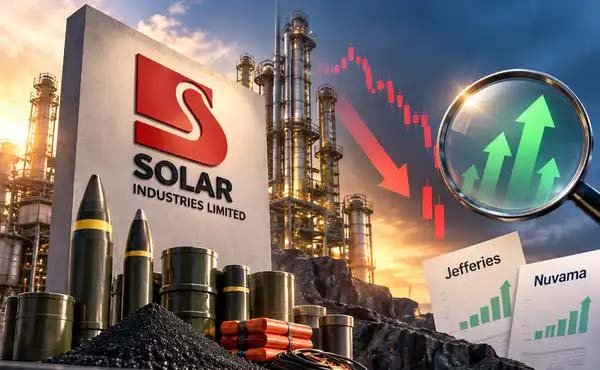
The deal also carries financial and execution risks. Its size has prompted investor concerns over funding, and Solar’s shares reportedly fell more than 12% during intraday trading after the announcement. Integrating Omnia’s businesses across multiple regions will require careful management, while the company must balance commercial explosives operations with its fast-growing defence portfolio.
Still, the proposed acquisition underlines how India’s defence industry is changing. Indian firms are no longer focused solely on replacing imports or supplying the domestic market. With stronger production capabilities, rising exports and greater access to technology, they are beginning to build global businesses – and Solar’s $1.35 billion bet may mark one of the clearest signs of that transformation.






