


CHENNAI. Indian space start-up Agnikul Cosmos is seeing growing interest from overseas satellite companies seeking dedicated launches to specific orbital positions, according to chief executive Srinath Ravichandran. The trend reflects a broader shift in the small-satellite market, where customers increasingly want control over launch schedules, deployment parameters and orbital destinations instead of sharing space on larger rockets.
“A large share of the enquiries is coming from international customers,” Ravichandran told media, as satellite operators look beyond rideshare missions. Under the conventional rideshare model, several spacecraft travel together on one rocket, reducing launch costs but limiting the timing and orbit available to each customer. A dedicated mission can offer greater flexibility, although it may carry a higher price.

The opportunity is central to Agnikul’s business model. Founded in 2017 by Srinath Ravichandran and Moin SPM, the Chennai-based company is developing Agnibaan, a configurable orbital launch vehicle designed for small satellites. The rocket’s engine configuration can be adjusted to match mission requirements, allowing the company to tailor vehicle size and performance rather than forcing customers to adapt to a fixed platform.
Agnibaan is designed to place small spacecraft into low Earth orbit. The company’s product information lists a vehicle mass of about 490 kilograms and an intended orbital altitude of approximately 680 kilometres. It is powered by Agnilet, a single-piece, three-dimensional-printed semi-cryogenic engine developed and manufactured in-house.
The technology is intended to simplify production while shortening development cycles. A single-piece printed combustion section reduces the number of components and joints that must be assembled, potentially lowering manufacturing complexity and improving repeatability. Agnikul has also promoted the use of electric pump-fed propulsion and modular engine clustering, features that could allow different rocket configurations for different payloads.
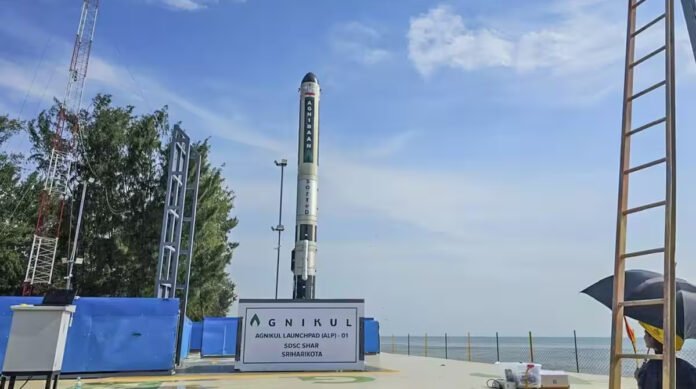
The company’s approach received a major demonstration on May 30, 2024, when its Agnibaan SOrTeD vehicle completed a suborbital mission from Agnikul’s private launchpad at Sriharikota. The flight marked several milestones, including the launch of a rocket using a single-piece 3D-printed engine, India’s first semi-cryogenic rocket-engine flight and the first launch from an Indian private launchpad.

SOrTeD was initially developed as a technology demonstrator but has since become a standalone product for low-altitude experiments and technology validation. Agnikul says the vehicle can carry payloads of up to 30 kilograms and reach near-space environments. Its orbital-class Agnibaan, by contrast, is intended for commercial satellite deployment and can be configured for different payload requirements.
The company’s launch infrastructure is another part of its pitch to international customers. Its Dhanush mobile launchpad is designed to be transported and deployed at authorised locations, enabling missions to be planned around orbital requirements rather than a single fixed launch site. The company says this mobility can improve mission efficiency and provide more choices for satellite operators.

Agnikul is also preparing for a longer-term push into reusability. At the 2025 International Astronautical Congress, the company announced plans for a rocket whose booster stage could return to Earth and fly multiple missions. Reusability could reduce launch costs, but it will require advances in recovery, guidance, refurbishment and operational reliability.
The start-up’s expansion comes as India seeks to build a larger private space industry following policy reforms that opened satellite, launch and space-service activities to non-government companies. Support from the Indian Space Research Organisation and the Indian National Space Promotion and Authorisation Centre has helped private firms gain access to technical guidance and launch infrastructure.
Agnikul’s immediate challenge is converting enquiries into contracts and regular flights. It must demonstrate orbital reliability, achieve a sustainable launch cadence and compete with established providers and other emerging small-launch companies. Yet, the company’s combination of customisation, in-house manufacturing and dedicated mission planning gives it a distinct proposition.
For satellite operators, the appeal is straightforward: a launch designed around the spacecraft, not the other way around. For India, Agnikul’s progress offers a test of whether domestic innovation can translate into a globally competitive space-services business.






