


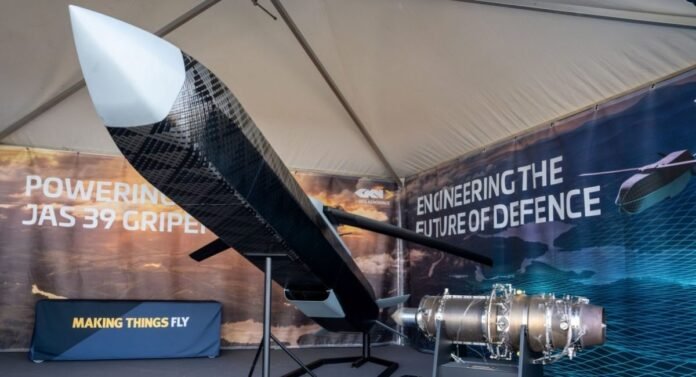
GKN Aerospace has developed an ITAR-free turbojet engine in under a year for Sweden’s Project Otto, enabling long-range strike capabilities up to 1,000 kilometres with scalable 3D-printed manufacturing.
In a major leap for European defence technology, Swedish aerospace firm GKN Aerospace has engineered a compact turbojet engine and long-range UAV demonstrator under “Project Otto” in less than twelve months.

Officially commissioned by the Swedish Ministry of Defence under a 150 million Swedish kronor ($15.8 million) contract, the programme was originally scheduled as an 18-month project. Its rapid completion highlights how modern defence manufacturing can move from concept to hardware in record time.
Unveiled at an air show at Malmen Air Base in Linköping, the demonstrator blurs the line between an unmanned aerial vehicle (UAV) and a high-precision cruise missile or one-way effector. The platform is engineered to deliver a 300-kilogramme payload across 600 kilometres or a 100-kilogramme warhead over a 1,000-kilometre range. Swedish Brigadier General Carl-Fredrik Edström confirmed that initial flight testing is scheduled to take place no later than early 2027.
Two major technical innovations set the new propulsion system apart:
- Additive Manufacturing:By heavily utilising 3D printing for core engine components, GKN Aerospace drastically reduced production timelines, simplified assembly and laid the groundwork for rapid, cost-effective mass production.
- ITAR-Free Architecture: The engine relies entirely on non-US components and intellectual property.Being completely free of US International Traffic in Arms Regulations (ITAR) frees the technology from restrictive American export controls.
The project brings together specialised industrial capabilities across GKN’s European footprint, combining Swedish propulsion heritage from Volvo Aero with airframe design from Dutch-based Fokker.

Beyond enhancing Sweden’s domestic deterrence capabilities, Project Otto holds significant strategic implications for European partners, particularly Ukraine. As Kyiv seeks to scale-up its long-range strike arsenal with affordable, mass-produced small turbojet engines, an ITAR-free, 3D-printed propulsion system offers an ideal blueprint. The unencumbered export profile simplifies technology transfers, licensing and potential joint production initiatives outside the United States.






