


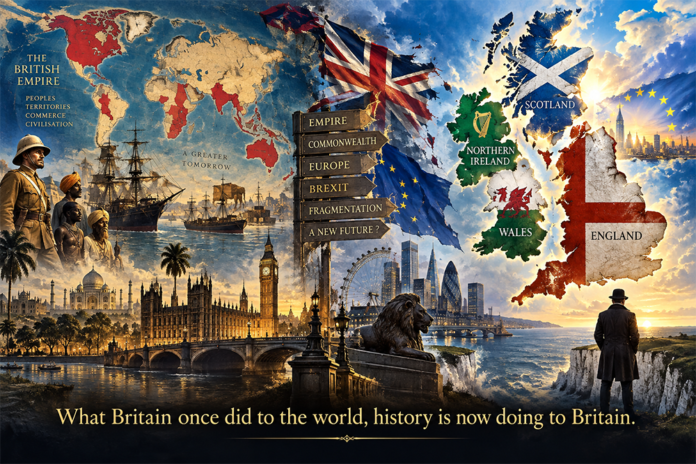
Britain once drew the map of the world; today the world is watching Britain redraw its own map. On September 14, 2026, in Cardiff, the leaders of Scotland, Wales and Northern Ireland came together in an unprecedented assertion of self-determination, calling on Westminster to prepare for constitutional change and declaring their aspirations towards a future linked more closely with Europe. For the first time, the three devolved nations were represented by political leadership committed to breaking, or fundamentally transforming, the existing British state. The irony is difficult to miss. The country that once assembled the greatest multinational empire in history now finds its own multinational union under strain. Britain did not collapse in a single dramatic moment. It has been contracting, politically and psychologically, for decades. The question now is whether this is merely another phase in Britain’s long transformation — or whether history is finally bringing the empire home.
From Rule, Britannia to Who are We? The British Empire was not merely a collection of territories. It was an extraordinary political system held together by military power, commerce, the Crown, English institutions, maritime supremacy and a powerful belief in Britain’s civilisational mission. At its height, Britain governed territories across continents and ruled over roughly a quarter of the world’s population. Then came two world wars, decolonisation, the rise of America and the Soviet Union, the emergence of Asian powers and the inexorable transfer of political authority back to the peoples Britain had once governed. The empire disappeared, but its institutions and influence survived through the Commonwealth, the English language, London’s financial system and Britain’s permanent seat on the UN Security Council.

Yet there was another transformation. Britain progressively moved from imperial power to European power, pooling sovereignty within the European project while maintaining a distinctive national identity. Then came Brexit, and Britain chose to reclaim sovereignty from Brussels. The decision was presented as a restoration of national control, but history has an uncomfortable sense of irony. The moment Britain asserted that a political community should have the right to determine its own destiny, Scotland, Wales and Northern Ireland acquired an even more powerful question to ask: if Britain can choose its future independently of Europe, why should its constituent nations not demand the same right from Britain? The Cardiff pact has now given that question a common political platform.
History has an uncomfortable sense of irony. The moment Britain asserted that a political community should have the right to determine its own destiny, Scotland, Wales and Northern Ireland gained a more powerful question: if Britain can choose its future independently of Europe, why should its constituent nations not demand the same right from Britain?
The Union that Empire Built: The United Kingdom was never simply a homogeneous nation-state. It was a union of nations whose different histories were accommodated within a larger British identity. Empire, war, monarchy, economic interdependence, and the shared projection of British power abroad reinforced that identity. When Britain fought two world wars, the idea of British-ness carried an extraordinary strategic weight. When the empire existed, London represented not merely England but the command centre of a global system. Today that external purpose has largely disappeared, while the internal identities of the constituent nations have become stronger.
Scotland increasingly sees its political future through a European lens; Wales is demanding a new constitutional settlement; Northern Ireland possesses a unique pathway towards Irish reunification under the principle of consent embedded in the Good Friday framework. A Union survives not because its borders are drawn on a map, but because its people believe their future is safer, richer and more meaningful together. When that belief weakens, constitutional structures can survive for years, even decades, but their moral foundations begin to crack.
Brexit: The Sovereignty that Came Back Twice: Brexit may therefore prove to be one of the great unintended constitutional accelerators of modern Britain. The British electorate voted to leave the European Union in 2016 and formally departed in 2020 because many believed that sovereignty had become too distant from the British people. The argument was powerful: decisions affecting Britain should be made in Britain. But sovereignty is a principle that does not easily stop at a convenient boundary. Once the right of a political community to determine its own destiny becomes the central argument, smaller political communities can invoke precisely the same principle.

In England and Wales, those identifying as Christian fell from 59.3% in 2011 to 46.2% in 2021, while those reporting no religion rose from 25.2% to 37.2%. For the first time, fewer than half identified as Christian. Christianity in Britain has moved from being a lived social foundation to being a cultural inheritance
That is the paradox now confronting Westminster. Britain reclaimed sovereignty from Europe, while Scotland and others increasingly demand sovereignty from Britain. The European Union, once portrayed by British nationalists as the force diminishing British independence, may now become the destination some of Britain’s constituent nations look to after independence. The irony is almost Shakespearean: Britain left Europe to recover sovereignty, while parts of Britain may seek to leave Britain to recover sovereignty and return to Europe.
When an Empire Comes Home: The transformation, however, is not only constitutional. Britain has changed profoundly from within. The end of empire did not end the movement of people between Britain and its former imperial world. Commonwealth migration, family reunification and successive generations transformed British cities, institutions and culture. Birmingham and Bradford today bear little resemblance to the Britain of the 1950s. In the 2021 census, Muslims constituted 29.9% of Birmingham’s population and 30.5% of Bradford’s, while London’s Muslim population reached 15%.

But the deeper transformation is not simply the growth of Muslim communities. It is the simultaneous weakening of Britain’s inherited Christian identity. In England and Wales, those identifying as Christian fell from 59.3% in 2011 to 46.2% in 2021, while those reporting no religion rose from 25.2% to 37.2%. For the first time, fewer than half identified as Christian. Christianity in Britain has increasingly moved from being a lived social foundation to being a cultural inheritance. Meanwhile, immigrant communities have often retained stronger religious identities, creating a striking contrast between an increasingly secular indigenous society and more visibly religious minorities.
The deeper question therefore is whether a society that has voluntarily loosened its own cultural and religious moorings can maintain a sufficiently strong common identity in an age of rapid demographic change. The answer will depend less on immigration than on integration, shared citizenship, equal application of law and the confidence with which Britain defines what it means to be British.
The empire did not simply disappear. Some of its peoples, cultures, languages and histories eventually came home.
The real challenge before England is not whether it can survive without an empire. It is whether it can discover a compelling identity after empire. Britain’s greatest tragedy would not be that its empire ended. Empires end; history moves on. Its greater tragedy would be to remain psychologically imprisoned by an empire that no longer exists
Karma, or the Law of Unintended Consequences? Is this political karma? Not in the mystical sense. But if karma is understood as the return of consequences created by one’s own actions, Britain offers one of history’s most compelling examples. Britain exported borders, institutions, language, commerce, migration networks and political ideas across the world. It created a Commonwealth that outlived the empire. It encouraged mobility and internationalism. It became multicultural. It joined Europe. It then left Europe. Every decision appeared rational within its own historical moment, yet the accumulated consequences are now interacting in ways nobody fully designed.
History rarely punishes. It remembers.
Britain’s present predicament is the cumulative result of a civilisation transitioning from empire to nation, from nation to European partner, and from European partner back to sovereign state — while simultaneously becoming less certain about its inherited identity. That is why the crisis is deeper than the possible breakup of the United Kingdom. A smaller Britain that continues to measure itself against the empire it once possessed could become strategically confused.
The real challenge before England is therefore not whether it can survive without an empire. It is whether it can discover a compelling identity after empire. Britain’s greatest tragedy would not be that its empire ended. Empires end; history moves on. Its greater tragedy would be to remain psychologically imprisoned by an empire that no longer exists while failing to build a national purpose for the country that remains.
Britain once ruled the world because it knew what it wanted to be. Today, its greatest strategic question is whether, after losing an empire and perhaps its Union, it still knows what it wants to become.

Lt Gen Rajeev Chaudhry (Retd) writes on contemporary national and international issues, strategic implications of infrastructure development towards national power, geo-moral dimension of international relations, and leadership nuances in a changing social construct. The views expressed are of the author and do not necessarily reflect the views of Raksha Anirveda





