


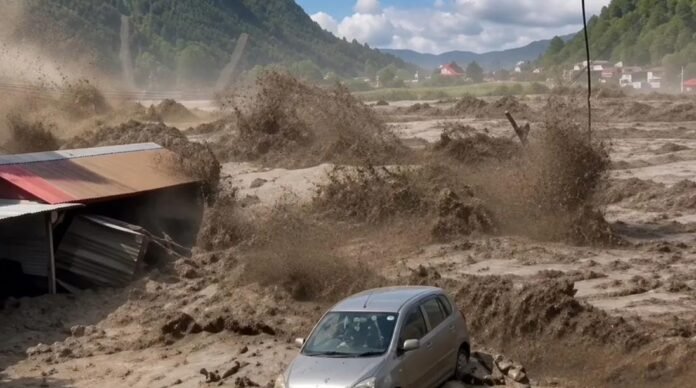
On August 26, 2026, Wednesday, at 0820 hours, as per Nepal Standard Time, the inhabitants of Gyirong (Tibet) and Rasuwagadhi (Nepal) experienced the first mild tremor, followed by a severe tremor of magnitude 5.2. There was panic at the border post on both sides and the land port.
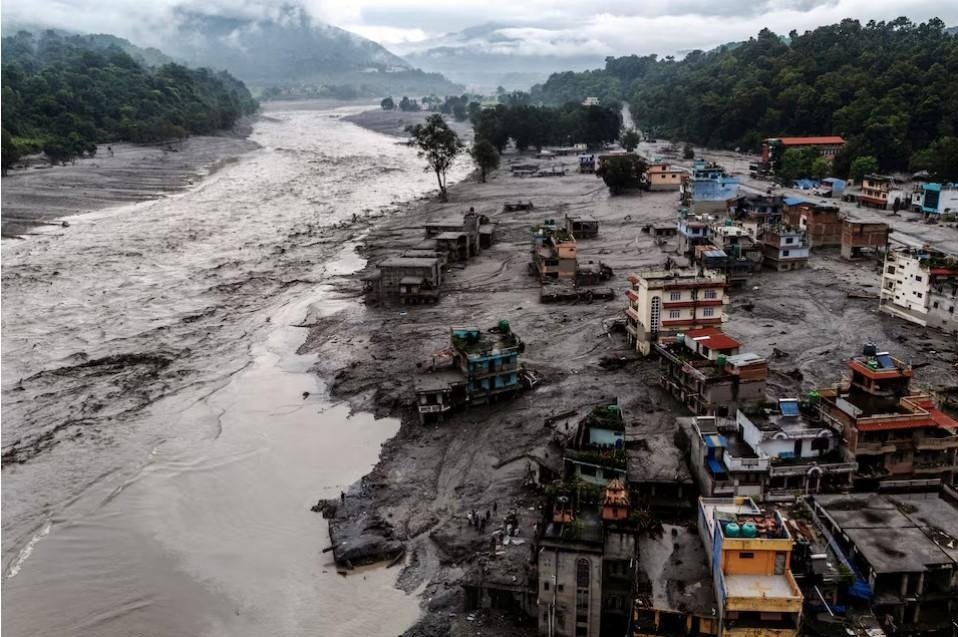
Suddenly, at 0840 hours, flash floodwaters with sand and mud came gushing down, roaring at full speed in the Bhotekoshi (Trishuli) River, and the water level rose from about 5 feet to 13 feet by 0920 hours. The speed of rolling down muddy water and debris was 180 km per hour, as recorded by CCTVs of Gyirong port, as per the government of Xigaze, Tibet Autonomous Region (TAS). The amalgamated sludge and debris travelled downhill 20 km in 12 minutes. The houses, shops, schools, and bridges suddenly disappeared from the landscape. Thousands of villagers, tourists, port officials, and border guards were buried alive, and a few decomposed bodies were found down in the Narayani River 200 km away after 48 hours.

Gloom enveloped Nepal and Tibet. The toll taken by flash floods as of September 1 was about 1,050, as per the National Disaster Risk Reduction and Management Authority (NDRRMA), confirmed dead, and 3,925 (including 592 foreign nationals) people missing and untraceable, including 320 Indians and 558 Tibetans. About 1,500 people have been severely injured by nature’s fury.
Nepal asked for 42 Bailey bridges from India and China as 13 major and minor bridges on the Bhutekoshi River were swept away. Chinese rescue teams reached the core disaster site from the north on August 28 at 1500 hours after almost 50 hours around Gyirong dry port and commenced relief and search missions with the help of inflatable boats, drones and helicopters.
Nepal mobilised 10,000 troops for the massive rescue operation, facing the sludge, poor visibility, and inhospitable terrain in the Rasuwa region. They evacuated 350 workers trapped in the Rasuwa hydro project tunnel, which provided a safe zone for fortunate workers. The search for the other 600 workers trapped in various tunnel sites, Trishuli 3A and Trishuli 3B, is underway.
The toll taken by flash floods as of September 1 was about 1,050 confirmed dead, and 3,925 people, including 592 foreign nationals, missing and untraceable, which includes 320 Indians and 558 Tibetans. About 1,500 people have been severely injured by nature’s fury
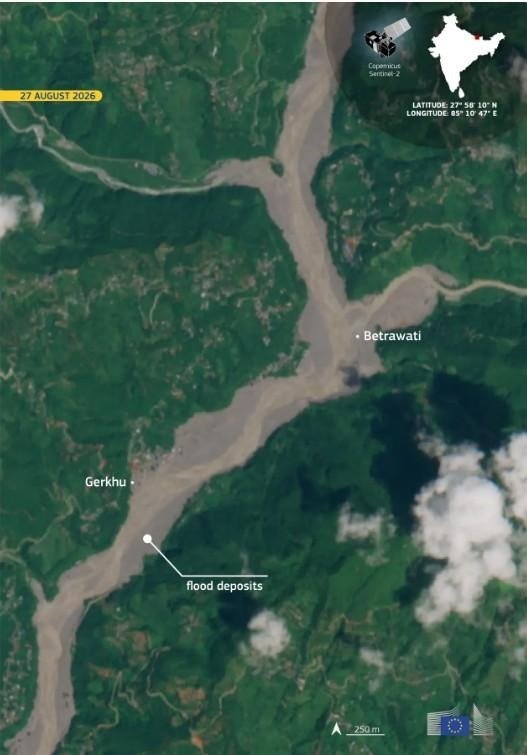
Satellite imagery showed that the flash flood originated at the glaciated lake at Langtang Lirung in the Tibetan Himalayan region. The lake burst due to tremors and flowed down rapidly through a narrow gorge and reached the Bhutekoshi River near Gyitori and further down to Rauwa, Nuwakot, Dhading, Gorkha, Tanahun, Nawaparasi, and Chitwan district towns, creating havoc along the riverside. India, China, the UN, and the EU have come out generously for HADR missions as Nepal’s new Prime Minister Balen Shah is tested for the first time, facing unforeseen natural disasters and crises.

India Sends Relief Material, Rescue Teams
India, as usual, was among the first responders, and within 48 hours, two C130J Hercules, with 40 tonnes of relief material, landed in Kathmandu along with medical and rescue teams. The Indian team established a special lab to test the DNA of victims for identification of decomposed remains. Two more IAF C17 Globe Master Cargo planes, with an additional 20 tonnes of relief materials, including medicines, tents and five Bailey bridges, landed at Kathmandu Airport. The fifth IAF transport aircraft has just landed at Tribhuvan International Airport with an additional 20 tonnes of relief material and special rescue equipment.
Prime Minister Narendra Modi assured Balen Shah that all assistance will be provided on priority. Indian Army Chief General Dheeraj Seth, recently conferred with the rank of General in the Nepalese Army by the President of Nepal, promised all possible help from the Indian Army to repair and install bridges, set up field hospitals with OTs, and send rescue teams.

India, as usual, was among the first responders, and within 48 hours, two C130J Hercules aircraft carrying 40 tonnes of relief material landed in Kathmandu, along with medical and rescue teams. The Indian team established a special lab to test the DNA of victims for identification of decomposed remains
The Geography of the Region
The origin of the Glacial Lake Outburst Flood (GLOF), or the flash flood, was the Lende River (Donglin Tsangpo) in the Langtang Lirung National Park area in Gyirong County of the TAR border area. Lende River merges downstream into the Trishuli River system. Notably, there was a heavy flash flood in this area in 2015 as well.
The present site of the disaster is the Nepal-Tibet border crossing at Gyirong land port and Rasuwa post of Nepal. This is a strategic border crossing for trade and tourism. This border crossing is an important transit point for Holy Mount Kailash on Mansarovar Lake, worshipped by Hindu, Buddhist, Jain, and Bon pilgrims. Hundreds of pilgrims and tourists visit the holy site by this route. There is a huge immigration checkpoint complex at the junction of two rivers, with a concrete bridge later replaced by a Bailey bridge. The satellite imagery of 2005 and 2011 shows that the entire confluence area was devoid of any concrete structure, but had tin sheds, and there was no bridge. China built a friendship motorable road and bridge in 2015 called the Pasang-Lhamu Highway (Trishuli Highway), which made Kailash Mountain visits more comfortable for pilgrims and tourists. It also boosted trade between Nepal and Tibet. Since 1900, flash floods and mudslides have occurred several times in this region, taking a heavy toll on local villagers, but the route was restored, and trade relations continued. Trishuli River flows down, joins the Narayani River, and enters India 240 km away Gangetic river system. The area is on the northern side of Kathmandu in central Nepal.
The Cause of the Deluge
The cause of the present deluge is under investigation, but as assumed earlier, it was due to the collapse of a part of the glacier in a narrow gorge in the Langtang region and the accumulation of lakhs of gallons of ice and water. The seismic quake caused the glacial lake to burst, and millions of cubic metres of water with mud and debris rushed down the sharp gradient and caused devastation in districts of Rasuwa, Nawakot, Dhanding, Gorkha and Chitwan located along the Trishuli river system.
The rescue and search mission is in progress on a war footing. The Nepal government has mobilised 10,000 troops from the Nepal Army and police, who are deployed for search and relief work day and night, but the terrain is inhospitable and difficult to approach due to sludge and loose mud all over. Balen Shah visited Nuwakot district to monitor the situation and has appealed to the world for help in the hour of crisis. The Council of Ministers has declared the area a disaster zone under the Disaster Risk Reduction Management Act of 2014 and offered free medical treatment and relief compensation, but the situation is beyond control.
China has mobilised PLA troops from Sichuan province and People’s Armed Police personnel for rescue missions, along with 150 vehicles, sniffer dogs, and speed boats, and evacuated 555 tourists and 500 tourists to safe areas. The PLA has installed a Bailey bridge and will also establish a flood warning and monitoring system assisted by satellites
Many Nations Offer Unconditional Help
China has mobilised PLA troops from Sichuan province and People’s Armed Police personnel for rescue missions along with 150 vehicles, sniffer dogs, and speed boats, and evacuated 555 tourists and 500 tourists to safe areas. The motorable road from Gyrong town county to Rasuwa border is now in bad shape. The bridge has also been washed away, but the PLA has installed a Bailey bridge. It will also establish a flood warning and monitoring system assisted by satellites.
Australia has donated 2 million dollars for relief work; Canada has provided 5 million dollars for relief missions. Ireland has donated 5 million Euros. Malaysia has offered one million dollars as a relief fund. Singapore has provided 1 million dollars. Pakistan and Bangladesh have also sent relief teams to Nepal. The UAE has donated 10 million US dollars. The UK has donated 5 million pounds, and the US has given 5 million dollars. Vietnam and Iran have conveyed condolences to Nepal for the victims. WHO, Red Cross and Red Crescent teams are operating medical camps.
Prime Minister Modi said that India stands with Nepal in the hour of crisis; specialist and medical teams and 70 tonnes of relief material have already been airlifted. The cause for worry for India is that 275 Indians are still missing and 128 persons of Indian origin are still untraceable.
Australia has donated 2 million dollars, Canada 5 million dollars, Ireland 5 million Euros, the UAE 10 million US dollars, the UK 5 million pounds, Singapore 1 million dollars, and the US has given 5 million dollars. Malaysia has offered 1 million dollars. Pakistan and Bangladesh have also sent relief teams to Nepal
The situation in the Himalayan Kingdom is bad and beyond the control of the Nepalese government, although it is doing its best. This is the time when India and China should jointly deploy their human and technical resources, including medical teams, rescue teams, specialised teams for tunnel rescue, dozers, boats, bridging equipment, underground body detection teams, helicopters, drones, and rescue as many lives as possible and restore traffic movement. Indian Ambassador to Nepal Naveen Shrivastva informed that an Indian specialised team, in coordination with the Nepal Army, has reached tunnel mouths at Chilime and Langtong sites. Positive news of survivors is awaited.
Meanwhile, all these future water bomb sites in the Himalayas need to be identified through satellite imagery along the Indo-Tibetan border and kept under watch. Joint monitoring units must give adequate warning to people living in danger zones and prevent loss of human lives and property. We must respect nature and should not block the water flow by choking it with concrete structures on natural banks. May rescue teams locate the trapped hydel workers fast, and all nations join hands and help Nepal as per Indian philosophy of Vasudhaiva Kutumbakam (the world is one family).

-The writer is an Indian Army veteran and a defence analyst. He has keen interest in Geo-strategic affairs and writes regularly on internal and external affairs issues related to India and neighbours. The views expressed are personal and do not necessarily reflect the views of Raksha Anirveda





