


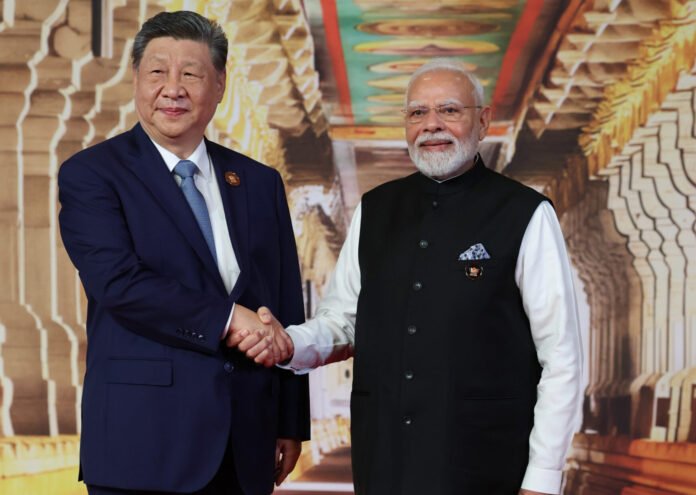
The mechanics of modern multipolar diplomacy often demand that bitter bilateral rivals share a stage to construct larger institutional alternatives to Western-dominated global governance. The 18th BRICS Summit held at Bharat Mandapam in New Delhi provided a vivid case study of this delicate balancing act.
Set against the backdrop of an expanded BRICS+ architecture, the high-stakes bilateral engagements between Indian Prime Minister Narendra Modi and Chinese President Xi Jinping underscored the complex relationship between managing severe bilateral friction and sustaining multilateral momentum.

For emerging powers navigating a fragmented global order, the New Delhi summit demonstrated how states preserve critical national security priorities while simultaneously underwriting the viability of non-Western economic platforms.
The Imperative of Bilateral De-escalation in Multilateral Forums
Multilateral coalitions risk complete structural paralysis when deep-seated animosities between their primary economic engines remain unchecked. The enduring friction along the Line of Actual Control (LAC) following the 2020 Himalayan border standoffs demonstrated how localised territorial crises can cast a persistent shadow over collective agenda-setting within trans-regional forums.
High-level talks provided a pragmatic buffer, preventing border disputes along the Line of Actual Control from paralysing the broader operational goals of the summit
The dialogue held on the sidelines of the BRICS summit represented a deliberate, pragmatic effort to prevent bilateral disputes from eroding the operational cohesion of the bloc. By leveraging the structured, multilateral setting provided by the Ministry of External Affairs, both leaderships engaged in high-level strategic recalibration without incurring the immediate domestic political liabilities that typically accompany bilateral state visits.
This institutional insulation allowed New Delhi and Beijing to establish a functional boundary between acute security friction in the high-altitude border regions and their common analytical ground regarding global financial governance, reform of the Bretton Woods institutions and Global South advocacy.

The talks demonstrated that within expanding multilateral arrangements, bilateral stabilisation is not an extraneous diplomatic pursuit but a structural requirement for institutional credibility. Without establishing a baseline of diplomatic predictability between its two largest sovereign economies, any ambitious BRICS agenda risks being reduced to ineffective rhetorical declarations.
Economic Interdependence and Trade Normalisation Realities
Beyond territorial boundary management, calibrated economic normalisation formed the core of the discussions. The imperative to address severe trade asymmetries while guarding critical supply chains against strategic leverage highlights the permanent tension between national economic security and regional trade integration.

Discussions highlighted a shift toward sector-specific trade mechanics, balancing national economic security and supply chain reliability without demanding total economic decoupling
India’s posture – maintaining that peace and tranquility along the border remain an indispensable pre-requisite for systemic economic normalisation—contrasted with Beijing’s long-standing diplomatic preference to compartmentalise commercial relations away from political-security friction.
The interactions in New Delhi reflected a nuanced shift toward regulated economic pragmatism. Faced with global economic fragmentation, protectionist industrial policies in Western markets, and shifting trade rules, both economies recognise the strategic and economic costs of an absolute operational decoupling.
The deliberate dialogue around supply chain reliability and market access signals a mutual recognition that regional stability requires structured commercial mechanisms. However, as noted in ongoing trade policy assessments by international institutions like the United Nations Conference on Trade and Development, strict regulatory oversight on cross-border investments alongside persistent market imbalances means that economic normalisation within multilateral blocs manifests not as unfettered free trade, but as a tightly negotiated, sector-specific arrangement designed to protect domestic industries while maintaining necessary trade channels.
Institutional Cohesion in an Expanded BRICS Era
The integration of new member nations into the BRICS platform has fundamentally reshaped the internal political dynamics of the bloc. In this expanded, more heterogeneous configuration, the bilateral equilibrium between India and China acts as the principal axis around which institutional consensus is engineered.
Managing friction between foundational members reassured incoming BRICS+ nations that the platform remains a forum for non-aligned cooperation rather than power competition
Had the two founding members remained locked in an unmitigated zero-sum contest during the summit proceedings, the expanded bloc would have fractured into competing ideological or political sub-factions.
Such fragmentation would undermine the trust of incoming members who view the bloc as an instrument for non-aligned economic cooperation rather than an arena for big-power competition.
The diplomatic engagement between New Delhi and Beijing sent a clear operational signal to the expanded membership: strategic rivalry can be managed alongside institutional cooperation.
By agreeing to maintain active dialogue through established border management frameworks while endorsing the joint summit declarations, both nations showed that collective consensus can be forged despite deep structural divergences.
This dynamic reinforces an essential principle of contemporary international relations: effective mini-lateralism does not require complete strategic alignment among member states; rather, it requires a shared commitment to keeping institutional channels functional while containing bilateral friction.
Strategic Autonomy and the Limits of Alignment
The significance of the outreach from New Delhi lies in the reaffirmation of strategic autonomy as an organising notion for principal emerging economies.
For India, its firm stand on border security coupled with active participation in steering the regional multi-faceted framework reveals a sophisticated diplomatic practice, of making contacts with Beijing, wherever joint economic and political interests match, while resisting one-sided strategic encroachments at the same time.
Dense working groups and financial initiatives created built-in disincentives against unchecked escalation, forcing rivals to weigh bilateral disputes against coalition goals
For China, its readiness to negotiate with an important neighbour represents a strategic need for projecting stability in the Global South amid severe geopolitical transformations.
The diplomatic developments from New Delhi show that managing tensions within multilateral platforms is a negotiation process that requires ongoing work rather than a single act denoting the end of the process.
As multilateral blocks acquire a greater role in local currency trading, natural resources coordination and the technology standards, for them the sustainable development will mostly depend on how they are capable of finding a balance: avoiding bilateral conflicts from hampering common strategic goals.
Structural Equilibrium: Institutional Architecture as a Friction Buffer
The long-term viability of non-Western multilateralism rests on its capacity to convert acute bilateral conflict into managed institutional competition.
The New Delhi summit demonstrated that when multilateral platforms reach a sufficient level of institutional maturity, they cease to be mere backdrops for state diplomacy and instead function as structural buffers against bilateral escalation.
The summit proved that modern mini-lateralism no longer requires strategic alignment, showing rival powers can build global alternatives while competing along immediate borders
By embedding hostile neighbours within a dense network of sectoral working groups, financial initiatives and joint policy declarations, multilateral frameworks create built-in disincentives against unchecked escalation.
The diplomatic architecture forces rival capitals to continuously calculate the institutional cost of letting bilateral disputes disrupt broader coalition goals.
This structural buffer transforms how regional rivalries play out in the contemporary global order. Rather than escalating into absolute confrontation or collapsing into transactional deal-making, bilateral disputes within a robust multilateral bloc undergo a process of systemic containment.
Managing friction within multilateral blocs thus introduces a new model of global governance: strategic alignment is no longer the foundational requirement for long-term cooperation. Instead, institutional platforms are explicitly engineered to accommodate geopolitical rivals, allowing them, to construct counter-balances to global financial dominance, while locked in severe competition along their immediate geographic frontiers.

The writer is a policy analyst, author and researcher with research experience in South Asian geopolitics, India's foreign policy and the Indo-Pacific. The views expressed are personal and do not necessarily reflect the views of Raksha Anirveda





