

This year, India celebrates 61 years of its victory in the 1965 Indo-Pak War. It’s more than a commemoration of a military triumph; we must take out time to reminisce the gallant efforts of the soldiers of the Indian armed forces who thwarted the nefarious designs of Pakistan to grab Kashmir by treachery – a gambit Pakistan repeated in subsequent wars, but met with back-to-back humiliating defeats.
It’s also a moment to recall the geopolitical and strategic contours that shaped that conflict – lessons that remain uncannily relevant in today’s shifting regional landscape. As the generation that fought those battles fades into history, retelling this story becomes vital – not merely to honour the heroes of Phillora, Asal Uttar and Haji Pir, but to ensure that India’s future decision-makers never lose sight of the strategic interplay of diplomacy, alliance politics and miscalculation that led to war.

The Global Chessboard: Cold War Alignments and Pakistan’s Calculations
The seeds of the 1965 conflict were sown in the early years of the Cold War. Pakistan’s leadership under Field Marshal Ayub Khan chose to align firmly with the United States, seeing in Washington’s Anti-Communist agenda, an opportunity to strengthen its military capability against India.
In September 1954, Pakistan joined SEATO (South East Asia Treaty Organisation), followed by CENTO (Central Treaty Organisation) in 1955. The US sought to use Pakistan as a bulwark against Soviet and Chinese influence, while Pakistan hoped to leverage the alliance to gain strategic parity with India.
Between 1956 and 1964, Pakistan received a windfall of US military hardware: M47 and M48 Patton tanks, F-86 Sabre jets, F-104 Starfighters, B-57 bombers and C-130 transport aircraft. By the mid-1960s, Pakistan’s armed forces were among the most US-equipped in the non-NATO world.
In contrast, India’s non-aligned posture meant that American aid was limited and conditional. The US viewed India with caution, particularly after New Delhi’s leadership in the Non-Aligned Movement. This asymmetric military modernisation left Pakistan brimming with overconfidence – a mis-judgment that would later prove costly.

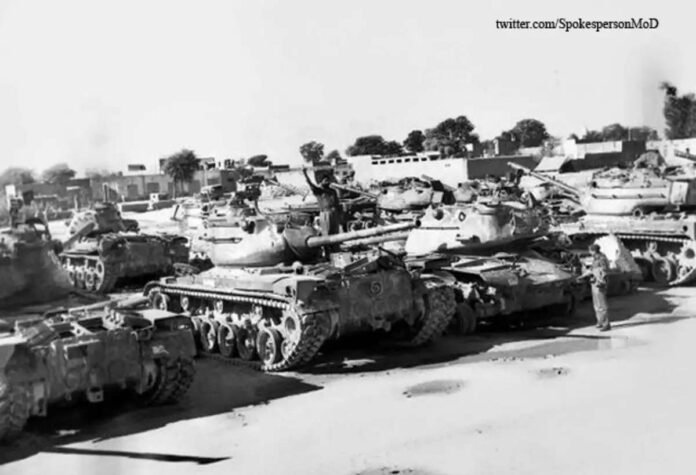
Flush with over $800 million in advanced US military hardware like Patton tanks and Sabre jets, Rawalpindi mistook technical parity and India’s post-1962 political transition for vulnerability, launching a war built on false assumptions of swift success
That overconfidence was also shaped by propaganda. The Pakistani media, at the time, portrayed its army as the “shield of Islam” and its US-supplied arsenal as invincible. Indian restraint and moderation were misconstrued as weakness. In reality, India’s rebuilding of its armed forces after the 1962 setback was deliberate, methodical and underpinned by a quiet determination not to be caught unprepared again.
A Comparative Military Balance
By 1965, Pakistan’s Army fielded roughly 765 tanks compared to India’s 720, but the quality differential was significant. Pakistan operated nine regiments of Patton’s, nine of Shermans and three of Chaffee’s, whereas India had eight Sherman regiments, four Centurion regiments and two of AMX-13s.

In artillery, Pakistan had modern 155 mm guns and 8-inch Howitzers, while India relied heavily on 120 mm mortars and 7.2-inch guns. Its air force boasted faster, more advanced platforms. On paper, Pakistan appeared militarily superior, particularly in armour and air power.
This technical advantage, bolstered by US support and further cooperation with Britain, created an illusion of invincibility in Rawalpindi. It was an illusion that would unravel dramatically within a year.
What the numbers missed was the Indian soldier’s morale, training and adaptability. Leadership – from corps commanders to company officers – proved decisive. The Indian Army’s institutional memory, its discipline and the moral authority of its leadership became the true force multipliers when war finally broke out.
Pakistan’s China Card and the Diplomatic Web
The geopolitical equation deepened when Pakistan began tilting towards China after India’s 1962 border conflict with Beijing. The US, attempting to assist India with limited post-war aid worth around $47 million, inadvertently pushed Pakistan further into China’s orbit.
By comparison, Pakistan had already received over $1.5 billion in American aid – of which $800 million was military. In 1963, Pakistan ceded 5,200 sq km of territory in the Shaksgam Valley to China, sealing a de facto strategic partnership that endures to this day.
Pakistan’s Operation Gibraltar failed when local Kashmiris reported infiltrators rather than joining an uprising, forcing a desperate escalation into Operation Grand Slam that met a swift, coordinated Indian military response
India, increasingly alienated from Washington, began leaning toward the Soviet Union for security and defence cooperation – a realignment that would later crystallise in the 1971 Indo-Soviet Treaty. These diplomatic crosscurrents meant that by 1965, South Asia had already become a miniature theatre of the global Cold War.
India’s Domestic Scene: Transition and Turbulence
Domestically, India was navigating political and social flux. The theft of a relic – a strand of the Prophet Mohammad’s hair – from Hazratbal Shrine in 1964 triggered unrest in Jammu and Kashmir, which Pakistan misread as an indicator of instability.
In Punjab, the agitation for a Punjabi Suba was gaining momentum. And, following Nehru’s death in May 1964, Lal Bahadur Shastri had taken over as Prime Minister – a transition that Ayub Khan and his Foreign Minister, Zulfikar Ali Bhutto, misinterpreted as weakness.
Ayub, already politically insecure after a close and contested presidential election against Fatima Jinnah, believed that a quick military success in Kashmir could restore his domestic standing and deliver a psychological blow to India. But in reading India’s democracy as fragility, he fatally misunderstood its resilience.
From Rann of Kutch to Operation Gibraltar
Tensions first flared in the Rann of Kutch in early 1965, where India’s 31 Infantry Brigade Group clashed with Pakistan’s 8 Division and 24 Cavalry. A ceasefire brokered by the UK on July 1, 1965 temporarily calmed the front, but it emboldened Pakistan’s military planners.
By August 1965, Pakistan launched Operation Gibraltar, a covert infiltration by around 30,000 troops in six groups, aiming to incite rebellion in Jammu and Kashmir. These six groups were named Tariq, Qasim, Khalid, Salahuddin, Ghaznavi and Babur. They were launched by Pak GOC 12 Division, Maj Gen Akhtar Hussain Malik, with three objectives – disrupt Indian control of J&K, incite armed revolt and create conditions for “liberation”.
Guided by the resolute stance of Western Army Commander Lt Gen Harbaksh Singh and ground-level tactical ingenuity, Indian forces repelled enemy advances and dominated massive armoured clashes like the Battle of Phillora
The Tariq group’s objective was to disrupt the route towards Zojila Pass and take control of Amarnath. Qasim’s aim was to destroy bridges on the Bandipura-Gandarbal road. Khalid group was to attack infrastructure at Handwara and destroy the Kupwara power station. Salahuddin group’s target was to sever road links and capture Srinagar Radio Station and airfield. Ghaznavi was tasked to attack Rajouri-Naushera; Babur was to target Udhampur HQ and disrupt communications.
Indian forces in the valley were limited – only four J & K Militia battalions and an animal-transport company. Later, 4 Sikh Light Infantry and 2/9 Gurkha Rifles were dispatched with additional brigades from Leh and Jammu.
Let’s analyse the progress of these six groups. Tariq group could never reach its objective due to high-altitude casualties. Qasim failed to generate local support. Salahuddin lost surprise and was detected during infiltration. Only Ghaznavi achieved some success but without strategic impact.
Here, I would like to mention the pivotal role of Lt Gen Harbaksh Singh, the Western Army Commander. On August 8, after infiltration by these Pak groups, the J&K government panicked and proposed martial law. Lt Gen Harbaksh strongly intervened, reasoning that martial law would validate Pakistani propaganda and demoralise Kashmiris. His advice was accepted – a decision that proved crucial.
As we can see, this Pak gambit failed miserably. Several locals reported the infiltrators instead of rising in revolt. On August 5, a local Gujjar boy named Mohammad Din reported armed men near Tangmarg. The 19 Division was alerted and killed several infiltrators – all part of Salahuddin group led by Pak Major Mansha Khan. By August 15, Operation Gibraltar had failed. Pakistan had wrongly assumed local uprising and underestimated India’s coordinated counter-response.
When these plans collapsed, Pakistan escalated to Operation Grand Slam on September 01, targeting Akhnoor to sever India’s lines of communication to J&K.
Despite operating older aircraft, the Indian Air Force achieved crucial tactical victories – exemplified by Sqn Ldr Trevor Keelor’s historic Sabre kill – demonstrating immense courage despite restricted strategic employment of air assets
India Strikes Back
In a bold counterstroke, India widened the conflict across the International Border. On September 6, 1965, XI Corps advanced towards Lahore, Barki and Kasur, while I Corps launched major thrusts in the Sialkot sector with its 1 Armoured Division, 6 Division, 14 Division and 26 Division.
The Battle of Phillora, led by India’s 1 Armoured Division, became one of the largest tank battles since World War II – and ended decisively in India’s favour. Despite its superior hardware, Pakistan’s forces faltered under the weight of Indian tenacity and leadership.
India’s success on land was matched by courage in the air. The Indian Air Force, though operating less advanced aircraft, fought with extraordinary ingenuity and valour, keeping control of the skies in crucial sectors.
Victory with Restraint
By the ceasefire, India had captured 1,920 sq km of Pakistani territory, while Pakistan held 540 sq km of Indian land. India lost 2,862 soldiers, while Pakistan’s fatalities were estimated at 5,847. Notably, Indian Army had used only 14 per cent of its ammunition reserves, while Pakistan had exhausted over 80 per cent – a telling indicator of sustainability.
By the ceasefire, India held 1,920 square kilometers of enemy territory having utilised just 14 per cent of its ammunition reserves, starkly contrasting with Pakistan’s near-total depletion of military resources
Now, let’s take stock of our Air Force assets at the time of the ceasefire. Before we do that, I should highlight that the then Air Chief Marshal Arjan Singh was disheartened, when the ceasefire was declared after 17 days, since the IAF had consumed less than 10 per cent of its resources.
When the IAF was gaining air superiority, the ceasefire was announced. IAF pilots had begun dominating Pakistani counterparts in dogfights through sheer guts and tactics despite facing superior aircraft like Sabres and Starfighters.
None can forget how on September 3, Sqn Ldr Trevor Keelor, flying a Gnat, shot down a Sabre – the first kill by the IAF. Initially, the IAF operated only in the Chhamb sector, using Vampires by day and Mystères by night.
The Pakistani Air Force would have been fully destroyed had the war continued a little longer. This brings us to a vital lesson – political and military objectives must align from day one, as we saw recently in Operation Sindoor. Another key lesson was the offensive use of air power, which we hesitated to deploy in 1965. Even in 1962, air power was left out – a costly error.
Strategic restraint, combined with international pressure, led to the Tashkent Agreement of January 10, 1966, brokered by the Soviet Union. Although India returned territories such as Haji Pir Pass, the moral and military victory was unequivocal. Much credit goes to Lt Gen Harbaksh Singh, whose leadership on the Western Front became a legend.
With Pakistan’s current leadership demonstrating familiar overconfidence amid domestic distress and an expanding China-Pakistan nexus, 1965 serves as a sharp reminder that deterrence requires constant jointness, intelligence and proactive defence
Echoes in 2026: Lessons from the Past
Sixty years later, history seems to rhyme. Pakistan’s economic distress, internal political divisions and over-reliance on external patrons – first the US, now China – echo the vulnerabilities of the 1960s.
The China-Pakistan nexus, much like 1965, is again being leveraged as a counterweight to India’s growing power.
As Pakistan’s current military leadership under Gen Asim Munir exudes familiar overconfidence amid domestic fragility, one must ask: could another misadventure be on the horizon? The lessons of 1965 are clear – strategic overconfidence, misreading of India’s resolve and external dependence can be fatal miscalculations.
For India, the message is equally sharp: vigilance, unity and readiness remain the best guarantees of peace. We need better intelligence, jointness, integration amongst the forces and offensive use of air power. We should not delay any further implementation of theatre commands. Even the concept of Agniveers needs a relook.
At the same time, India’s security calculus must now extend beyond land and air to cyberspace, outer space and information warfare. The strategic frontiers have expanded, but the guiding principle endures – peace is secured by preparedness.
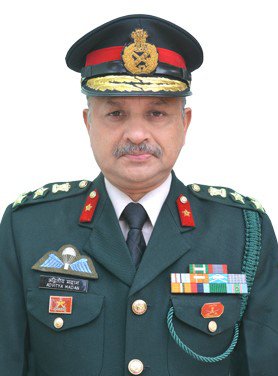
The writer commanded 15 Punjab in Lebanon under United Nations Flag, commanded 27 Sector as DIG in Churachandpur and was Brigadier Operational Logistics in HQ Western Command. He is currently an analyst on geopolitics, international and defence affairs. The views expressed are personal and do not necessarily carry the views of Raksha Anirveda





