

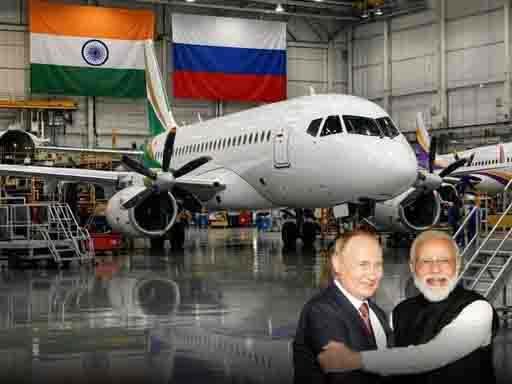
Aproposal to bring 50 Russian regional aircraft to India is drawing attention not only for its potential to improve connectivity, but also for its possible role in establishing a domestic civil-aircraft manufacturing capability.
Omkam Aviations has signed a letter of intent with Russia’s United Aircraft Corporation (UAC) covering 50 Il-114-300 turboprop aircraft. The first phase would involve six imported aircraft and associated support systems, requiring an estimated investment of ₹1,500 crore. Omkam has proposed following the initial imports with an assembly line in India and, later, production under a technology-transfer arrangement.

The Il-114-300 is a twin-engine turboprop designed for short-haul regional routes. It can carry approximately 66 to 68 passengers and is intended to operate from smaller airports and runways with limited ground infrastructure. Those characteristics could make it suitable for links between Tier 2 and Tier 3 cities and larger economic centres.
India’s regional aviation programme has sought to expand air connectivity beyond major metropolitan hubs. However, the country’s regional-aircraft market remains constrained by infrastructure, airline finances, maintenance requirements and the availability of suitable aircraft.
A locally supported turboprop fleet could help address some of those challenges by combining imported technology with domestic training, maintenance and production.
Omkam Managing Director Peeyush Kumar Aggarwal said the Il-114-300 was compatible with India’s regional connectivity requirements. The company has discussed direct services between smaller cities, potentially reducing the need for passengers to travel through large hubs such as Delhi or Mumbai. Proposed examples have included routes linking cities such as Meerut, Agra, Pune and Noida, although no specific services or schedules have been confirmed.

The current proposal is not yet a firm aircraft purchase order. It is a letter of intent, and delivery schedules, financing terms and the final commercial structure remain subject to negotiations and approvals. Sberbank has indicated support in principle for financing the project, but the amount and conditions of that funding have not been disclosed.
The manufacturing element would be more significant than the initial aircraft purchase. Establishing an Indian assembly line could create work in airframe integration, component production, avionics, systems installation and maintenance. Over time, technology transfer could support the development of domestic engineering skills and a supplier network serving both Indian operators and possible export customers.

However, the proposed localisation plan still lacks several important details. The parties have not announced the location of the production facility, the level of indigenous content, the total investment required for manufacturing or a timetable for moving from assembly to full production. The programme would also need to address certification, spare-parts availability, pilot training and long-term technical support.
The proposal is part of a wider expansion in India-Russia civil aviation cooperation. Other Indian companies have expressed interest in the Il-114-300, while UAC is separately discussing the licenced production of its SJ-100 regional jet with Hindustan Aeronautics Limited. The SJ-100 is a short-range aircraft capable of carrying up to 103 passengers, making it complementary to the smaller turboprop in a potential regional fleet.
UAC has also signed preliminary agreements involving additional Indian aviation companies. Reports indicate that proposed commitments could eventually cover more than 100 Il-114-300 aircraft, although several participating firms are still developing their airline operations and none of the preliminary agreements should be treated as confirmed deliveries.
For Russia, India offers a large and growing aviation market at a time when its aerospace sector is seeking new customers and industrial partners. For India, the partnership could provide an opportunity to build civil-aircraft capabilities without beginning immediately with a clean-sheet indigenous design.
The proposal’s success will depend on converting the letter of intent into binding contracts and demonstrating that the aircraft can be operated economically. If those hurdles are overcome, six imported turboprops could become the first step toward a broader Indian regional-aircraft manufacturing ecosystem.






