


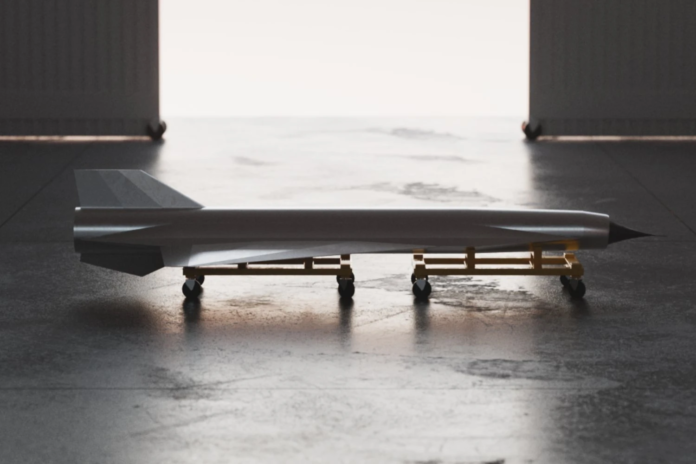
LOS ANGELES. Hermeus is developing a new expendable, ramjet-powered vehicle designed to provide sustained high-Mach flight testing without the cost and complexity of building a bespoke aircraft for every experiment.
Called Ramjet-X, the vehicle will be released from the company’s reusable Quarterhorse aircraft after being carried to the speed and altitude required for ramjet operation. Once released, Ramjet-X will ignite its air-breathing engine and continue under ramjet power, while Quarterhorse returns to base for future missions.

The architecture addresses one of the basic limitations of ramjet propulsion: a ramjet cannot produce useful thrust from a standstill. Unlike a turbojet, it has no compressor driven by a rotating turbine. Instead, it relies on the vehicle’s forward speed to compress incoming air before fuel is injected and burned.
That means a ramjet-powered vehicle first needs an external boost. Traditionally, this has involved a rocket booster, another aircraft or a large, expendable launch system. Hermeus says using a reusable Quarterhorse aircraft as the accelerator could make repeated tests more economical and operationally practical.
The company has not disclosed every performance parameter for Ramjet-X, including its precise top speed, range or payload capacity. However, its stated purpose is to operate in sustained high-Mach conditions, creating a platform for testing propulsion systems, sensors, communications equipment, materials, autonomy software and other aerospace technologies.
“High-speed flight testing is extremely expensive, and you don’t get many shots at it,” Hermeus chief executive Zach Shore said. The company believes Ramjet-X can reduce that barrier by offering a repeatable test vehicle rather than requiring customers to develop an entire high-speed aircraft programme for each experiment.

Hermeus plans to offer the capability as high-Mach Flight Test as a Service. Customers would be able to install experimental payloads and gather data in an environment that is difficult to recreate in wind tunnels or computer simulations. The model could appeal to defence contractors, research institutions, space companies and manufacturers developing components for fast aircraft and missiles.
Ramjet-X is also connected to Hermeus’s broader work on combined-cycle propulsion. Its Chimera engine concept combines turbine and ramjet technologies, allowing different propulsion modes to operate at different stages of flight. A turbine can provide thrust at lower speeds, while the ramjet takes over after the vehicle reaches conditions suitable for high-speed air-breathing propulsion.

The distinction is important because a purely ramjet-powered aircraft cannot simply take off from a runway and accelerate through the lower-speed regime. Ramjets generally become useful only after achieving substantial forward velocity and perform most efficiently at supersonic speeds. They can operate at much higher speeds, but aerodynamic heating, material durability, fuel control and stability become progressively more difficult.
Hermeus is conducting Ramjet-X engine testing at its HEAT facility in Jacksonville, Florida, while engineers develop high-temperature structures at the company’s headquarters in El Segundo, California. Integrated vehicle testing is currently planned for 2027.
The programme’s most significant promise may be its economics. High-speed flight research has traditionally depended on expensive, limited-use aircraft, large test ranges and lengthy preparation cycles. An expendable vehicle could eliminate refurbishment after each mission, while the reusable carrier could lower the cost of getting the test article airborne.
There are substantial risks. The company must prove that Ramjet-X can survive severe aerodynamic heating, maintain stable propulsion and transmit useful data during a demanding flight. It must also demonstrate that its reusable launch architecture can operate reliably and safely.
If successful, however, Ramjet-X could turn high-Mach testing from an occasional national programme into a more accessible commercial service – giving aerospace developers more opportunities to test, fail, improve and fly again.






