


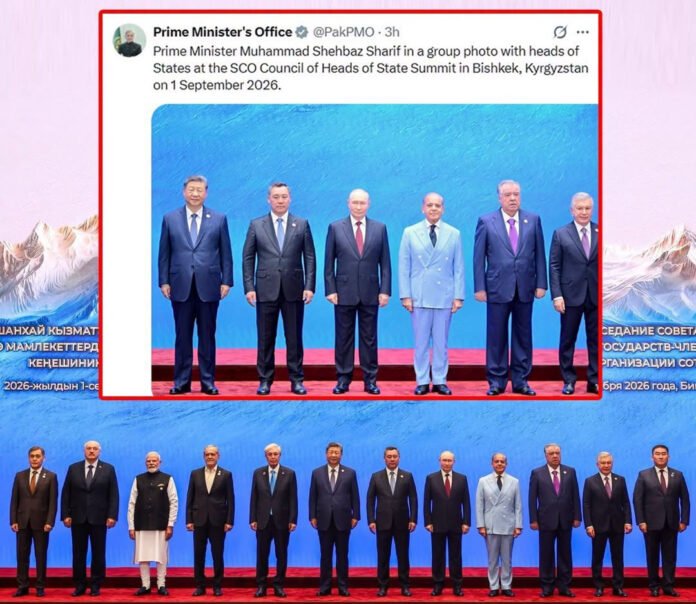
On September 1, 2026, at the close of the 26th Shanghai Cooperation Organisation (SCO) summit in Bishkek, the official account of Pakistan’s Prime Minister’s Office posted the customary family photograph of the assembled heads of state. Except that it was not the photograph.
The version Islamabad circulated had been cropped so that Prime Minister Shehbaz Sharif sat in the centre of the frame, with Indian Prime Minister Narendra Modi, Iranian President Masoud Pezeshkian and three other leaders removed from the view.

The unedited image, shared by the Indian side, showed Sharif standing fourth from the right, nowhere near the middle. Within hours, and after a wave of online ridicule, Sharif posted the full, uncropped picture on his own account. The Pakistani PMO offered no explanation, then or since.
The episode is trivial in itself and revealing in proportion to its triviality. It is worth taking seriously, because the question it has provoked in India, was this a message that the leaders erased from the frame will find themselves erased from the guest list when Pakistan hosts the SCO in 2027?… it deserves a clearer answer than the outrage cycle has supplied.
Begin with the most mundane explanation, because it is also the best supported. This was not, on the available evidence, a surgical strike against India or Iran. It was a vanity edit that went wrong.
Five leaders were cut, not one, and the object of the exercise was plainly to relocate Sharif from the periphery of the arrangement to its optical heart. That the crop happened to remove the Indian prime minister, hours after Modi had used the summit floor to warn that there could be no double standards on terrorism, gave the picture its sting and its virality.

But the simplest reading is a communications team optimising for a domestic feed rather than a foreign ministry sending a coded diplomatic signal. Islamabad, tellingly, has declined to confirm any motive at all, which means every grander interpretation, including the one now circulating, remains inference rather than established fact.
Pakistan cannot disinvite full members like India from the 2027 summit; the SCO is a consensus-driven, treaty-based organisation whose heavyweights would never tolerate structural exclusion
So, to the sharper question. Does the crop foreshadow a 2027 summit to which the erased nations will simply not be invited?

Here the answer is no, and the reason is structural rather than charitable. The SCO is not a guest list that a rotating chair curates to taste. It is a treaty-based, consensus-driven organisation of ten members in which India, Iran and Pakistan sit as full members alongside China, Russia and the Central Asian states.
The chair’s role is to convene, to set an agenda, and to steward the machinery of some thirty ministerial and expert meetings across the year, not to admit or exclude sovereign members according to bilateral mood.
A host that attempted to disinvite a full member would not be snubbing that member; it would be repudiating the organisation and forfeiting the chairmanship’s entire purpose.
Neither Beijing nor Moscow, the bloc’s other heavyweights, would tolerate a presidency that weaponised the calendar against a fellow member, least of all against India, whose participation is part of what gives the forum its claim to represent the Eurasian mainstream.
Both nations have consistently maintained functional participation in SCO meetings despite bilateral tensions, treating the platform as essential multilateral infrastructure rather than a venue for petty theatre
The precedent cuts the same way. India and Pakistan have shared SCO rooms throughout the deep freeze in their bilateral relations. External Affairs Minister S Jaishankar travelled to Islamabad for the 2024 foreign ministers’ meeting; Pakistan’s then foreign minister had earlier attended in Goa.
India has consistently treated the platform as functional infrastructure, a place to press its positions on terrorism and connectivity on its own terms, rather than a venue for bilateral theatre, and it has refused to let the organisation become hostage to the dispute with Pakistan. That posture will not change because of a photograph.
Whether Modi personally travels to Islamabad is a separate matter, and an open one; India is more likely to participate at a calibrated level, than to send its prime minister into a capital with which it has no functioning bilateral track. But participation and invitation are not in question. A member cannot be un-invited from a body it belongs to.
If the crop is not a guest list, though, it is not nothing either. Its real signal is about disposition, and disposition is what a chairmanship actually tests.
The instinct on display in Bishkek was to privilege how a moment looks to a home audience over how a member behaves within an institution, to treat a shared multilateral record as raw material for national self-presentation.
While Narendra Modi may not travel to Islamabad personally, India will almost certainly participate through calibrated, high-level diplomatic representation rather than boycotting the proceedings
That instinct is the precise opposite of the one a credible chair requires, which is the capacity to host all members with equal seriousness, including those with whom relations are difficult, and to resist the temptation to convert every occasion into a scoreboard.
Editing rivals out of a picture one fully controls is a small act. But it is a sign about how a host will handle the far larger domain a presidency does not control, viz. the protocol, the optics, the seating, the communiqués, the thousand points at which an aggrieved chair can either elevate the organisation or shrink it to the size of its own grievances.
That is the message worth drawing from the affair, not a threat of exclusion, which the SCO’s architecture forbids, but a preview of temperament, which the architecture cannot.
Pakistan enters its chairmanship with a genuine opportunity to project seriousness on a platform where it shares a table with three of the world’s more consequential capitals.
The photograph suggests the competing pull of a narrower reflex. The 2027 summit will not be judged by who stood where in a group shot, or by who was briefly cropped from one.
It will be judged by whether Islamabad chairs the organisation for the organisation, or for the audience back home. The crop was a small vote for the latter. The year ahead will show whether it was an aberration or an omen.
The writer is an expert on geopolitics, national security, and counter-terrorism; and he regularly contributes his subject thought-leadership and academic commentary with several publications in newspapers, journals, and periodicals. He works with investigative agencies, regulatory bodies, financial institutions and enterprises, providing strategic and regulatory advisory. The views expressed are personal and do not necessarily carry the views of Raksha Anirveda





