


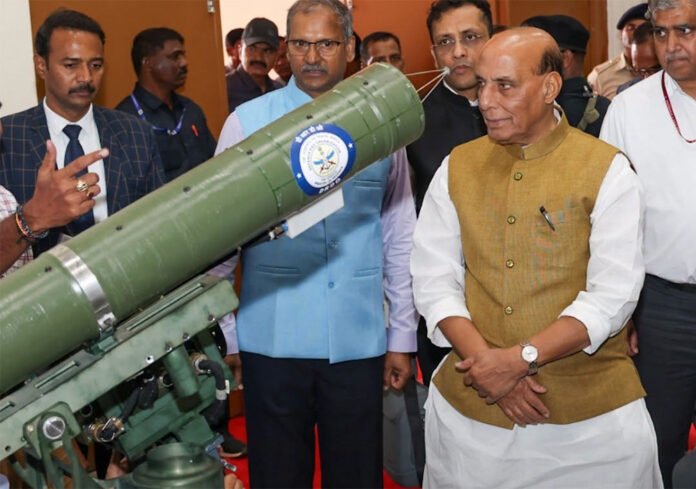
NEW DELHI. In a landmark policy shift aimed at bolstering self-reliance in military hardware, Defence Minister Rajnath Singh has formally approved the transfer of technology for all conventional missile systems developed by the Defence Research and Development Organisation to Indian private industry. The strategic move marks a fundamental departure from the traditional model where missile development was strictly tied to state-run nominated production agencies, opening-up an extensive portfolio of advanced guided weapons to domestic commercial manufacturers.
The government initiative covers a wide swathe of tactical and battlefield weapons systems, ranging from air-defence networks like Akash and Akash-NG to Astra air-to-air missiles, anti-radiation platforms and man-portable anti-tank guided systems.

However, the Ministry of Defence clarified that strategic deterrent assets, including the nuclear-capable Agni series and submarine-launched K-series ballistic missiles, will remain outside this framework, alongside foreign-partner joint ventures like BrahMos.
Under the approved guidelines, qualified domestic companies will be permitted to undertake complete end-to-end indigenous production of conventional missile systems, provided they meet rigorous qualification, certification and regulatory benchmarks.While private entities manage industrial assembly and manufacturing scaling, the research organisation will maintain oversight on overall design certification and quality assurance to safeguard system reliability.
The overarching objective of this policy is to transition advanced missile systems rapidly from early development cycles into high-rate industrial manufacturing.By leveraging private capital, modern manufacturing facilities and specialised engineering talents, the Ministry aims to deepen the national industrial ecosystem.
This initiative creates immediate production and tier-supplier opportunities for micro, small, and medium enterprises across the domestic aerospace component supply chain.

Expanding domestic missile production comes amidst changing regional security dynamics and rising demand for sustained, high-volume inventory production.Expanding local production capacity ensures the armed forces can sustain long-term operational capabilities without facing critical supply chain vulnerabilities or relying heavily on foreign original equipment manufacturers during crises.
This opening builds upon earlier reforms like the Development-cum-Production Partner model, which integrated major private defence majors directly into early missile testing and prototyping phases.With major private firms already constructing modern propellant facilities and dedicated missile parks, industry absorption capacity for complex military tech has reached unprecedented levels.

The policy aligns with broader momentum across the domestic defence sector.Official figures highlight that overall Indian defence production has expanded significantly in recent years, with private companies contributing nearly a quarter of total national defence output.With national defence export targets setting ambitious benchmarks, opening conventional missile manufacturing provides private manufacturers with the operational scale needed to supply domestic forces while expanding foreign military sales.By converting government research into scalable commercial production, India takes a decisive step toward defence autonomy.






