


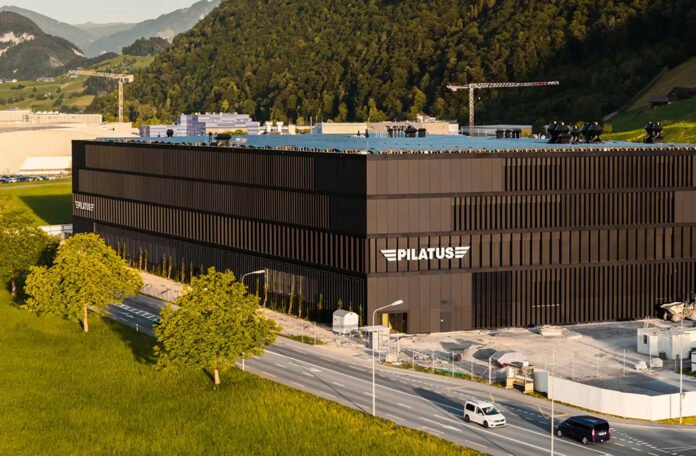
New Delhi: With its striking new “Schwarzhorn” building, Pilatus has officially opened an ultra-modern centre of advanced composite competence in canton Nidwalden: effective immediately, the development and production of composite components will be united under one roof for the first time. The new building provides state-of-the-art workplaces for around 300 employees and has been designed to meet the highest standards of sustainability.
Composites – also known as fiber-reinforced materials – have been used since over 40 years at Pilatus, but only for non-load-bearing secondary structures such as covers and cowlings. The PC-24 Super Versatile Jet marks a departure from this in that composite materials are now used for primary structural components as well: composite load-bearing control surfaces represent an important technological development in aircraft construction because they are lighter, and therefore contribute to fuel savings. Pilatus plans to expand the use of composites in the future.

Named after a Swiss mountain and the colour of the composite components, the “Schwarzhorn” building brings all the process steps together under one roof – from delivery and storage of raw materials through to component production, subassembly, and surface treatment, to storage and order picking. The components are delivered directly to the final assembly as finished kits. The largely self-sufficient composite production process allows all the disciplines involved to concentrate fully on value-adding activities. The manufacturing areas also provide the opportunity to use state-of-the-art manufacturing and inspection technologies in the future and to further automate production steps. The close collaboration between manufacturing and development is another key aspect associated with the new building.
“With this building, Pilatus is once again reaffirming its commitment to Switzerland as a place of innovation, manufacturing, and training – and to our sustainable development here at our home base, where our roots lie. Costing 100 million Swiss francs, this building is the most expensive facility we have invested in to date,” said Pilatus CEO Markus Bucher.
Setting New Standards in Sustainability
In addition to production technology, the “Schwarzhorn” is also setting new standards in terms of energy-related performance. Photovoltaic installations on the roof and facades, plus the use of process-related waste heat and groundwater for heating and cooling respectively, significantly reduce the need for energy from external sources.
Another first for Pilatus is the company’s goal of obtaining LEED Platinum certification for the new building. This internationally recognised label stands for sustainable construction and focuses on resource conservation, environmental protection and reduction of energy and water consumption.







