


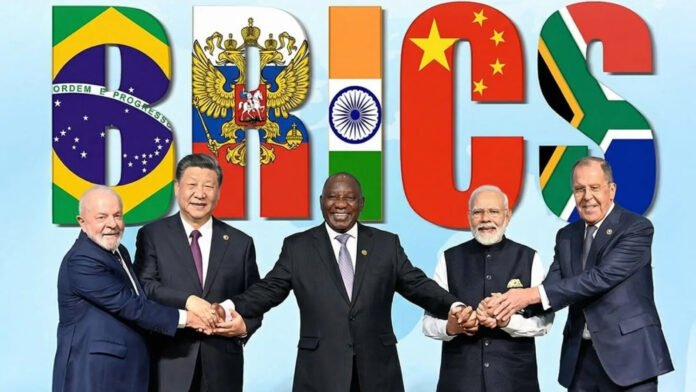
India will host the 18th edition of the BRICS Summit over two days on September 12 and 13 at a time at a time when trade tensions, supply-chain disruptions, geopolitical conflicts and rapid technological change are reshaping the global economy. India, as Chairman of this grouping will be seeking concrete cooperation in trade, cross-border payments, supply chains, technology and artificial intelligence, energy, development finance and global governance.
That is why the September summit is less about announcing another grand vision and more about showing whether BRICS can deliver practical cooperation.

In the present situation, India’s BRICS Chairmanship is guided by the theme “Building 18th for Resilience, Innovation, Cooperation and Sustainability”, reflecting a people-centric and humanity-first approach articulated by Prime Minister Modi at the 2025 Rio Summit.
The summit prioritises actionable cooperation across cross-border trade, MSME integration and the Strategy for Economic Partnership 2030, leveraging the combined market power of major manufacturing economies, energy producers and key consumer hubs
‘Our goal will be to redefine BRICS as Building Resilience and Innovation for Cooperation and Sustainability. Just as we brought inclusivity to our G-20 Presidency and placed the concerns of the Global South at the forefront of the agenda, similarly, during our Presidency of BRICS, we will advance this forum with a people-centric approach and the spirit of ‘Humanity First,’ said PM Modi.
The Summit will bring together leaders from BRICS Member and Partner Countries, along with Outreach Invitees.
India’s Chairmanship of BRICS has been marked by more than 350 meetings and high-level engagements across over 25 cities nationwide, spanning BRICS’ three key pillars: political and security cooperation, economic and financial cooperation, and cultural and people-to-people exchange. These efforts, along with business and people-to-people initiatives, have helped deliver practical, development-focused outcomes for the BRICS partnership.

India is championing a comprehensive supply-chain framework to insulate member states from geopolitical conflicts, export controls and shipping bottlenecks without creating a closed trading bloc
As a founding member of BRICS, India has chaired the group three times before – in 2012, 2016, and 2021 and took on its fourth Chairmanship. This year also marks a milestone: BRICS turns 20 since its founding.
India wants BRICS to become more useful to businesses, particularly by improving trade flows within the grouping and making global supply chains less vulnerable to shocks.

At the BRICS Trade Ministers Meeting in Jaipur in August, members advanced work on the Strategy for Economic Partnership 2030. The proposed strategy covers trade in goods and services, investment, the digital economy, industry, innovation and financial cooperation. Ministers also backed measures aimed at expanding the participation of MSMEs in global trade.
Over the years at BRICS Summit meetings, India has also been pushing for more balanced intra-BRICS trade and more diversified global value chains.
That is of immense importance to the BRICS members because the expanded group brings together major manufacturing economies, energy producers, commodity exporters and some of the world’s largest consumer markets.
Rather than pursuing an unfeasible single currency, the grouping focuses on local-currency settlements, linking fast payment systems and integrating central bank digital currencies (CBDCs) to streamline cross-border trade
A supply-chain framework is expected to be among the important outcomes India will seek at the summit. The objective is not to create a closed trading bloc, but to improve resilience against disruptions caused by wars, shipping problems, export restrictions and overdependence on particular suppliers.
India is also making clear that BRICS cooperation should complement, rather than replace, the multilateral trading system. At the Jaipur meeting, New Delhi backed the WTO as the core of global trade governance while defending special and differential treatment for developing economies.
Another issue that is expected to draw focus at the two-day Summit is Cross-border payments as India is promoting greater use of national currencies in trade, and is exploring ways for BRICS payment systems to work more closely with one another.
Recent discussions have included the possible linking of fast payment systems and central bank digital currencies. India is also expected to push BRICS partners towards more seamless cross-border digital payment arrangements.
This is important because the most realistic BRICS financial project is not a common currency. The members have widely different monetary systems, financial markets and policy priorities. Building payment connectivity and enabling local-currency settlement is far more achievable than creating a single currency.
Reaffirming commitment to the World Trade Organisation, India emphasises that BRICS initiatives should complement global trade governance while safeguarding special and differential treatment for developing nations
For India, it also fits with the broader push to increase the international use of the rupee.
The two-day Summit will see India focusing on the need to step-up progress on trade and supply chains. It would also emphasise on payment systems that can actually connect markets. It wants the NDB and local-currency finance to play a larger role. It wants BRICS countries to cooperate on AI, digital infrastructure and critical technologies.
And it wants a stronger collective voice for the Global South in global institutions. The broad objective is therefore, not simply to build an anti-Western bloc or replace the dollar. It is to create a larger economic and diplomatic platform where emerging economies can cooperate on the systems that increasingly determine their growth and strategic autonomy.
India wants BRICS to strengthen the voice of emerging and developing economies in institutions that still reflect an older global balance of power. That means pushing for reform of the United Nations and UN Security Council, IMF, World Bank and WTO, among other international institutions.
The agenda highlights cooperation in artificial intelligence, critical technologies and digital public infrastructure, positioning BRICS as a platform for strategic autonomy and Global South development
External Affairs Minister S Jaishankar has repeatedly linked the BRICS agenda to what India describes as the need for a more representative and effective multilateral system.
This is also where BRICS faces its biggest internal challenge. The 11 members do not share identical geopolitical interests. India and China have their own strategic competition. Russia has a very different relationship with the West from countries such as India, Brazil or the UAE. Questions involving conflicts and security can therefore be much harder to negotiate than economic issues.
The expanded grouping now includes Brazil, Russia, India, China, South Africa, Egypt, Ethiopia, Iran, the UAE, Indonesia and Saudi Arabia, although Saudi Arabia’s status has been described differently by some official sources. The expansion has increased the blocs’ economic weight, but also made consensus more difficult.
With expanded membership bringing varied geopolitical priorities, India’s chairmanship aims to anchor the bloc on practical economic synergy rather than anti-Western sentiment
That is why the September summit is less about announcing another grand vision and more about showing whether BRICS can deliver practical cooperation.
India wants progress on trade and supply chains. It wants payment systems that can actually connect markets. It wants the NDB and local-currency finance to play a larger role. It wants BRICS countries to cooperate on AI, digital infrastructure and critical technologies.
And it wants a stronger collective voice for the Global South in global institutions. The broad objective is therefore not simply to build an anti-Western bloc or replace the dollar. It is to create a larger economic and diplomatic platform where emerging economies can cooperate on the systems that increasingly determine their growth and strategic autonomy.
The September 12-13 summit in New Delhi will show how much of that ambition can be converted into concrete outcomes.

– The writer is a senior journalist and media consultant. The views expressed are of the writer and do not necessarily reflect the views of Raksha Anirveda.





