


For most of the modern era, power was measured in tanks, warheads and carrier groups. That measure is changing. A rare-earth magnet, a piece of denied software code, or a single lithography machine can now do what an aircraft carrier once did: freeze an adversary’s options without firing a shot. The battlefield has quietly shifted from the front line to the supply chain, and few states have grasped how quickly it happened.
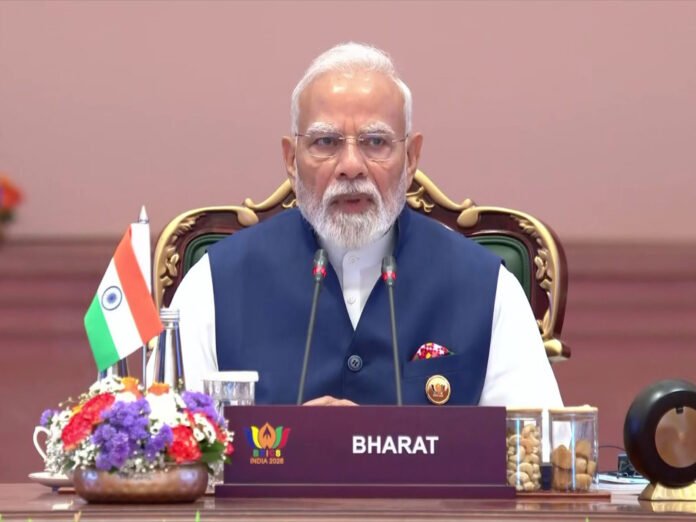
This tension surfaced at the BRICS summit hosted by New Delhi on September 13 and 14, 2026. Xi Jinping used the platform to offer BRICS members Chinese support for building open-source artificial intelligence and smart manufacturing capacity, framing it as support for the Global South against Western technological dominance. Prime Minister Modi, chairing the session, offered a pointed reply without naming Beijing, warning that the weaponisation of technology and critical minerals could hinder shared progress and calling for greater inclusivity in adopting new technology. The exchange captured the bloc’s deeper problem: unity against Washington’s tariffs and sanctions was easy to declare in a joint statement, but the mineral and technology anxieties within BRICS itself were harder to paper over.

When China placed rare earth magnets under a global export licensing system in 2025 amid its tariff standoff with the US, Indian automotive assembly lines felt the effect within weeks. Since April 2025, China has enforced a licensing regime for seven rare earth elements central to magnets, motors and munitions guidance
India speaks from direct experience. After the deadly 2020 border clash between Indian and Chinese troops, Beijing slowed fertiliser clearances and delayed shipments of certain equipment to India, an early demonstration that routine trade approvals could be used as pressure. When China placed rare earth magnets under a global export licensing system in 2025 amid its tariff standoff with Washington, Indian automotive assembly lines felt the effect within weeks, a reminder that a dispute between two other powers can still reach an Indian factory floor.
Rare earths are the clearest case in the wider pattern. Since April 2025, China has enforced a strict licensing regime for seven rare earth elements central to magnets, motors and munitions guidance. Beijing eased parts of that regime in November 2025 under trade pressure, only to reopen the pressure point in January 2026 with a dual-use export ban aimed at Japan, triggered by a diplomatic dispute over Taiwan. Trade analysts have described this pattern in blunt terms: not a scarcity problem, but a deliberate weaponisation of chokepoints. China holds close to 90% of global rare earth refining and separation capacity. A country can mine its own ore and still be unable to turn it into a usable magnet, because the knowledge to refine it sits almost entirely in Chinese hands. Export controls on processing technology and technical know-how, imposed in October 2025, made that dependency explicit. Control, in this sense, is not about who owns the rock. It is about who owns the chemistry.
Khanij Bidesh India Limited has secured lithium exploration rights in Argentina’s Catamarca province, and India joined Australia, Japan and the United States in launching the Quad Critical Minerals Initiative Framework in New Delhi in May 2026, aimed at diversifying supply chains away from a single dominant source
The same logic now governs semiconductors. Advanced lithography equipment, AI accelerator chips, and the software toolchains that design them have become instruments of statecraft rather than items of commerce. Washington restricts the export of high-end chips and chipmaking tools to slow a rival’s military modernisation. Beijing restricts the materials without which no chip factory anywhere can function. Each side holds a lever over the other, and neither lever requires moving a single soldier. This is coercion by denial, and it rewards whoever controls the narrowest bottleneck in a very long chain, not whoever has the largest economy.
For India, this is not an abstract debate. Rare earth magnets are integral to missile guidance systems, drone motors, radar assemblies, and the electric propulsion India seeks for its next-generation naval and land platforms. A defence industrial base that depends on imported magnets can be quietly throttled in a crisis, well before the first missile leaves its rail. New Delhi has begun to respond with seriousness.

The National Critical Mineral Mission, approved by the Union Cabinet with an outlay of Rs 34,300 crore over seven years, aims to reduce import dependence across 30 identified critical minerals, 24 of which now fall under the Central government’s auction authority. In November 2025, the government approved a Rs 7,280 crore scheme to build 6,000 MTPA of integrated rare earth permanent magnet manufacturing capacity, covering the chain from oxide to finished magnet rather than mining alone.
The Union Budget for 2026-27 has proposed dedicated rare earth corridors in Odisha, Kerala, Andhra Pradesh and Tamil Nadu, intended to cluster processing, research and manufacturing rather than leave India as a raw material exporter waiting on someone else’s refinery. Khanij Bidesh India Limited has secured lithium exploration rights in Argentina’s Catamarca province, and India joined Australia, Japan and the United States in launching the Quad Critical Minerals Initiative Framework at New Delhi in May 2026, aimed at diversifying supply chains away from a single dominant source.

The weaponisation of technology and minerals is not a passing trade dispute. It is a structural feature of a world in which supply chains have become as strategic as sea lanes, and where a licensing notice from a commerce ministry can achieve what a blockade once required a navy to do
These are the right instincts, but instincts are not yet capacity. Mining is the easy half of the problem. Refining, separation and magnet manufacturing are the hard half, and that is precisely where China built its advantage over four decades, not four years. A corridor announced in a budget speech takes years to become a functioning plant with trained metallurgists and qualified output. India’s own reserves of rare earths, held largely by IREL in Odisha and Kerala, remain underexploited relative to their potential, constrained by processing bottlenecks rather than by geology. Building mines without building the chemistry to go with them will only shift India’s dependence from one import basket to another.
There is a broader lesson here for how India thinks about strategic autonomy. Deterrence used to mean submarines, satellites and strike aircraft. It now also means a domestic magnet line that keeps running even when a foreign ministry in Beijing decides to make a point to Tokyo, Washington or New Delhi. Stockpiling matters, recycling matters, and so does the unglamorous work of training metallurgists and chemical engineers who can do what Chinese refineries have spent 40 years learning to do. None of that carries the drama of a missile test, but all of it decides whether the missile can be built at all.
PM Modi’s warning at the BRICS summit was aimed at a room, not just at Beijing, but the underlying point applies everywhere. The weaponisation of technology and minerals is not a passing trade dispute. It is a structural feature of a world in which supply chains have become as strategic as sea lanes, and where a licensing notice from a commerce ministry can achieve what a blockade once required a navy to do. States that treat this as an economic footnote will find their military options quietly narrowed in the middle of a crisis, at the very moment those options matter most. States that build sovereign capacity across the full value chain, from ore to finished component, will retain the freedom to act when it counts. India has taken the first steps. The test now is whether the corridors on paper become refineries on the ground before the next chokepoint closes.

The writer, a PVSM, AVSM, VSM has had an illustrious career spanning nearly four decades. A distinguished Armoured Corps officer, he has served in various prestigious staff and command appointments including Commander Independent Armoured Brigade, ADG PP, GOC Armoured Division and GOC Strike 1. The officer retired as DG Mechanised Forces in December 2017 during which he was the architect to initiate process for reintroduction of Light Tank and Chairman on the study on C5ISR for Indian Army. Subsequently he was Consultant MoD/OFB from 2018 to 2020. He is also a reputed defence analyst, a motivational speaker and prolific writer on matters of military, defence technology and national security. The views expressed are personal and do not necessarily carry the views of Raksha Anirveda





