



At first glance, the on-going CJP protest appears to be another episode in India’s vibrant democratic tradition – citizens expressing dissent over a contentious public issue. Yet, as reports of violence, attacks on police personnel, destruction of public property and the participation of groups beyond the original stakeholders emerged, the debate quickly expanded beyond the immediate grievance.
A strategic question began to surface: can a legitimate protest, over time, be hijacked by organised violent elements, political opportunists or even external influence campaigns pursuing objectives far removed from the original cause?

This is precisely why national security today demands that we examine not merely events, but the narratives built around them. The defining question of our age is no longer simply who controls territory, but who shapes public perception. That marks the beginning of a new form of conflict.
The New Battlefield
For centuries, military power determined the rise and fall of nations. Victory belonged to the side that commanded larger armies, superior weapons and stronger alliances. The twentieth century expanded the battlefield to include economic sanctions, proxy wars, covert operations and ideological competition.
The twenty-first century has introduced yet another dimension – the cognitive battlefield.
Today, the objective is increasingly to influence minds rather than capture land. Instead of destroying bridges, adversaries seek to erode trust. Instead of occupying cities, they attempt to occupy the national imagination.

A society that loses confidence in its institutions can become strategically vulnerable even when its economy grows, its military remains strong and its borders stay secure. This is the essence of narrative warfare.
Narratives shape how citizens interpret events, identify heroes and villains, judge governments and define national interest. Once a compelling narrative gains momentum, facts often struggle to reverse its impact. Public perception begins to influence political outcomes, investor confidence, diplomatic standing and even national morale.

Twenty-first-century geopolitical conflict prioritizes occupying national imagination over capturing territory. Fueled by rapid digital communication and AI, narrative warfare targets public perception, seeking to erode trust in democratic institutions long before any physical boundary is breached
Digital technology has accelerated this transformation dramatically. Information now travels faster than verification. Artificial Intelligence produces persuasive content at unprecedented speed. Social media platforms reward outrage more readily than nuance. In this environment, perception itself has become a strategic weapon.
The decisive battles of the future may therefore be fought less with missiles than with messages.
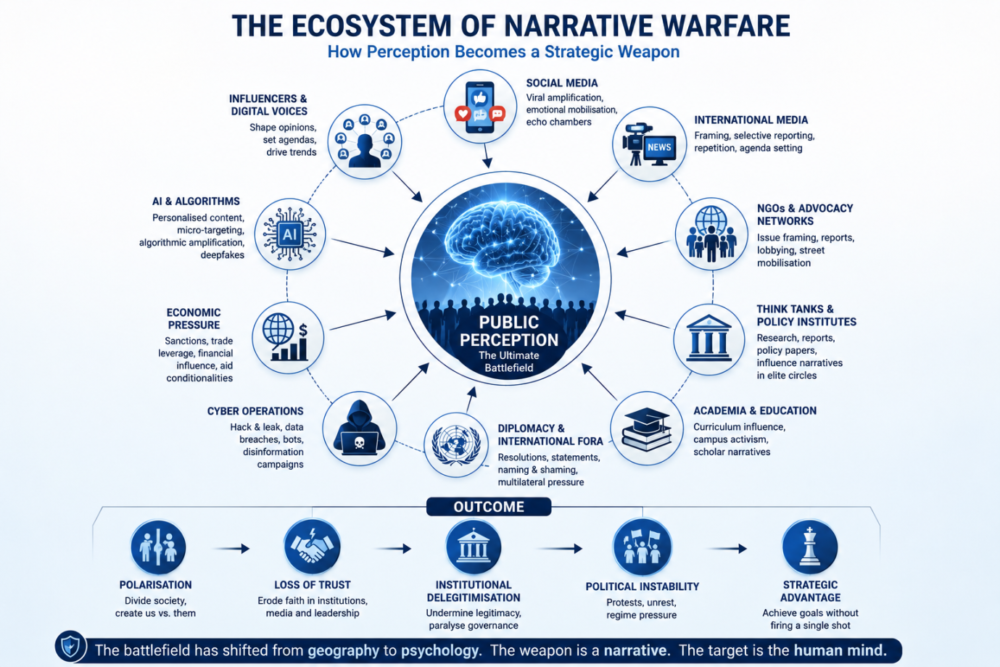
Anatomy of Narrative Warfare
Narrative warfare is neither simple propaganda nor ordinary public relations. It is the systematic attempt to shape the political, social and psychological environment in which decisions are made.
Its strength lies not in any single instrument but in the cumulative effect of many.
International media coverage, social media campaigns, think tanks, academic discourse, advocacy organisations, legal activism, diplomatic messaging, cyber operations and economic pressure can all influence public opinion.
Rather than relying on simple propaganda, narrative warfare coordinates media, social platforms, and advocacy groups to amplify existing internal fault lines. By converting local grievances into deep polarization, external and domestic actors strategically undermine national stability without firing a single shot
Each performs a legitimate role within its own sphere. Yet, when multiple streams reinforce a common storyline, intentionally or unintentionally, they can create a powerful perception that transcends objective reality.
History offers many examples of major powers seeking to shape political developments beyond their borders through non-military means. During the Cold War, ideological competition was fought as intensely through information campaigns and influence operations as through military deterrence. Contemporary geopolitical competition has refined these methods rather than abandoned them.
Recent political upheavals in Sri Lanka, Bangladesh and Nepal illustrate the complexity of this emerging battle-space. In each case, domestic political and economic factors were unquestionably significant.
At the same time, the transitions unfolded amidst intense international attention and broader geopolitical competition. The information, narratives and international perception became central components of the political contest.
The lesson is neither to dismiss every protest as foreign-inspired nor to ignore the possibility that external actors may seek to exploit domestic fault lines. Both extremes are strategically unwise.
Narrative warfare succeeds not by manufacturing divisions from nothing, but by amplifying existing grievances until they overshadow institutional resilience. It converts disagreement into distrust, distrust into polarisation and polarisation into strategic vulnerability.
That is why the most important battles of the twenty-first century may no longer begin at the border. They may begin in the information ecosystem, spread through competing narratives and ultimately reshape the political destiny of nations without a single bullet being fired.
Why Rising Powers Become Targets
History suggests that periods of major geopolitical transition are rarely peaceful. As nations rise economically, technologically and strategically, they inevitably alter existing equations of power.
Established powers seek to preserve influence while emerging powers seek greater strategic autonomy. This competition increasingly unfolds not only through trade, technology or military capability, but also through ideas, perceptions and narratives.
As India expands its global economic and diplomatic influence while maintaining strategic autonomy, it naturally faces heightened scrutiny. Its open democratic framework and active domestic debates make it a primary target for competing external narratives seeking to challenge its sovereignty
India today represents one of the world’s fastest-growing major economies, an increasingly influential diplomatic actor and a nation determined to pursue an independent foreign policy.
Whether on energy security, strategic partnerships, digital sovereignty or indigenous technological development, New Delhi has demonstrated a willingness to make decisions based primarily on national interest rather than bloc politics.
Such autonomy inevitably attracts greater international scrutiny. Differences over issues such as foreign funding regulations, educational reforms, technology governance, human rights, trade policies or strategic alignments are likely to generate competing narratives both within and outside the country. This is neither surprising nor unique to India. Every consequential power experience similar contestation.
India’s Emerging Cognitive Battle-space
India’s greatest strength has always been its democratic resilience. It has accommodated extraordinary diversity while preserving constitutional continuity. Yet the very openness that defines Indian democracy also presents opportunities for manipulation.
India’s vibrant democracy and digital connectivity create ripe conditions for rapid misinformation and viral outrage. The nation faces a delicate balance: it must safeguard constitutional rights to peaceful dissent while actively defending against coordinated, tech-driven campaigns designed to incite violence and destabilize governance
The digital revolution has transformed every citizen into both a consumer and producer of information. News travels instantly. Rumours travel even faster. Artificial Intelligence, deep-fakes and algorithm-driven amplification have made it increasingly difficult to distinguish authentic information from carefully crafted misinformation.
Simultaneously, debates surrounding identity, education, history, language, religion, federalism and economic inequality have acquired unprecedented emotional intensity. In such an environment, narratives can spread far more rapidly than facts.
The challenge before India is therefore twofold. It must protect the constitutional right to peaceful protest, dissent and free expression while remaining vigilant against organised violence, disinformation campaigns and any coordinated attempts—whether domestic or external – to exploit legitimate grievances for destabilising purposes.
A mature democracy does not fear criticism. It fears only the erosion of public trust through manipulation, misinformation and sustained polarisation. Ultimately, the true battleground is neither Parliament nor the street. It is public confidence itself.
Building National Narrative Resilience
If narrative warfare represents the newest instrument of geopolitical competition, India’s response cannot simply be reactive. It must be comprehensive, democratic and forward-looking.
- First, India requires a coherent national strategic communication framework capable of presenting factual, timely and credible information during crises. In the absence of trusted communication, speculation inevitably fills the vacuum.
- Second, greater transparency in political financing, foreign funding and institutional partnerships will reduce opportunities for both genuine interference and unfounded suspicion. Transparency strengthens legitimacy.
Countering cognitive threats requires proactive governance rather than reactive censorship. India can strengthen national defense by establishing clear strategic communications, enhancing digital literacy, ensuring funding transparency, and reinforcing the integrity of key public institutions to continuously earn citizen trust
- Third, digital literacy must become a national mission. Citizens should be equipped to recognise manipulated content, coordinated influence campaigns and misinformation without compromising their freedom to access diverse viewpoints.
- Fourth, intelligence and law-enforcement agencies must continue strengthening their capacity to identify covert influence operations, cyber-enabled information campaigns and organised violence while ensuring that all actions remain firmly within the constitutional framework and the rule of law.
- Fifth, governments must distinguish carefully between peaceful democratic dissent and criminal violence. Protecting the former while dealing firmly with the latter reinforces both democracy and national security.
- Finally, India’s greatest defence lies in strengthening the very institutions that hostile narratives seek to undermine – an impartial judiciary, professional civil services, credible media, accountable governance, robust electoral systems and an informed citizenry. Trust cannot be manufactured during a crisis; it must be cultivated continuously.
Narrative resilience is therefore not merely an information strategy. It is an outcome of good governance, institutional credibility and national confidence.
Winning the War Before It Begins
The defining conflicts of the twenty-first century may not resemble the wars of the twentieth. They may unfold without invading armies, aerial bombardment or territorial occupation. Instead, they will seek to weaken nations from within by eroding confidence, amplifying divisions and reshaping public perception.
India’s response should neither be paranoia nor complacency. It should be strategic confidence. A confident nation does not suppress debate; it enriches it with facts. It does not fear criticism; it answers it through stronger institutions. It does not weaken democracy in the name of security; it strengthens democracy as the foundation of security.
The first line of defence in the cognitive age is no longer the border fence alone. It is an informed citizen, a trusted institution and a cohesive society. The wars of the future may not begin with artillery. They may begin with a hashtag, gather strength through a narrative and seek victory through the erosion of public trust.
Nations that understand this transformation will be better prepared not merely to defend their borders, but to defend the confidence of their people – the ultimate source of national power.

Lt Gen Rajeev Chaudhry (Retd) writes on contemporary national and international issues, strategic implications of infrastructure development towards national power, geo-moral dimension of international relations, and leadership nuances in a changing social construct. The views expressed are of the author and do not necessarily reflect the views of Raksha Anirveda





