


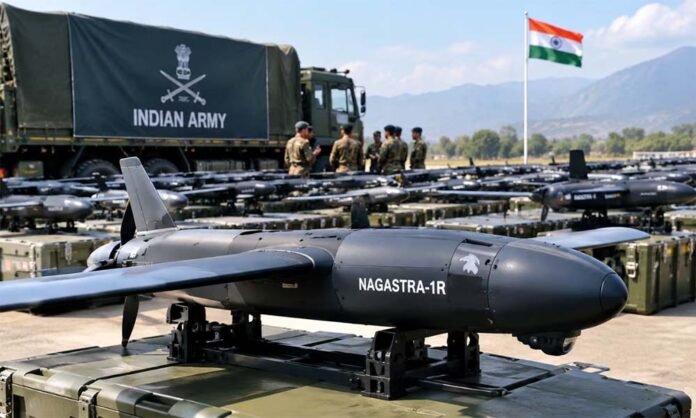
The latest delivery by Solar Defence and Aerospace strengthens the Army’s short-range precision-strike capability and marks a significant step in the expansion of India’s domestically developed loitering-munition programme. Solar Defence and Aerospace Limited (SDAL), a subsidiary of Solar Industries India, said the order followed technical evaluations and live trials under the Army’s emergency procurement process. The company described the consignment as the largest single-batch supply of loitering munitions to the Indian Army by a manufacturer.
The Nagastra-1R is a short-range variant configured to meet Army requirements. It is designed to circle over an area, gather information and strike a designated target if authorised. Unlike a conventional one-way drone, the system can reportedly abort its mission and return for recovery if the target is not identified or the attack is called off. That feature allows recovery of the munition, rather than its destruction on every sortie.

SDAL said four companies took part in the technical trials, but that it alone demonstrated all the required operational parameters. The Army’s order came after those tests, according to reporting on the delivery. The company has not publicly disclosed the contract’s value, the delivery schedule beyond the single batch, or details of future orders.
The system is an electric-powered, fixed-wing unmanned aircraft. Reported specifications for the Nagastra platform include an endurance of up to 60 minutes, a range of 15 kilometres when controlled by an operator and up to 30 kilometres in autonomous mode. The exact performance of a particular sortie can depend on mission conditions and configuration. The 1R’s reported equipment includes a 360-degree gimbal camera, an optional thermal camera and encrypted video and telemetry links.
The munition is reported to have a circular error probable of about two metres-a measure indicating how close rounds or strikes are expected to fall to a target. Its ability to loiter can give operators time to observe an area before selecting a target. The system is intended for short-range operations, where portable equipment and operator control may support rapid deployment. These are reported specifications; battlefield effectiveness depends on training, communications, target conditions and operational context.
The 450-unit delivery should be distinguished from an earlier Nagastra-1 procurement. In 2023, Solar Industries’ subsidiary Economic Explosives Limited received a ₹212-crore contract for the baseline Nagastra-1 loitering munitions. The Army received 480 of those systems in 2024, according to reporting on that earlier delivery. The new consignment is for the updated Nagastra-1R variant, not a repeat of the earlier 480-unit batch.

The earlier system was developed by Economic Explosives Limited in association with Bengaluru-based Z-Motion Autonomous Systems. The 1R incorporates changes, including updated observation equipment and communications features, according to published descriptions. The company has said the variant contains more than 80 per cent indigenous content. Domestic production is a stated objective of India’s defence policy, although the precise supply-chain composition of each system has not been disclosed in the delivery announcement.
Loitering munitions have attracted attention in conflicts where relatively low-cost unmanned systems can provide surveillance and precision attacks. Their use also raises operational challenges: forces must protect command links, distinguish legitimate targets, manage electronic interference and ensure that human operators comply with applicable laws and rules of engagement. The ability to abort and recover can support flexible operations, but does not remove the need for rigorous targeting and oversight.

The order followed the Army’s emergency procurement route, allowing it to acquire systems after evaluating them against operational requirements. Such procurement does not by itself establish how widely the weapon will be deployed or whether further batches are planned. SDAL said the delivery represents a milestone for its loitering-munition programme and points to further deployments with the armed forces.
For the Army, the consignment adds a locally produced option for precision strikes at short ranges. The next measure of the programme’s success will be how reliably the systems perform in service, how effectively units can integrate them into operations, and whether the manufacturer can sustain production and support.






