


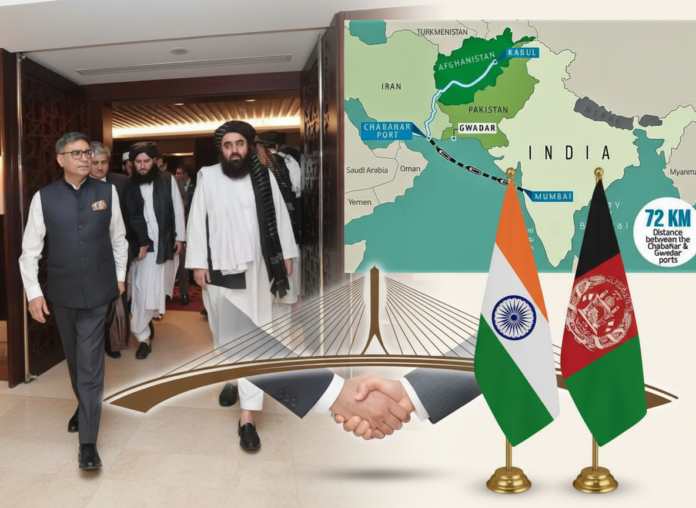
Much has happened in five years since Afghanistan Taliban 2.0 came into existence on August 14, 2021 and Indo-Afghan relations appear to have taken a positive turn and the relations assumes significance in the wake of the deterioration of relations between Afghanistan and one-time close ally and neighbour Pakistan.
As Afghanistan under Taliban celebrated its Independence Day or locally called Afghan Liberation Day on August 19, the relations between India and Afghanistan have indeed been warming up with India extending increased assistance.

It is imperative to note that India and Afghanistan share long-standing historical and cultural ties and though India does not formally recognise the Taliban administration, New Delhi has shifted toward pragmatic, direct diplomatic and humanitarian engagement to secure trade routes, counter regional terrorism and provide vital medical and food aid to Afghanistan.
In the existing scenario, Afghanistan is important for India for various reasons including India’s vision of being a regional leader and a great power, coupled with its competition with China over resources and its need to counter Pakistani influence.
Following the high-level Delhi meeting between EAM Dr S Jaishankar and Afghan Foreign Minister Mawlawi Amir Khan Muttaqi, both nations underscored mutual respect for sovereignty. Kabul formally pledged not to allow Afghan territory to be used against India, while unequivocally condemning regional terrorism
Since British rule and the Anglo-Russian relations, Afghanistan’s location at the crossroads of South and Central Asia makes it a critical hub for India’s regional and international interests.
With Afghanistan having been a major source of instability and terrorism in the region, India has a vested interest in ensuring peace and stability in the country.

Apart from the political aspect, India needs to strengthen ties with the Taliban ruled country as Afghanistan has abundant natural resources such as oil, natural gas and minerals, and India sees potential for mutually beneficial cooperation in these sectors.
India sees its relationship with Afghanistan as an important part of its regional cooperation in South Asia, and is committed to supporting Afghanistan’s efforts towards peace, stability and development.

Afghanistan which is a completely landlocked nation – the nearest coast being the Arabian Sea, about 300 miles (480 km) to the south – and, because of both its isolation and its volatile political history, it remains one of the most poorly surveyed areas of the world.
It is bounded to the east and south by Pakistan (including areas of Pakistan occupied Kashmir), to the west by Iran, and to the north by the Central Asian states of Turkmenistan, Uzbekistan and Tajikistan.
It also has a short border with Xinjiang, China, at the end of the long, narrow Wakhan Corridor, in the extreme northeast. Its overall area is roughly twice that of Norway.
India continues to anchor its soft power through impactful healthcare initiatives. Key projects include constructing a 30-bed hospital in Bagram, regional maternity clinics, an Oncology Centre and critical infrastructure upgrades at Kabul’s Indira Gandhi Institute of Child Health, alongside providing prosthetic limbs and specialised treatment
Four years since the Taliban’s return on August 15, 2021, Afghanistan reflects a landscape of both advances and setbacks. The regime has consolidated control across the country, strengthened fiscal management, curtailed opium cultivation, and delivered an improved security environment, while sustaining pragmatic relations with regional neighbours.
At the same time, its refusal to embrace inclusivity and persistent curbs on women’s rights have deepened humanitarian distress. Though international engagement has grown, contradictions continue to define governance.
Meanwhile, India-Afghanistan relations are undergoing a pragmatic transition, moving from complete disengagement after the 2021 Taliban takeover to active diplomatic, economic and humanitarian interactions.
Driven by shifting regional dynamics and deteriorating Afghan-Pakistan ties, India upgraded its technical mission in Kabul to a full embassy, while continuing to provide extensive humanitarian aid and development.
In the prevailing scenario on the North West borders of India, it becomes imperative that Afghanistan’s economic development and stable security conditions are also essential for India’s strategic interests in Central Asia.
The country connects India to the energy-rich Central Asian countries along with access to new markets. This link is essential for India due to its ever-increasing energy needs.
India’s engagement in Afghanistan is a long-term commitment. For India’s future interests in the country, it needs to invest in building better economic opportunities that prevent insurgencies. Afghanistan’s domestic stability is important for India’s regional integration, too. India should not slack on its economic diplomacy especially with China’s increasing interest in Afghanistan.
Recognising Afghanistan’s vast untapped mineral wealth and energy needs, the Taliban administration has invited Indian firms to invest in domestic mining. Furthermore, both sides agreed to partner on sustainable water management and hydroelectric infrastructure, building on the legacy of the Salma Dam
Indo-Afghan relations were put on a major step forward when on October 10, 2025, External Affairs Minister Dr S Jaishankar held detailed discussions with the Afghan Foreign Minister, Mawlawi Amir Khan Muttaqi, in New Delhi on a wide range of issues of mutual interest, as well as important regional developments.
Jaishankar expressed his deep appreciation to Afghanistan for its strong condemnation of the terrorist attack in Pahalgam, Jammu and Kashmir on April 22, 2025, as well as for the sincere condolences and solidarity expressed with the people and Government of India.
Both sides unequivocally condemned all acts of terrorism emanating from regional countries. They underscored the importance of promoting peace, stability and mutual trust in the region.
Both sides have also emphasised respect for each other’s sovereignty and territorial integrity. External Affairs Minister appreciated Afghan side’s understanding of Indias security concerns. The Afghan Foreign Minister reiterated the commitment that the Afghan government will not allow any group or individual to use the territory of Afghanistan against India.
Considering Afghanistan’s pressing requirement for economic recovery and development, both sides agreed that India would further deepen its engagement in development cooperation projects, particularly in the sectors of healthcare, public infrastructure and capacity-building.
As part of India’s ongoing healthcare cooperation with Afghanistan, several projects are being undertaken, including the establishment of a Thalassemia Centre, a Modern Diagnostic Centre and replacement of the heating system at the Indira Gandhi Institute of Child Health (IGICH) in Kabul.
Afghanistan’s location at the crossroads of South and Central Asia makes its domestic stability essential for India’s energy security and market expansion. Maintaining active economic diplomacy in Kabul allows New Delhi to counter Pakistani influence and balance growing Chinese interest in the region
Additionally, India will construct a 30-bed hospital in Kabul’s Bagrami district, an Oncology Centre and a Trauma Centre in Kabul, and five Maternity Health Clinics in the provinces of Paktika, Khost, and Paktia.
About 75 prosthetic limbs have been successfully fitted to Afghan nationals, which was widely appreciated by both the Afghan government and the international community. India will also continue to extend medical assistance and provide high-quality healthcare treatment to Afghan nationals.
Both sides welcomed the commencement of the India-Afghanistan Air Freight Corridor, which will further enhance direct trade and commerce between the two countries. The new corridor is expected to streamline connectivity and boost bilateral trade.
The Afghan side invited Indian companies to invest in the mining sector which would help strengthen the bilateral trade and commercial relations.
Appreciating India’s assistance in construction and maintenance of India-Afghanistan Friendship Dam (Salma Dam) in Herat, both sides also underscored the importance of sustainable water management and agreed to cooperate on hydroelectric projects with a view to addressing Afghanistan’s energy needs and support its agricultural development.
Overall, both sides agreed to maintain close communication and continue regular engagement, for mutual benefit.

– The writer is a senior journalist and media consultant. The views expressed are of the writer and do not necessarily reflect the views of Raksha Anirveda.





