


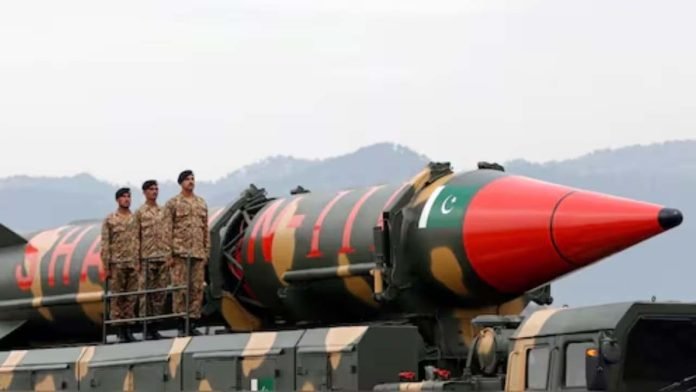
New Delhi: Pakistan may acquire North Korea’s Hwasong-18 ICBM instead of developing a new missile, as it doesn’t have the technical know-how or industrial base to produce such highly sophisticated systems.
Recent intelligence assessments and multiple reports indicate that Pakistan is actively pursuing the development of a nuclear-armed intercontinental ballistic missile (ICBM) capable of reaching the continental United States. This marks a significant shift in Pakistan’s traditionally India-focused nuclear strategy and has raised serious concerns in Washington and among global security analysts.

Historically, Pakistan has maintained that its nuclear arsenal and ballistic missile program are designed solely to deter India, which possesses conventional military superiority in the region. Until now, Pakistan’s missile development efforts have concentrated on short- and medium-range systems, such as the Shaheen-III, which has a range of about 2,700 km—enough to cover most of India but not intercontinental distances.
However, according to recent US intelligence cited by Foreign Affairs, Pakistan’s military ambitions have expanded following heightened tensions with India, particularly after the Indian military’s Operation Sindoor in May 2025. The new focus is on developing an ICBM, a weapon system with a range exceeding 5,500 km, capable of delivering nuclear warheads to targets across continents, including the United States.
While Islamabad continues to publicly assert that its nuclear program is aimed at deterring India, US intelligence agencies believe the pursuit of ICBM capability is also intended to deter potential American intervention—either in the form of a preventive strike against Pakistan’s nuclear arsenal or involvement on India’s behalf in a future conflict.
This strategic calculus mirrors the logic behind other nuclear states’ acquisition of long-range deterrent capabilities.

The prospect of a Pakistani ICBM has triggered alarm in Washington. US officials have made it clear that if Pakistan acquires an ICBM capable of targeting American territory, the US would be compelled to treat Pakistan as a nuclear adversary. Historically, no country with ICBMs that can reach the US is considered a strategic ally by Washington. This development would necessitate a substantial revision of US policy toward Pakistan, potentially resulting in further diplomatic isolation and the imposition of additional sanctions.
The US has already imposed sanctions on several Pakistani entities involved in long-range missile development, citing attempts to acquire relevant technology and materials—often with reported assistance from China. These sanctions freeze assets and prohibit American companies from engaging in business with the targeted organisations.

If Pakistan succeeds in developing and deploying an ICBM, it would join a select group of nations—including the US, Russia, China, France, the UK, India, Israel, and North Korea—that possess such capabilities. This would not only alter the strategic balance in South Asia but also introduce a new dimension to global nuclear deterrence dynamics, especially as the US already faces mounting challenges from Russia, China, North Korea, and Iran.
The possibility of strategic alignment or coordination among these nuclear-armed states further complicates the global security environment, raising the spectre of a more fragmented and dangerous world order.
Pakistan’s nuclear weapons program began in the early 1970s, primarily as a response to India’s nuclear ambitions. The country conducted its first nuclear tests in 1998 and is currently estimated to possess around 165–170 nuclear warheads. Pakistan is not a signatory to the Nuclear Non-Proliferation Treaty (NPT) or the Comprehensive Test Ban Treaty (CTBT), underscoring its commitment to maintaining full sovereignty over its nuclear policy.
In summary, credible reports and US intelligence assessments indicate that Pakistan is developing a nuclear-capable ICBM that could reach the United States, marking a significant evolution in its strategic doctrine.
This development is viewed with grave concern in Washington, which has signaled that such a move would force the US to treat Pakistan as a nuclear adversary, with far-reaching implications for bilateral relations and global security. The situation remains fluid, and further escalation or policy responses from the US and its allies are likely as Pakistan’s ICBM program progresses.






