


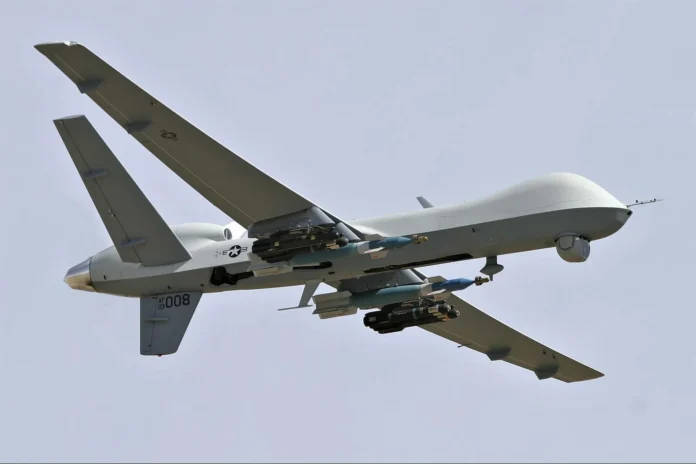
SAN DIEGO. In a major development for the future of uncrewed aviation, defence tech leader General Atomics Aeronautical Systems (GA-ASI) has officially unveiled its next-generation platform intended to replace the venerable MQ-9 Reaper. Dubbed the Wildfire, the new unmanned aerial system (UAS) represents a shift away from legacy medium-altitude platforms toward highly scalable, semi-autonomous mass capable of surviving high-threat environments.
The unveiling arrives at a pivotal moment for defence planners. While the MQ-9 Reaper served as the undisputed workhorse of counter-insurgency and precision-strike missions for over two decades, modern contested airspace has exposed the limits of legacy architectures. Heavy operational losses in hostile zones – alongside the necessity to prepare for potential peer-to-peer conflict – have pushed the Pentagon to seek cheaper, modular platforms that can be produced rapidly and deployed in vast numbers without crippling costs.

Built for Distance, Scale and Heavy Ordnance
Engineered to overcome the vulnerabilities of older designs, the Wildfire is purpose-built to deliver immense range and payload capacity while maintaining affordable manufacturing costs:
- Unprecedented Reach: Designed with an eye on sprawling operational theaters like the Indo-Pacific, the platform targets a remarkable 10,000-nautical-mile ferry range.
- Heavy Strike Capability: Moving beyond light precision munitions, the Wildfire is built to carry up to four AGM-158C Long Range Anti-Ship Missiles (LRASMs), turning an uncrewed system into a formidable maritime interdiction asset.
- Swarm Intelligence: Built from the ground-up to operate in semi-autonomous networks, up to 100 Wildfire aircraft can be orchestrated simultaneously to form a unified common operating picture.
- Targeted Unit Cost: By focusing on scalable manufacturing processes, General Atomics aims to keep the unit price under $30 million, allowing military forces to field massed formations in high-risk zones where losses are expected.
A Modular Future for Air Dominance
The Wildfire design leverages General Atomics’ evolving family-of-systems philosophy, which emphasises hardware standardisation to drastically reduce production bottlenecks and cost. By utilising shared structural cores – similar to the design principles pioneered in the company’s modular Gambit Series – the Wildfire can rapidly adapt in-theatre for varying missions, ranging from traditional Full Motion Video (FMV) intelligence gathering to electronic warfare and deep maritime strike.
General Atomics has pitched the Wildfire platform for the Defence Innovation Unit’s (DIU) Massed Modular Aircraft (MMA) initiative, a Pentagon competition designed to rapidly source a flexible MQ-9 successor. However, company officials emphasised that the aircraft’s development path remains independent of any single government programme, promising to deliver production-ready platforms years ahead of conventional acquisition timelines.
As military commanders increasingly prioritise affordable mass, long-range survival, and artificial intelligence integration, the Wildfire marks the clear end of an era for legacy remote-piloted aircraft—and the start of a far more lethal, autonomous chapter in military aviation.







