


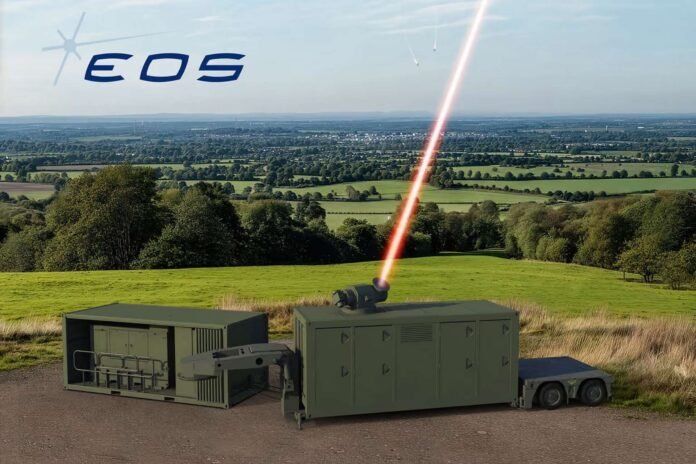
The Dutch Ministry of Defence has reached an agreement with Australian defence-technology company Electro Optic Systems (EOS) to advance the “Apollo” high-energy laser weapon, marking a significant step in Europe’s response to the growing threat posed by drone swarms.
The letter of intent, signed by the Dutch State Secretary for Defence Derk Boswijk and EOS, covers joint development work and the establishment of a production facility in the Netherlands. The planned site would serve as EOS’s European manufacturing hub, potentially supporting future exports to other countries.

The agreement does not yet represent a final procurement contract. No delivery schedule or contract value has been disclosed, with detailed commercial arrangements expected to follow if the partnership progresses to the next stage.
Apollo is a 100-kilowatt-class high-energy laser system designed primarily to defeat drones and other small unmanned aerial systems. EOS says the weapon can be scaled to 150 kilowatts and is capable of engaging as many as 20 drones per minute, subject to operational conditions and target characteristics.
The system is intended to address a central problem in modern air defence: the growing use of inexpensive drones in large numbers. Conventional missiles can destroy individual targets, but their cost and limited ammunition stocks make sustained defence against mass attacks difficult. A directed-energy weapon, by contrast, uses electricity rather than conventional ammunition for each engagement, potentially offering a much lower cost per shot.
That advantage could become increasingly important as militaries confront waves of commercially produced drones, loitering munitions and low-cost surveillance aircraft. The technology is not expected to replace missiles or guns. Instead, laser systems would form part of a layered counter-drone network alongside radar, electronic warfare, machine guns, autocannons and interceptor missiles.

EOS has positioned Apollo as an extension of its existing counter-drone portfolio. The company already develops kinetic systems, including remotely operated weapon stations, and says the laser programme has undergone several years of field testing and firing trials. Its high-energy laser architecture includes algorithms, radar integration, threat detection, target acquisition and beam-control systems.
The Dutch announcement follows a separate EOS order announced in August 2025 from another European NATO member. That order, valued at €71.4 million, covers a 100-kilowatt-class counter-drone capability, including equipment, spare parts, training and documentation. Delivery is scheduled across 2025-2028, with production taking place at EOS’s Singapore facility.

Together, the agreements indicate that European interest in directed-energy weapons is moving from laboratory demonstrations towards industrial partnerships and operational procurement. Governments are seeking systems that can remain on alert for long periods and respond economically to repeated drone incursions.
For the Netherlands, local production could provide more than a new defence capability. It may create an industrial base for high-energy lasers, optics, tracking systems and air-defence integration, while giving Dutch companies opportunities to participate in development and maintenance.
The programme will still face technical and operational challenges. Lasers require substantial power, precise tracking and clear lines of sight. Heavy rain, fog, dust and atmospheric turbulence can reduce effectiveness. The system must also detect and prioritise multiple targets quickly, especially when attackers use coordinated swarms or employ decoys.
The planned Dutch-EOS partnership therefore represents an important industrial and strategic signal, but not an immediate shield against drone attacks. Its success will depend on testing, integration with existing NATO air-defence networks and the conversion of the letter of intent into a funded production programme.






