


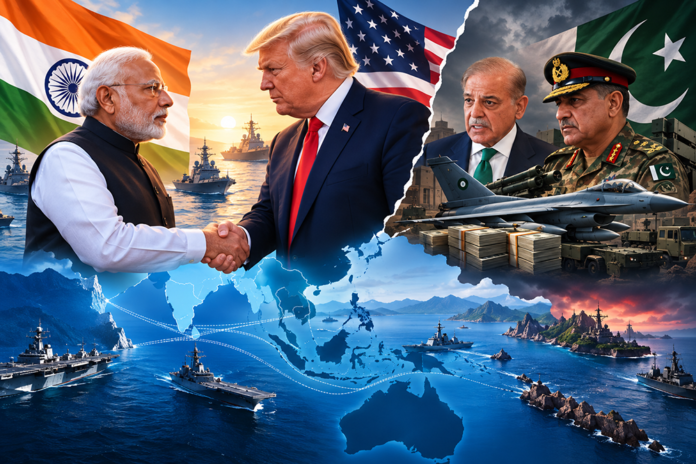
Against the backdrop of the palm-fringed coastlines of Cebu in the Philippines, the luxury resorts of the island city served as an unexpected crucible for high-stakes geopolitical engineering. On October 28, 2026, on the sidelines of the 13th Association of Southeast Asian Nations (ASEAN) Defence Ministers’ Meeting-Plus (ADMM-Plus), Indian Defence Minister Rajnath Singh sat down with US Secretary of War Pete Hegseth.
The atmosphere in the bilateral meeting room was a study in contrasts. Outside, the ASEAN forum grappled with regional maritime friction and South China Sea anxieties. Inside, Singh and Hegseth were navigating the intricacies of a “Major Defence Partnership” that has rapidly become the cornerstone of Washington’s Indo-Pacific strategy. However, the ambient warmth of the venue could not mask the undercurrent of cold strategic calculations, particularly because the Pentagon undergoes unprecedented domestic restructuring and Washington balances its highly disruptive military posture elsewhere in Asia.

The Context: A Decade of Alignment Under Re-Engineered Banners
The meeting arrived at a significant milestone: the first anniversary of the renewed 10-year Framework for the US-India Major Defence Partnership, which was inked in late 2025. This framework serves as the comprehensive policy roadmap replacing the older 2015 iteration, binding New Delhi and Washington to a decade of deep operational coordination, intelligence sharing, and integrated defence-industrial ecosystems.
The Trump administration views India as a vital counterweight to Chinese assertiveness in the Pacific. For New Delhi, Washington is an indispensable source of critical dual-use technologies and jet engines essential for India’s self-reliance in military modernisation
Over the past few years, this partnership’s momentum has been undeniable. The militaries of both countries recently concluded the high-intensity Yudh Abhyas joint exercise in India, showcasing an unprecedented level of tactical interoperability. Structurally, the alliance is underpinned by a matrix of foundational pacts — including LEMOA, COMCASA, and BECA — which have transformed bilateral ties from transactional arms sales into deep, systemic integration.
For the Trump administration, India is viewed as a vital counterweight to Chinese assertiveness in the Pacific. For New Delhi, Washington is an indispensable source of critical dual-use technologies and jet engines — such as the highly anticipated co-production of GE F414 engines — essential for India’s domestic Aatmanirbhar (self-reliance) military modernisation.
The Friction: The F-16 Package and India’s Proliferation Warning
Despite the public display of bilateral camaraderie, the Cebu meeting quickly collided with a persistent, historical friction point: Washington’s enduring military-assistance packages to Pakistan.

Media reports and recent Pentagon notifications highlighted a $686 million US military assistance package aimed at extending the operational life, avionics capabilities, and sustainment of Pakistan’s F-16 fighter jet fleet. While Washington routinely defends these sustainment packages under the banner of regional counter-terrorism and counter-insurgency operations, New Delhi has consistently rejected this rationale, pointing out that Pakistan has historically deployed these advanced American assets against India — most notably during the post-Balakot aerial engagements.
Media reports and recent Pentagon notifications highlighted a $686 million US military assistance package to Islamabad aimed at extending the operational life, avionics capabilities, and sustainment of Pakistan’s F-16 fighter jet fleet
In Cebu, Rajnath Singh did not mince words. He directly flagged New Delhi’s sharp objections to the F-16 upgrades, delivering a calculated and sobering warning to Hegseth. Singh cautioned that the transfer of sensitive, advanced military technologies and cryptographic systems to Islamabad is fraught with long-term regional risks. Crucially, the Indian Defence Minister warned that such sophisticated hardware could ultimately leak or be transferred to a “third country”.

Though unnamed in the official communiqués, this was a clear and direct reference to China, given Islamabad’s deep, collaborative defence ties with Beijing in developing fifth-generation platforms. New Delhi’s message was unmistakable: Washington’s short-term tactical balancing act in South Asia poses a direct threat to the sensitive technology loops that the US shares with India.
The Transatlantic Macro Overlay: The Mumbai-Jamnagar Axis
This defence friction cannot be parsed in isolation from the broader diplomatic and economic ledger. Just eight days before the Cebu meeting, on October 20–21, 2026, US Secretary of State Marco Rubio made his second high-profile visit to India this year, engaging in intensive consultations with Indian External Affairs Minister Dr S Jaishankar.
Significantly, Rubio’s itinerary bypassed New Delhi entirely, focusing instead on Mumbai and the industrial hub of Jamnagar. This structural choice underscored the hyper-pragmatic, transactional core of the second Trump administration’s foreign policy. In Mumbai, Jaishankar and Rubio pushed forward on the India-US Bilateral Trade Agreement (BTA), with Rubio indicating that a comprehensive free trade deal is imminent, requiring the resolution of only a “small number of items”. The economic overtone was further consolidated at the “Freedom 250” reception in Mumbai celebrating American independence, which featured a telephonic address by President Donald Trump.
Rajnath Singh flagged New Delhi’s sharp objections to the F-16 upgrades. He cautioned that the transfer of sensitive, advanced military technologies and cryptographic systems to Islamabad is fraught with long-term regional risks
However, the real geopolitical pivot occurred in Jamnagar, home to Reliance Industries’ mega-refining complex. Faced with soaring domestic fuel prices ahead of the critical November 3 US midterm elections, Rubio actively leaned into India’s capabilities as a “refining superpower”. The US Secretary of State aggressively lobbied India to ramp up the processing of dense, heavy crude — specifically from Venezuela — to help keep global energy prices artificially depressed and insulate the US electorate from inflation. In tandem, Jaishankar, Rubio, and the UAE Foreign Minister held a trilateral huddle to lock down regional energy security corridors.
Direct Review and Critical Analysis
INDIA-US DEFENCE COOPERATION: THE CEBU AGGREGATES
| Strategic Convergences
|
• 10-Year Framework progression on co-production & technology
• High-level interoperability (e.g., Yudh Abhyas exercise) • Joint commitment to Indo-Pacific maritime security |
| Core Structural Friction | • $686M US F-16 sustainment and avionics package for Pakistan
• Risk of sensitive US tech leaking from Islamabad to China • Imbalance between global Indo-Pacific goals and regional alignment |
|
Outlook and Interoperability |
• Expanding military-to-military and logistics sharing
• Accelerated push for GE aerospace jet engine co-production |
The Cebu dialogue exposes the complex duality that defines contemporary India-US relations. On one level, the strategic convergence is real and deep. Rajnath Singh’s description of the partnership as the “cornerstone for a free, open, and secure Indo-Pacific” reflects an authentic alignment of maritime and systemic security goals. The operational coordination and the steady drive towards integrating defence supply chains demonstrate that both bureaucracies are working hard to build a resilient, long-term architecture.
However, a critical analysis of the meeting reveals a fundamental, unresolved contradiction in American foreign policy. The Trump administration’s Pentagon, led by the disruptive and reform-minded Pete Hegseth, is actively prosecuting a “peace through strength” mandate globally. Yet, by simultaneously backing a multi-million-dollar upgrade for Pakistan’s air force, Washington is running an outdated, hyphenated South Asia policy that directly undermines its broader Indo-Pacific goals.
Cebu proved that while India and the United States are closer than ever, they are not formal allies. New Delhi will continue to fiercely protect its regional red lines, and Washington must realise that it cannot buy Indian alignment in the East while funding strategic instability in the West
Hegseth’s reassuring rhetoric on cross-border terrorism — reaffirming “unwavering solidarity” with India — clashes directly with the reality of American defence contractors upgrading the avionics of an adversarial neighbour. India’s warning about technology leaks to a “third country” (China) was a brilliant tactical manoeuvre by New Delhi. It frames India’s regional security concerns in the exact vocabulary of Washington’s primary global anxiety: tech proliferation to Beijing.
Furthermore, the meeting must be viewed through the lens of internal Washington volatility. Even as Hegseth sat with Singh in Cebu, the Secretary of War was actively purging the Pentagon’s top uniformed brass, firing his chief military planner (J5), Lt Gen Brett Sylvia, over unfolding operational shifts elsewhere. This internal upheaval raises legitimate questions for New Delhi about institutional continuity within the US War Department. While the 10-year framework provides a steady policy direction, the rapid structural churn in Washington requires India to remain clear-eyed, pragmatic, and strategically autonomous.
Ultimately, Cebu proved that while India and the United States are closer than ever, they are not formal allies. New Delhi will continue to fiercely protect its regional red lines, and Washington must realise that it cannot buy Indian alignment in the East while funding strategic instability in the West.

–The writer is Assistant Professor, ICFAI School of Liberal Arts, ICFAI University, Jaipur. The views expressed are of the writer and do not necessarily reflect the views of Raksha Anirveda





